The Paisley Silk and the Boston Pride
The mud of Korea has a way of washing over everything, turning every uniform, every tent, and every spirit into the same tired shade of olive drab. But every so often, a tiny piece of the world left behind manages to sneak past the front lines, tucked away in an ordinary supply crate.
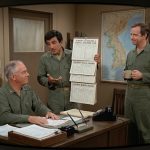
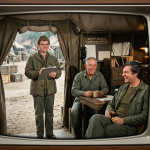
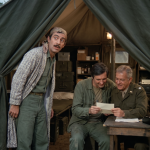
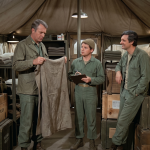
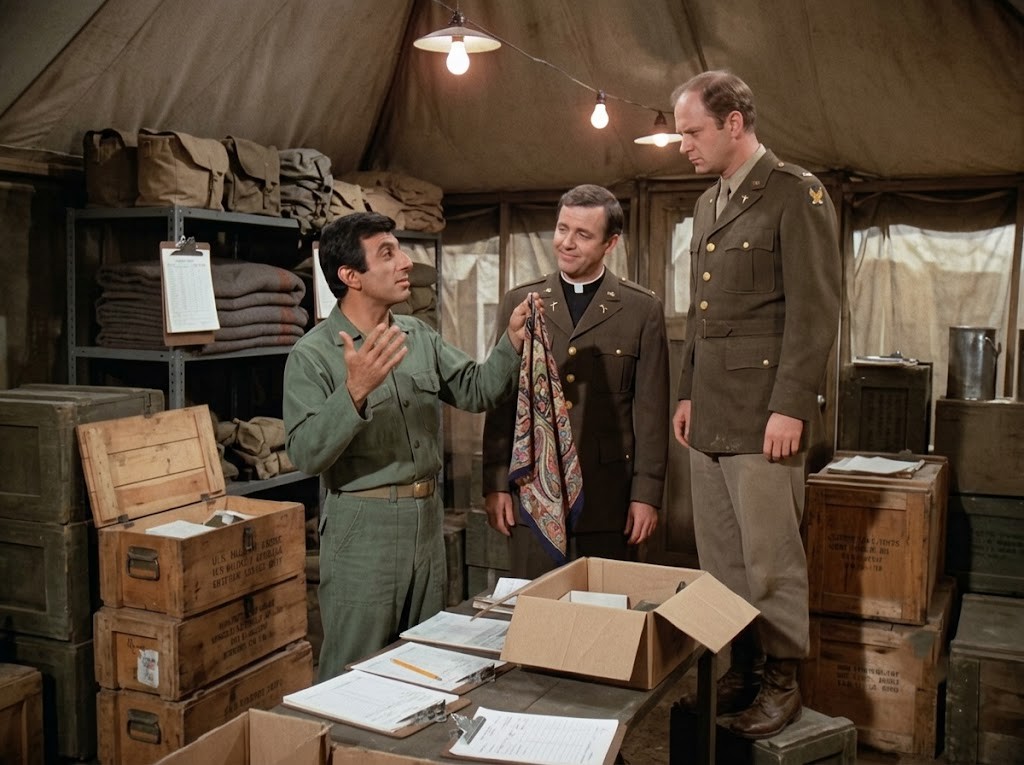
Inside the dim, cramped confines of the supply tent, the air smelled heavily of canvas, dust, and damp wood. Stacked wooden crates lined the perimeter, while clipboards crammed with inventory sheets littered the makeshift tables. Beneath the harsh glare of a couple of bare, hanging light bulbs, three men stood gathered around a freshly opened cardboard box, looking at an item that didn’t belong within a hundred miles of a war zone.
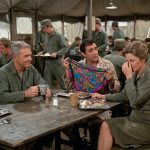
Corporal Max Klinger held the object aloft with the reverence of a high priest presenting a sacred relic. It was a beautiful silk scarf, adorned with an intricate, vibrant paisley pattern that caught the weak overhead light and shimmered with rich blues, deep reds, and golds. Klinger’s face was alive with dramatic enthusiasm as he gestured with his free hand, trying to convince his small audience of its monumental value.
“I’m telling you, Major, this isn’t just fabric,” Klinger insisted, his voice rising with theatrical passion. “This is pure silk! Straight from a boutique in Paris, by way of a very confused supply depot in Seoul. It has class, it has style, and frankly, it screams your name.”
Major Charles Emerson Winchester III stood rigidly, towering over the table as he looked down at the scarf. He was impeccably dressed in his clean dress uniform, looking every bit the proud Boston aristocrat who had been terribly misplaced in a wilderness of mud and misery. His brow was furrowed, his expression a mix of elite skepticism and reluctant curiosity as he studied the colorful pattern.
Beside him stood Father John Mulcahy, looking on with a gentle, amused smile. The padre had seen plenty of Klinger’s schemes, but he always looked for the good in them, his kind eyes twinkling with a quiet warmth. He crossed his arms loosely, enjoying the unfolding comedy as a rare, welcome distraction from the heavy duties of the day.
“And why, pray tell, Corporal, would I require a piece of civilian frivolity in this cultural wasteland?” Charles asked, his voice dripping with its trademark upper-class Bostonian cadence. “I am a surgeon, Klinger, not a runway model for the desperate.”
“Because, Major, tomorrow is your sister Honoria’s birthday,” Klinger said, hitting the perfect dramatic beat. He lowered his voice, letting a rare note of genuine sincerity slip through. “I saw the calendar in the mess hall. You’ve been looking lower than a snake’s belly all week, and we all know you couldn’t mail her anything from the PX but a can of spam and some bootlaces.”
Charles froze, his aristocratic mask slipping for a fraction of a second. The mention of his sister always struck a deep chord, and the realization that the camp’s most eccentric soldier had noticed his quiet homesickness caught him completely off guard.
Father Mulcahy’s smile softened into an expression of profound understanding. He looked from Klinger to Charles, recognizing the fragile bridge being built in the middle of a dingy supply tent.
Charles cleared his throat, adjusting his jacket as he tried to regain his formidable composure, though his eyes remained fixed on the silk scarf. “It is true that Honoria appreciates the finer things, and a Boston winter demands proper neckwear. However, Klinger, nothing in this camp comes without a price. What is the catch?”
Klinger smiled, but it wasn’t his usual mischievous grin—it was a look of tired, desperate hope. “No catch, Major. Just a trade. But it’s something only a man of your… refined background can provide, and it has to happen tonight.”
—
Charles narrowed his eyes, suspicious of the sudden shift in tone. “A trade, you say? Speak quickly, Corporal, before I lose what little patience this climate has left me.”
Klinger lowered the scarf gently, laying it across a clipboard like a fragile piece of glass. “Private Thompson over in Tent 4 hasn’t slept in three days. He’s nineteen, he’s from a small town in Ohio, and he’s terrified. He thinks he’s never going to hear anything beautiful again.”
Father Mulcahy stepped forward, his voice quiet and steady. “I spoke with young Thompson this morning, Charles. The boy is suffering from severe battle fatigue. He’s completely withdrawn. He won’t talk to me, and he won’t eat.”
“And what does a traumatized private have to do with me, or this piece of silk?” Charles asked, though the sharpness in his voice was beginning to give way to genuine concern.
“He heard you playing your phonograph last week, Major,” Klinger said softly, looking up at the towering surgeon. “He told the nurse it was the only time his head stopped ringing. I want you to take your classical records over to his tent tonight, sit with him, and play them. Just for an hour. That’s the price for the scarf.”
Charles looked at Klinger, then down at the beautiful paisley silk, and finally at Father Mulcahy. For all his bluster, his arrogance, and his constant complaints about the 4077th, Charles possessed a deeply hidden, fiercely protected well of compassion. The request wasn’t for cigarettes, or a pass to Seoul, or a favor with the brass—it was a request for medicine that couldn’t be found in an operating room.
“You expect me to cart my priceless Mozart recordings across a sea of mud to entertain a private?” Charles murmured, his voice lacking its usual bite.
“I think it’s a beautiful bargain, Charles,” Father Mulcahy said gently, placing a hand lightly on the major’s arm. “Sometimes, the finest things we possess are meant to be shared where they are needed most.”
The supply tent fell silent for a long moment, save for the distant, rhythmic thud of a generator somewhere out in the compound. The warmth of the small room felt distinct and isolated from the vast, cold war surrounding them.
Charles sighed, a long, weary sound that carried the weight of every difficult surgery he had performed that week. He reached out with a well-groomed hand and carefully picked up the silk scarf. He felt the texture between his fingers, imagining his sister wearing it on a crisp autumn walk through Boston Common.
“The boy has an ear for quality, I suppose,” Charles said, his tone returning to a familiar, haughty drawl that fooled absolutely no one in the room. “Very well. But if there is so much as a single scratch on my Brahms concerto, Klinger, I shall personally ensure your permanent assignment to latrine duty.”
Klinger’s face lit up, a genuine, radiant smile breaking through his exhaustion. “You won’t regret it, Major. Thompson won’t touch a thing, I promise.”
“See to it that you wrap that properly,” Charles added, gesturing to the scarf before folding it meticulously and handing it back to Klinger for safekeeping. “Honoria will know instantly if it has been handled by unwashed hands.”
“It’ll be packed in tissue paper and a clean box, Major,” Klinger said, his voice full of pride.
Father Mulcahy smiled broadly, his heart warmed by the exchange. “Thank you, Charles. I will walk over to Tent 4 with you. I believe the power of music, combined with a little Boston pride, might be exactly what the doctor ordered.”
Charles adjusted his dress uniform jacket one last time, standing tall and proud, though the stiffness in his shoulders had softened into something much more human. “Let us get this over with, Padre. Mozart waits for no man, not even a weary private from Ohio.”
As the two officers turned and walked out into the chilly Korean evening, Klinger stood alone by the wooden crates, holding the paisley scarf. He looked down at the bright splash of color against the drab background of the tent, feeling a quiet sense of victory that had nothing to do with getting out of the army, and everything to do with keeping his makeshift family together.
—
In a place where tomorrow was never guaranteed, they found their own quiet ways to bring a little bit of home to the mud.