The Lens of the 4077th
Some days in Korea don’t feel like they belong to a war at all. They belong to a strange, suspended animation where the dust settles just long enough for you to remember what your own laugh sounds like.
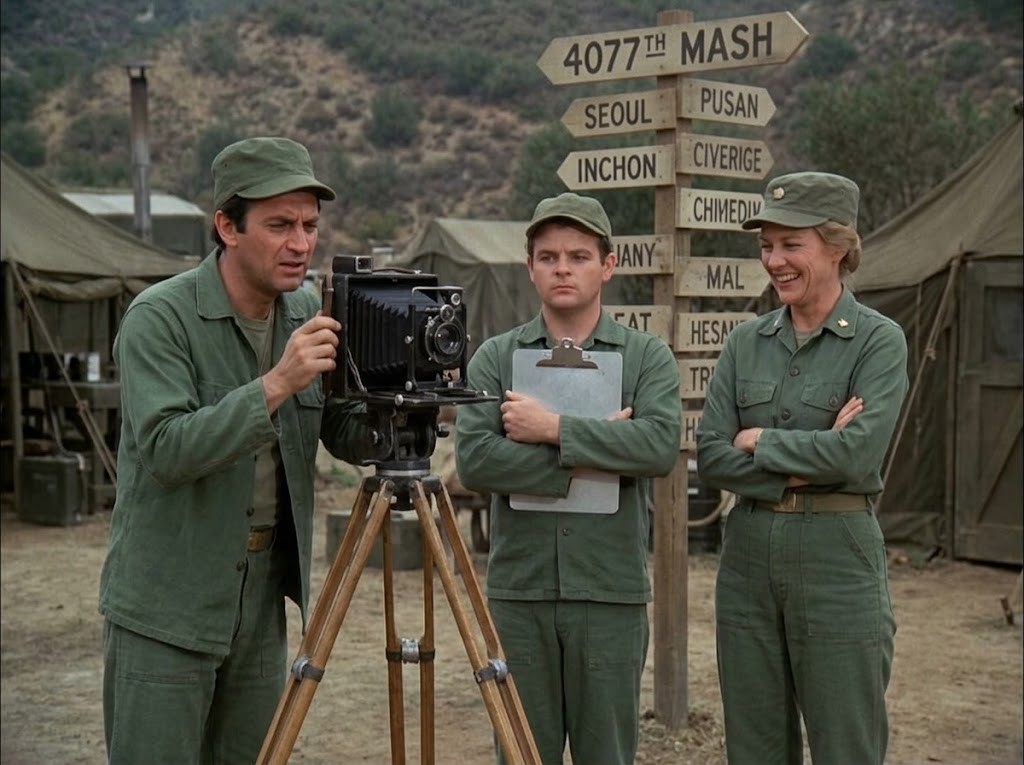
The image titled “P (18).jpg” captures one of those fleeting afternoons perfectly. Standing right beside the iconic signpost that points the way to Seoul, Inchon, and a dozen places none of us ever wanted to visit, a heavy wooden tripod is planted firmly into the dry dirt. Atop it sits a vintage, bellows-style press camera—a beautiful, complicated relic that looks completely out of place among the canvas tents of a mobile army surgical hospital.
Hawkeye Pierce is leaning over the viewfinder, his face a perfect mask of squinting frustration. He grips the wooden frame of the camera with both hands, adjusting a knob like a safe-cracker trying to find the combination to a vault. His fatigue shirt is worn, his cap is tilted forward, and his brow is furrowed so deeply you could plant seeds in it.
Next to him, Radar O’Reilly stands at absolute attention, clutching a silver clipboard tightly against his chest with crossed arms. His expression is completely blank, a stoic sentinel waiting for instructions that may never come, his eyes fixed forward. He looks like a man who has been asked to hold still for a photo that might take three weeks to develop.
Then there’s Margaret Houlihan. She stands to the right, arms crossed over her crisp olive-drab shirt, laughing with genuine, unrestrained warmth. Her eyes are bright, and her smile is wide enough to make you forget about the gray hills rising up in the background. It is a rare, unguarded moment of pure joy from a woman who usually carries the weight of the entire nursing staff on her shoulders.
“Pierce, if you don’t take the picture soon, we’re all going to turn into statues,” Margaret says, her laughter bubbling over. “Colonel Potter wanted this photo for the monthly report an hour ago. He’s already pacing in his office.”
“Patience, Major,” Hawkeye mutters, his fingers twitching on the focus dial. “Art cannot be rushed. Especially when the art in question involves trying to capture BJ Hunnicutt’s mustache in a way that doesn’t make him look like a Victorian villain. Besides, I think there’s a family of spiders living inside this lens.”
“Sir,” Radar pipes up, his voice cracking slightly but his body remaining dead still. “The Colonel said if this photo isn’t on the mail jeep by five o’clock, he’s going to personally assign you to inventory the latrine supplies. And he was using his serious voice. The one without the ‘Holy Toledo.'”
Hawkeye doesn’t look up from the viewfinder. “Radar, your dedication to military bureaucracy is a comfort to us all. Now, hold that clipboard higher. It reflects the light. It gives you a certain… angelic glow. Like a very short, very tired cherub in green fatigues.”
The afternoon sun casts long, soft shadows across the compound. For a few minutes, the constant background hum of the generators and the distant thud of artillery seem to fade away. It is just three friends, a signpost that points toward home, and a camera that refuses to cooperate.
Suddenly, a loud, definitive *snap* echoes from inside the camera housing. Hawkeye freezes. His hands drop from the wooden frame. The smile slowly fades from Margaret’s face, and Radar’s eyes dart sideways toward the doctor without moving his head a single millimeter.
“Tell me that was the shutter, Pierce,” Margaret says, her tone shifting from amusement to professional skepticism.
Hawkeye slowly straightens his back, rubbing the bridge of his nose. He looks at the camera, then at the signpost, and finally at the two of them. “Well, the good news is, the shutter works perfectly. The bad news is, a small piece of spring-loaded history just shot out of the back and is currently embedded in the dirt somewhere near Seoul.”
Radar lets out a tiny, deflated sigh, his shoulders slumping as he finally lowers the clipboard. “I knew it. I told Sparky we shouldn’t have borrowed this from the press pool. The guy who owned it said it survived the Big One, but he didn’t say it would survive you, sir.”
“Nonsense,” Hawkeye declares, immediately recovering his bravado. “It’s a minor setback. A momentary intermission in our cinematic masterpiece. Radar, fetch me a tongue depressor, a roll of medical tape, and whatever dignity Klinger has left in his tent. We are going to perform emergency surgery on this Kodak.”
Before Radar can move, Colonel Potter emerges from his office, his boots crunching on the gravel. He stops a few feet away, his arms crossed, a half-smoked cigar clamped firmly between his teeth. He looks at the camera, then at Hawkeye’s guilty expression.
“What’s the holdup, Pierce?” Potter asks, his voice a dry, comforting rumble. “The mail jeep is idling. I need that photograph of the camp staff to show the brass that we haven’t completely descended into anarchy out here.”
“Colonel, we are experiencing a slight mechanical rebellion,” Hawkeye explains, gesturing dramatically to the camera. “The apparatus has lost its internal fortitude. But fear not, we are about to stabilize the patient.”
Potter walks up to the tripod, pushes Hawkeye gently aside, and peers into the back of the camera. He taps the wooden frame with a weathered finger, hums quietly to himself, and then reaches into his pocket. He pulls out a small, bent paperclip. With the practiced hand of a man who has fixed everything from a Jeep engine to a broken bone, he hooks a tiny loose wire inside the bellows and clicks it back into place.
“There,” Potter says, stepping back and wiping his hands on his trousers. “My father used to fix the family camera with baling wire. Try it now.”
Hawkeye looks at the Colonel with genuine admiration. “Colonel, if you ever decide to leave the army, you have a bright future as a 19th-century locksmith.”
Margaret steps back into her position beside the signpost, her laughter returning, warmer this time. “All right, let’s do this before something else breaks. Radar, get in the frame.”
Radar steps up, pulling his clipboard back to his chest, his face shifting instantly back into his serious, dutiful expression. Hawkeye leans over the viewfinder once more, his hand resting gently on the shutter release. Through the glass, he looks at his friends—the fiercely loyal head nurse, the young clerk who holds the whole place together, and the old cowboy of a commander watching from the sidelines.
*Click.*
The shutter snaps cleanly this time. The moment is captured. It won’t look like much to the generals in Seoul—just a few tired people standing in front of a wooden sign in the middle of nowhere. But to the people who live it, the image in “P (18).jpg” is a record of a family that found each other in the most unlikely place on earth.
Hawkeye straightens up and smiles, a real, quiet smile that reaches his eyes. “Beautiful. Absolutely beautiful. We look almost civilized.”
Sometimes, the best medicine in Korea was just holding still long enough to let a moment of friendship catch up to you.