The Weight of an Empty Table
The ringing in your ears doesn’t stop when the choppers leave. It just changes key, morphing into a heavy, suffocating silence that settles over the canvas of the 4077th like morning fog.
In the post-op tent, the air still smells faintly of rubbing alcohol, sweat, and the damp wool of olive-drab blankets. The frantic rush of the last twelve hours had finally ground to a halt, leaving behind an exhaustion so deep it felt structural, as if bones had turned to lead.
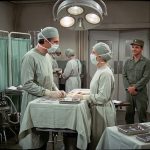
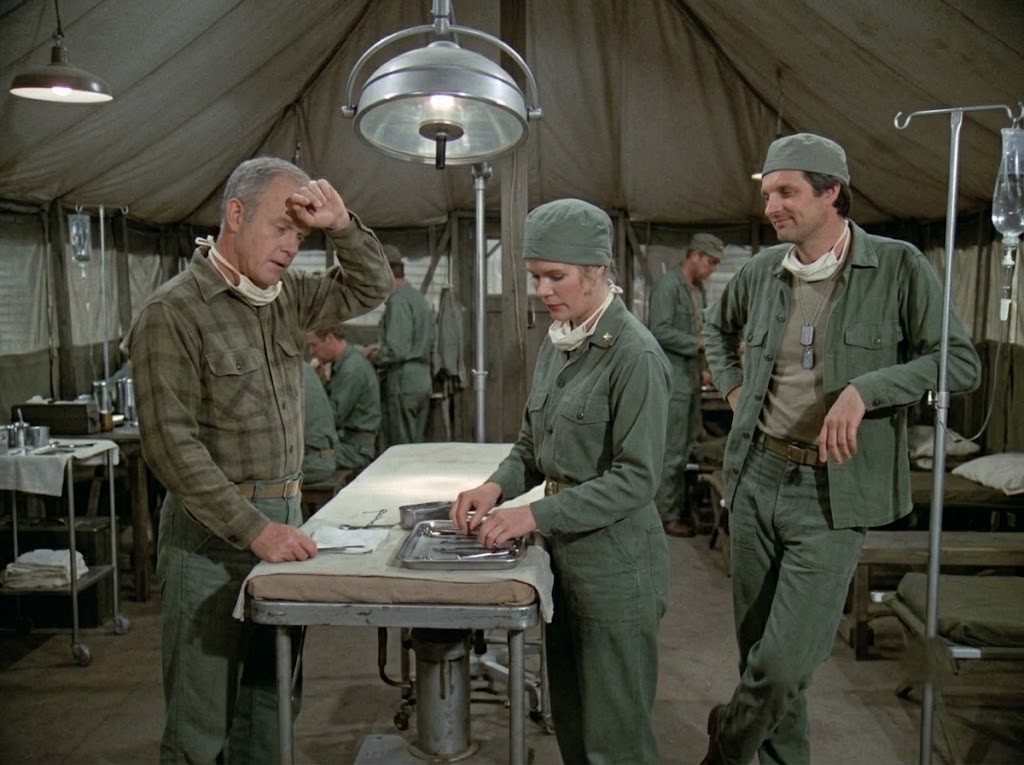
Colonel Potter stood by the central operating table, looking down at the stark white cloth. He slowly raised a hand, pressing the back of his wrist against his forehead to wipe away a layer of grime and fatigue that no towel could ever quite catch. His plaid-lined collar was undone, his surgical mask hanging loose around his neck like a deflated white flag.
Beside him, Major Margaret Houlihan was already in motion, her fingers methodically organizing a steel tray of surgical instruments. Her movements were precise, a defense mechanism against the sheer weight of the day, but her usual sharp demeanor had softened into a quiet, focused intensity.
Leaning casually against a nearby IV pole, Hawkeye Pierce watched them both with a tired, knowing smile. His dog tags rested against his t-shirt, catching the harsh glare of the overhead surgical light. Even with his posture relaxed and one hand hooked into his pocket, the shadows under his eyes told the real story—the story of a man who used wit as a tourniquet to keep from bleeding out emotionally.
“You know, Margaret,” Hawkeye said, his voice low and raspy from hours of shouting over the din of the generator. “If you polish those forceps any harder, you’re going to rub a hole right through to the 1960s. And frankly, I’d like to see what the future looks like, if only to find out if they ever invent a decent cup of coffee.”
Margaret didn’t look up, her fingers clicking a pair of hemostats into place on the tray. “Some of us find comfort in order, Pierce. When everything outside this tent is chaos, the least I can do is ensure my instruments are exactly where they belong.”
Potter let out a long, heavy sigh, lowering his arm but keeping his gaze fixed on the empty table. “Chaos is an understatement, Major. That was a rough one. Felt like trying to stop a leak in a dam with a handful of corks. Every time we turned around, there was another stretcher.”
In the background, the quiet hum of the post-op ward continued, with a few corpsmen moving silently between the occupied cots in the shadows. The worst of the storm had passed, but the emotional aftershock was palpable in the room, binding the three of them together in a shared, unspoken weariness.
Suddenly, the canvas door flap fluttered, and Radar O’Reilly slipped into the tent, clutching a clipboard tightly to his chest. His eyes were wide behind his glasses, darting between the Colonel and the two surgeons with an expression that instantly made the room grow colder.
“Colonel?” Radar piped up, his voice cracking slightly with an urgency that immediately broke through their exhaustion. “We… we have a problem with the final transport manifest from the frontline battalion.”
Potter straightened his posture, the paternal, steady authority returning to his shoulders in an instant. “What is it, Radar? Don’t spit-shat around it, son. Give it to me straight.”
Radar swallowed hard, looking down at his clipboard and then back up at the empty operating table where Potter had just been staring. “The last boy we operated on… the private from Ohio. His records didn’t come with him, and I just got a flash from headquarters. They’re saying he shouldn’t even be on our casualty list.”
—
Hawkeye shifted his weight off the IV pole, the easy smile instantly vanishing from his face as he exchanged a sharp, worried look with B.J. Hunnicutt, who had just quietly stepped up to the edge of the tent’s perimeter.
“What do you mean he shouldn’t be on the list, Radar?” Hawkeye asked, his tone dropping its sarcastic edge entirely. “We spent three hours putting him back together. I know every inch of his right lung by its first name. He’s very much here.”
Margaret froze, her hands hovering over the tray of instruments, her professional armor cracking just enough to let her deep empathy show. “Radar, speak clearly. Is there a mix-up with his identity? His family?”
“No, ma’am,” Radar said quickly, adjusting his glasses nervously. “It’s just… the battalion clerk says Private Miller was listed as missing in action two days ago, before the push even started. But the boy we have in the back… he’s wearing Miller’s dog tags. Only, the frontline unit says Miller’s squad was wiped out, and nobody survived.”
A heavy, uneasy silence fell over the group as the implications settled in. If the boy in the post-op cot wasn’t Miller, who was he? And if he was Miller, how had he survived a destroyed squad only to end up anonymous and broken on their operating table?
Colonel Potter walked over to Radar, taking the clipboard gently from the young clerk’s hands. He looked at the typed names, his seasoned eyes reading between the lines of bureaucratic ink. He had seen this kind of confusion in two world wars—the fog of battle swallowing names, faces, and truths until everything became a blur of olive drab.
“It doesn’t matter what the paperwork says right now,” Potter said softly, his voice carrying the deep, fatherly wisdom that kept the 4077th grounded. “Paperwork doesn’t bleed. That boy in the back does. We fixed what was broken inside him, and that’s the only ledger that counts tonight.”
Father Mulcahy, who had been quietly sitting with a recovering patient in the corner, stood up and adjusted his collar. He walked over to join the circle under the bright surgical lamp. “The Colonel is right. A soul is not lost just because a typewriter in Seoul made an error. I will go sit with him. When he wakes up, he will tell us his name.”
Hawkeye looked back at the empty operating table, the exhaustion catching up to him again, but the sharp anxiety had softened into a gentle, bittersweet realization. He looked at Margaret, who had quietly resumed organizing her tray, though her movements were gentler now, almost reverent.
“You see, Margaret?” Hawkeye said, a small, genuine smile returning to the corners of his mouth. “That’s why we keep the instruments clean. Not for the Army, and certainly not for the bureaucrats. But for the ghosts who walk through that door and need us to remember they’re still alive.”
Margaret looked up, meeting Hawkeye’s gaze. For a rare moment, there was no bickering, no rank, and no ideological divide between them. Just two tired doctors who had looked into the abyss together and managed to pull someone back. “They’re not ghosts yet, Pierce,” she said softly. “Not on our watch.”
Just then, Klinger peeked his head through the tent flap, wearing a surprisingly subdued floral sun hat but holding a tray of hot, questionable-looking mugs. “I thought you folks could use some of Swamp’s finest brew, or whatever it is the cook calls tea today. You all look like you’ve been through a meat grinder.”
“Thanks, Klinger,” B.J. said, stepping forward to take a mug, his warm, grounded presence acting as an anchor for the room. “We’ll take whatever comfort we can get tonight.”
Colonel Potter handed the clipboard back to Radar, giving the boy a reassuring pat on the shoulder. “Go get some rack time, Radar. You’ve done your piece. Tomorrow we’ll sort out the names. Tonight, we just let them sleep.”
Radar nodded, looking visibly relieved, and slipped back out into the Korean night.
The remaining staff stood together for a few quiet moments under the warm, glowing light of the post-op tent. Outside, the distant, low rumble of artillery reminded them that the world was still fractured, but inside this fragile canvas sanctuary, they had built a family out of necessity, humor, and a shared, stubborn refusal to let the darkness win.
Hawkeye took a sip of the hot tea, winced at the taste, and looked at his friends. “Well, Colonel, if the war doesn’t kill us, Klinger’s tea certainly will. But until then, I suppose we’re stuck with each other.”
Potter offered a dry, affectionate smile, the wrinkles around his eyes deepening with a profound affection for the misfits under his command. “There are worse places to be stuck, Pierce. Now eat your toast, clean your station, and get some sleep. We do it all over again tomorrow.”
—
Sometimes the greatest victory in the mud of Korea wasn’t saving a life, but simply holding onto each other long enough to remember why it mattered.