The Paperwork Offensive
The generator hummed its familiar, rattling tune against the cold Korean night.
Inside the commanding officer’s tent, the air was thick with the smell of cheap coffee, stale ink, and the particular kind of exhaustion that only settled over the 4077th after a three-day session in the O.R.
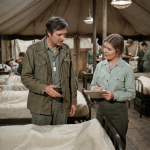
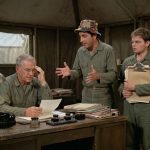
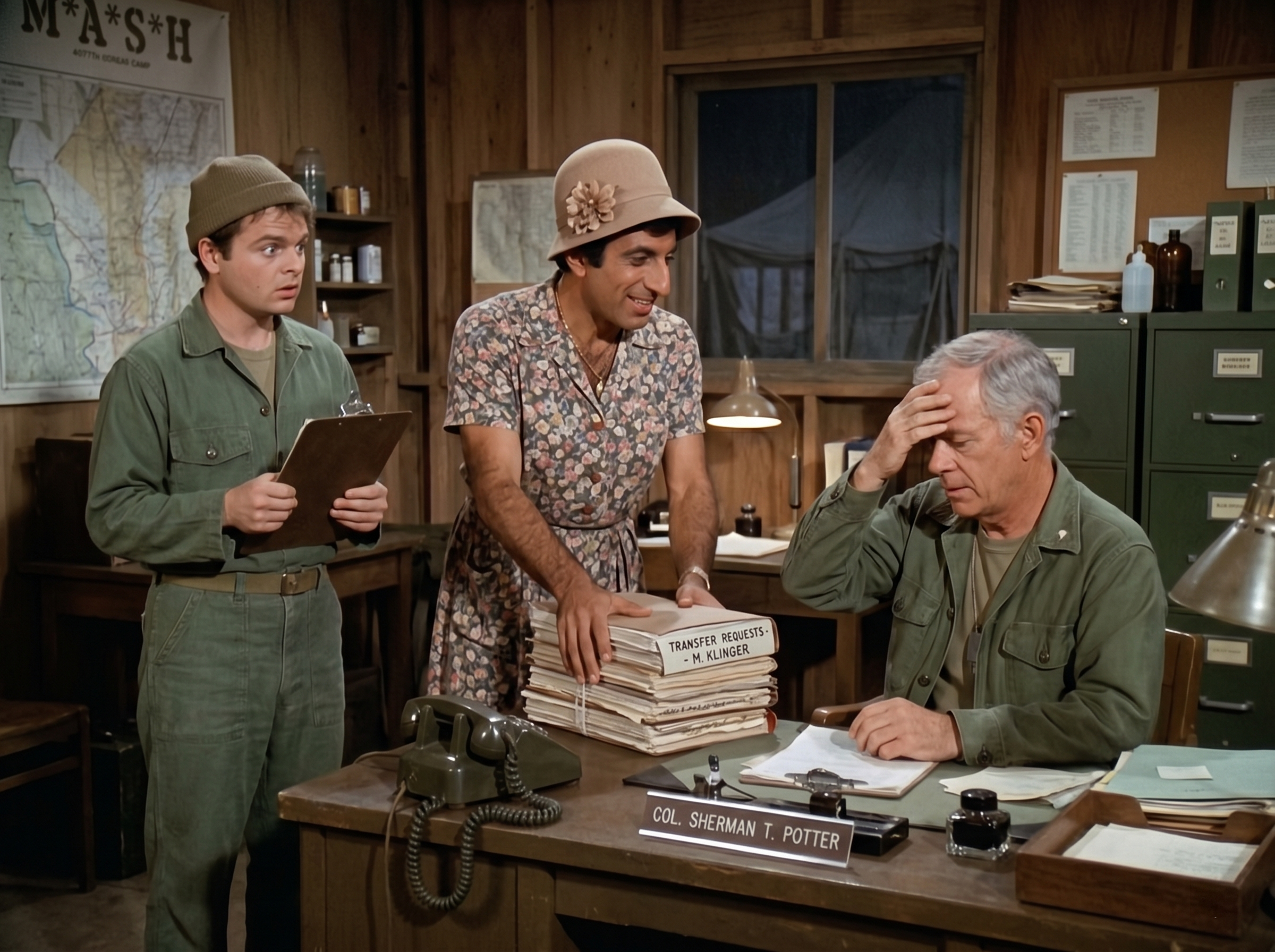
Colonel Sherman T. Potter sat behind his modest wooden desk, his posture folded into a compact knot of weary wisdom. He was a regular army man, a cavalry soldier who had seen enough wars to know that the paperwork was often more relentless than the enemy artillery.
He pinched the bridge of his nose, dragging his fingers up to massage a dull, throbbing headache at his hairline.
Before him sat a scattering of requisition forms, casualty reports, and the endless bureaucratic drivel that kept the Army machine grinding along.
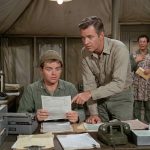
Standing quietly to the side, shifting his weight from one booted foot to the other, was Corporal Walter “Radar” O’Reilly.
Radar clutched a clipboard to his chest like a wooden shield. His knit olive-drab cap was pulled down low, and his wide, earnest eyes darted nervously around the room, waiting for the exact right moment to ask the Colonel to sign a form for more tongue depressors.
It was quiet. It was peaceful.
And at the 4077th, peace never lasted more than five minutes.
The office door swung open with a theatrical gust of evening wind.
In strode Corporal Maxwell Q. Klinger.
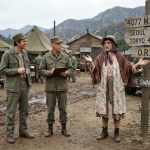
He was not wearing standard-issue fatigues. He was dressed in a sensible, ankle-length floral print dress, accessorized with a delicate gold chain and a tan cloche hat adorned with a cheerful pink flower.
He looked entirely ridiculous, completely out of place in a war zone, and absolutely, unequivocally determined.
Before Potter could even look up to register the intrusion, Klinger hoisted an absurdly massive stack of tied documents into the air.
With a mighty grunt and a flair for the dramatic, Klinger slammed the towering pile directly onto the center of Potter’s desk.
Thud.
The sound echoed off the thin wooden walls. The heavy rotary phone rattled. The inkwell shuddered. Radar flinched, clutching his clipboard tighter, his eyes bugging out behind his round spectacles as he looked from the paper tower to his commanding officer.
Potter didn’t move. He kept his hand glued to his forehead, closing his eyes in a silent, desperate prayer for patience.
He slowly opened one eye. Peeking out from under his palm, he read the bold, hand-lettered sign taped to the front of the colossal paper mountain.
It read: TRANSFER REQUESTS – M. KLINGER.
Klinger stood leaning over the desk, his hands proudly framing the stack. His face was lit with a sly, comic hope, a grin of absolute triumph plastered across his features.
“Colonel,” Klinger announced, his voice ringing with the pride of a conquering hero. “I present to you my masterpiece.”
Potter dropped his hand. He stared at the stack. It was nearly a foot tall. It looked heavy enough to anchor a battleship.
“Klinger,” Potter said, his voice dangerously soft and tight with suppressed fatigue. “What in the name of General Pershing’s pajamas is this?”
“This, sir, is my ticket home,” Klinger declared, adjusting the brim of his floral hat. “The collected works of Corporal Maxwell Q. Klinger. Volume One.”
Radar took a tiny, anxious step backward, squeaking out a small warning. “It’s, um, it’s twenty-seven pounds of paper, Colonel. He broke the mail clerk’s scale weighing it.”
Potter felt the vein in his neck begin to throb. The sheer audacity of it. The ridiculous, impossible volume of military bureaucracy sitting right in front of him, mocking his headache.
He placed his hands flat on the desk, took a deep, shuddering breath, and stared up into Klinger’s impossibly hopeful eyes. The room went dead silent. The explosion was coming.
The silence stretched on, thick and precarious.
Radar held his breath, waiting for the Colonel to shout, to order Klinger out, or to simply throw the twenty-seven-pound paper block through the nearest window.
Instead, Potter let out a long, heavy sigh. The fight drained out of his shoulders, replaced by the deep, bone-tiring reality of a man who just wanted to go to sleep.
“Twenty-seven pounds,” Potter murmured, shaking his head. He reached out and tapped the top of the stack with his index finger. “Son, do you realize how many trees had to die just so you could wear a dress in front of me?”
“A small sacrifice for my sanity, Colonel,” Klinger replied, though his triumphant grin softened just a fraction, sensing the old man’s fatigue.
“I have compiled every single Section 8 request, every medical evaluation, every letter from my entirely fictional dying uncle in Toledo, and every documented instance of my wearing women’s clothing in a combat zone since 1950,” Klinger explained, gesturing grandly.
“It’s cross-referenced, sir. Alphabetized. Color-coded. It’s a watertight legal document proving, without a shadow of a doubt, that I am absolutely, hopelessly, unequivocally bananas.”
Potter stared at him. He looked at the floral dress. He looked at the hat. He looked back at the exhausted, desperate eyes of a young man from Ohio who was trying everything in his power to survive a war he didn’t belong in.
“Klinger,” Potter said gently, the dry humor creeping back into his gravelly voice. “If you put half the effort into your regular duties as you do into trying to prove you’re crazy, you’d be running the Pentagon by Thursday.”
“I don’t want the Pentagon, Colonel,” Klinger said earnestly, dropping the theatrical act for just a second. “I just want Tony’s Packo’s hot dogs. I want the mudhens. I want a sidewalk that isn’t made of frozen Korean dirt.”
The room grew quiet again, but this time, it was a soft, understanding quiet.
Radar lowered his clipboard slightly. He knew that feeling. They all knew that feeling. The bone-deep ache for home that sat heavy in their chests every single day.
Potter leaned forward. He didn’t yell. He didn’t dress Klinger down.
Instead, he reached out and gently untied the string binding the top layer of the stack. He flipped open the cover page and adjusted his reading glasses.
“Let’s see here,” Potter muttered, skimming the first page. “Exhibit A… ‘Subject claims to be receiving radio broadcasts from a Martian named Steve through his dental fillings.’ Good Lord, Klinger, you used that one last October.”
“It’s a classic, sir!” Klinger defended, crossing his arms. “And entirely plausible given the state of military communications.”
Radar chimed in, unable to help himself. “Actually, Colonel, according to Army Regulation 40-501, paragraph 3, claiming to hear voices is only grounds for immediate discharge if the voices instruct the soldier to harm himself or others. Steve the Martian only told Klinger to invest in frozen orange juice.”
Potter looked at Radar. Radar snapped his mouth shut and brought the clipboard back up like a shield.
“Thank you, Radar,” Potter said dryly. “Your encyclopedic knowledge of military loopholes is a comfort to us all.”
Potter closed the file. He patted the top of the stack affectionately, as if it were a disobedient but beloved pet.
“It’s a beautiful piece of work, son. Truly. A monument to human stubbornness,” Potter said, looking up at Klinger. “But I can’t sign it.”
Klinger’s shoulders slumped. The grand theatrics melted away, leaving just a tired corporal in a dusty tent. “Not even a tiny signature, sir? Just a set of initials?”
“If I sign that, Klinger, I lose the best scrounger in the outfit. And more importantly,” Potter added, a warm, fatherly glint in his eye, “who’s going to bring a splash of color to our morning formations? The olive drab gets awfully monotonous.”
Klinger sighed, a long, defeated sound. But there was no real anger in it. It was part of the dance. The ritual they played out to keep the dark reality of the war at bay.
“Yes, sir,” Klinger murmured. He leaned over and hoisted the twenty-seven pounds of paper back into his arms. He suddenly looked very small underneath the massive stack.
“Take it back to your tent, Klinger,” Potter said softly. “Keep it safe. Maybe add a chapter about your sudden and unexplained urge to paint the mess hall pink. We’ll revisit it next month.”
Klinger paused at the door. He shifted the heavy burden, looking back over his shoulder. A small, genuine smile tugged at the corner of his mouth.
“Pink, sir? You really think that would work?”
“It couldn’t hurt, son,” Potter smiled back. “Now get out of here. And Klinger?”
“Yes, Colonel?”
“That hat really does bring out your eyes.”
Klinger beamed, his pride restored. “Thank you, sir. It’s the Toledo spring collection.”
He turned and marched out into the cold night, the door clicking shut behind him.
The tent was quiet once more. The hum of the generator seemed a little less harsh.
Potter let out a long breath and picked up his pen. He looked over at Radar, who was smiling softly at the closed door.
“Alright, Radar,” Potter said, shaking his head with a fond, weary chuckle. “What have you got for me?”
“Just the supply requisitions, Colonel,” Radar said brightly, stepping forward and placing the clipboard on the desk. “And, uh… I added a request for some pink paint. Just in case.”
Potter laughed, a warm, genuine sound that chased the chill from the room. He signed his name with a flourish, knowing that in this crazy, upside-down world, they were all exactly where they were supposed to be.
Stuck. Tired.
But together.
In a place where the world felt broken, they found a way to heal each other with laughter, one ridiculous moment at a time.