The Distance Home
In the 4077th, time wasn’t measured in hours or minutes on a clock. It was measured in the heavy, quiet spaces between the helicopters.
It was a Tuesday afternoon, though it could have easily been a Thursday. The camp was wrapped in that familiar, hazy golden hour light, the kind that turned the airborne dust into a soft, glowing fog. The war had granted them a rare, temporary reprieve. For the first time in three days, the O.R. was silent, and the exhaustion hung over the compound like a thick wool blanket.
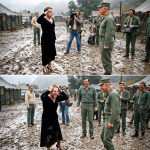
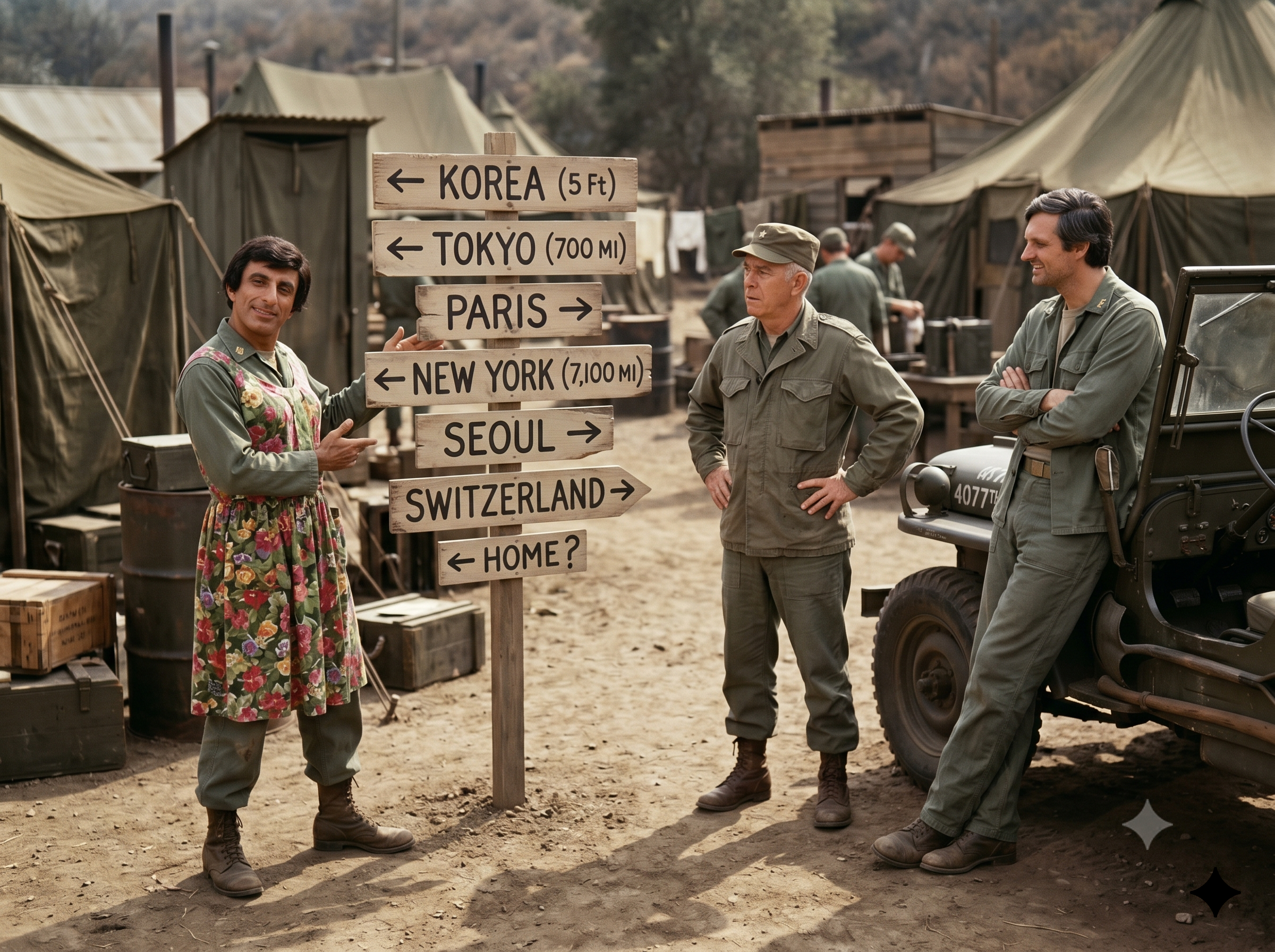
In the center of the dirt path, between the canvas tents and the stacked supply crates, Corporal Maxwell Q. Klinger stood at attention. Or, at least, his version of it.
He wasn’t wearing his usual parade-ground dresses or feathered hats today. Instead, he had compromised with the army regulations by wearing standard olive drab fatigues, brightened up by a loud, floral-print kitchen apron tied snugly around his waist. He stood with his chest puffed out, radiating the theatrical pride of a man unveiling a museum masterpiece.
Next to him stood his newest creation. It was a comically improvised directional signpost, built from scrap wood, broken crates, and sheer desperate imagination.
Roughly painted black arrows pointed toward destinations that felt like they existed on another planet. KOREA (5 Ft). TOKYO (700 MI). PARIS. NEW YORK (7,100 MI). SEOUL. SWITZERLAND. And at the very bottom, pointing nowhere in particular, was a smaller plank that simply read: <- HOME?
A few feet away, Hawkeye Pierce leaned casually against the fender of a parked jeep. His long, lanky frame was folded into a posture of practiced, bone-deep exhaustion. His arms were crossed over his chest, his uniform wrinkled and stained from days of endless surgery.
Yet, despite the fatigue pulling at the corners of his eyes, Hawkeye was smiling. It was an amused, teasing grin. He was thoroughly enjoying the comic contrast of the scene unfolding before him, soaking in the absurdity like a thirsty man drinking water. It was exactly the kind of ridiculousness he needed to remind him that he was still alive.
The source of the tension, however, stood directly in front of Klinger.
Colonel Sherman T. Potter had emerged from his office looking for a cup of coffee and a moment of peace. Instead, he had walked straight into Klinger’s latest unauthorized camp beautification project.
Potter stood firmly planted in the dirt, his hands resting squarely on his hips. His posture was stable, commanding, and unmistakably authoritative. He was staring at the sign, then at Klinger, then back at the sign.
His face was a masterpiece of fatherly exasperation. His jaw was set, his lips pressed into a tight line, but his eyes betrayed a flicker of something else. It wasn’t anger. It was that dry, weary patience of a man who had seen everything, yet was still somehow surprised by the daily circus of his own command.
Klinger gestured to the wooden post with a flourish of his hand. “Well, Colonel?” Klinger asked, his voice dripping with sly, theatrical hope. “I think it really ties the compound together. Gives us a sense of global perspective, don’t you agree?”
Hawkeye shifted his weight against the jeep, his grin widening. He didn’t say a word. He just watched, highly entertained, waiting for the old man to react.
Potter remained perfectly still, his eyes narrowing slightly beneath the brim of his cap. The silence in the dusty compound stretched out, thick and heavy.
Would the Colonel tear it down? Would he bark an order to turn the scrap wood into kindling for the mess tent? Hawkeye held his breath, watching the rigid set of Potter’s shoulders, waiting for the inevitable explosion.
The dusty wind kicked up a small swirl of dirt around Potter’s boots. The old cavalryman didn’t flinch. He just kept staring at the wooden planks.
“A sense of global perspective,” Potter finally repeated. His voice was low, gravelly, and entirely unreadable.
“Yes, sir!” Klinger beamed, adjusting the straps of his floral apron. “You see, Colonel, a man can get tunnel vision in a place like this. He looks left, tents. He looks right, tents. He looks down, mud. I felt it was my duty to remind the personnel of this unit that civilization is still out there. It’s just… mathematically out of reach.”
Hawkeye couldn’t help himself anymore. He let out a quiet chuckle, pushing slightly off the jeep. “He’s got a point, Colonel. I was just trying to hail a cab to Paris, but the traffic in the compound is murder today.”
Potter slowly turned his head to fix Hawkeye with a legendary, withering stare. “Pierce, unless that jeep you’re leaning on is about to sprout wings and fly you to the Champs-Élysées, I suggest you keep your worldly observations to yourself.”
“My lips are sealed, sir,” Hawkeye replied, offering a lazy, two-fingered salute while the smirk never left his face. He crossed his arms again, settling back in to watch the show.
Potter turned his attention back to Klinger. He stepped closer to the sign, his hands still planted firmly on his hips. He leaned in, squinting at the rough, uneven lettering painted on the wood.
“New York,” Potter read aloud, his tone dry. “Seven thousand, one hundred miles.”
“Give or take a few feet, Colonel,” Klinger offered helpfully. “I had to estimate the distance from the latrines.”
“And Korea… five feet.” Potter looked down at the dirt, then back up at Klinger. “I hate to break it to you, son, but I think we’re standing a bit closer to it than that.”
“Artistic license, sir. It felt too depressing to write ‘You Are Here’.” Klinger’s sly hope began to falter just a fraction. He searched Potter’s face for a sign of genuine anger, but the Colonel’s expression remained stoic.
For a long moment, Potter just looked at the young corporal. He took in the absurd floral apron worn over the sweat-stained fatigues. He saw the nervous energy vibrating behind Klinger’s eyes. He saw a kid from Toledo who was terrified, exhausted, and using every ounce of his theatrical spirit just to keep himself from falling apart.
Then, Potter’s eyes drifted down to the bottom plank.
<- HOME?
The question mark hung there in the air between them. It was a joke, sure. But it was also the unspoken prayer of every single person sleeping in those canvas tents. It was the heavy, unspoken truth of the 4077th. They were all lost in the middle of nowhere, stitched together by blood, mud, and bad coffee, wondering if they would ever find their way back to the lives they had left behind.
Hawkeye watched the change come over the Colonel. It was subtle, just a slight softening around the eyes, a microscopic relaxing of the shoulders. The comedy of the moment quietly melted away, leaving something much more tender in its place.
Potter wasn’t looking at a Section 8 candidate anymore. He was looking at his people. His family.
“You left something out, Klinger,” Potter said quietly. The gravel in his voice had smoothed out into something remarkably gentle.
Klinger blinked, genuinely surprised. “I did, sir? I thought I covered all the major hubs. I even put Switzerland in case anyone needed to declare neutrality.”
“Hannibal, Missouri,” Potter said, a faint, nostalgic smile finally breaking through his stern facade. “If you’re going to map out the civilized world, you might as well include the exact distance to Mildred’s front porch. I suspect it’s somewhere around six thousand, eight hundred miles, heading roughly that way.” He pointed a weathered finger vaguely over the horizon.
Klinger’s face lit up with absolute, unfeigned relief. The sly hope turned into a genuine, radiant smile. “I’ll paint a new plank immediately, Colonel! Hannibal, Missouri, coming right up.”
“See that you do,” Potter said, giving the signpost one last pat. He dropped his hands from his hips and turned back toward his office. He paused, looking over his shoulder. “And Klinger?”
“Yes, sir?”
“The apron really brings out the green in your fatigues. Very practical.”
“Thank you, sir! It has pockets!” Klinger called out proudly.
Potter just shook his head, a fond, weary chuckle escaping him as he walked away, leaving Klinger to admire his handiwork.
Hawkeye pushed off the jeep, walking over to Klinger. He slapped the corporal gently on the shoulder, his eyes tracing the arrows pointing toward Tokyo, Paris, and New York.
“Nice work, Klinger,” Hawkeye said softly, the teasing gone from his voice.
“You really think so, Captain?”
“Yeah. I do.” Hawkeye shoved his hands deep into his pockets, staring at the little arrow pointing toward Home. The fatigue was still there, settled deep in his bones, but for a brief moment, the camp didn’t feel quite so isolating.
They were thousands of miles from where they belonged, surrounded by dirt, war, and tragedy. But as Hawkeye looked at Klinger in his ridiculous apron, and thought of Potter measuring the distance to his wife’s front porch, he realized they weren’t entirely lost. They had built a home right here in the dust, purely out of necessity, humor, and each other.
“Come on,” Hawkeye said, nudging Klinger toward the mess tent. “Let’s go see if the food here is as far from actual cooking as we are from New York.”
They were a million miles from everything they knew, but standing together in the dust, they were exactly where they needed to be.