The Static Between Us
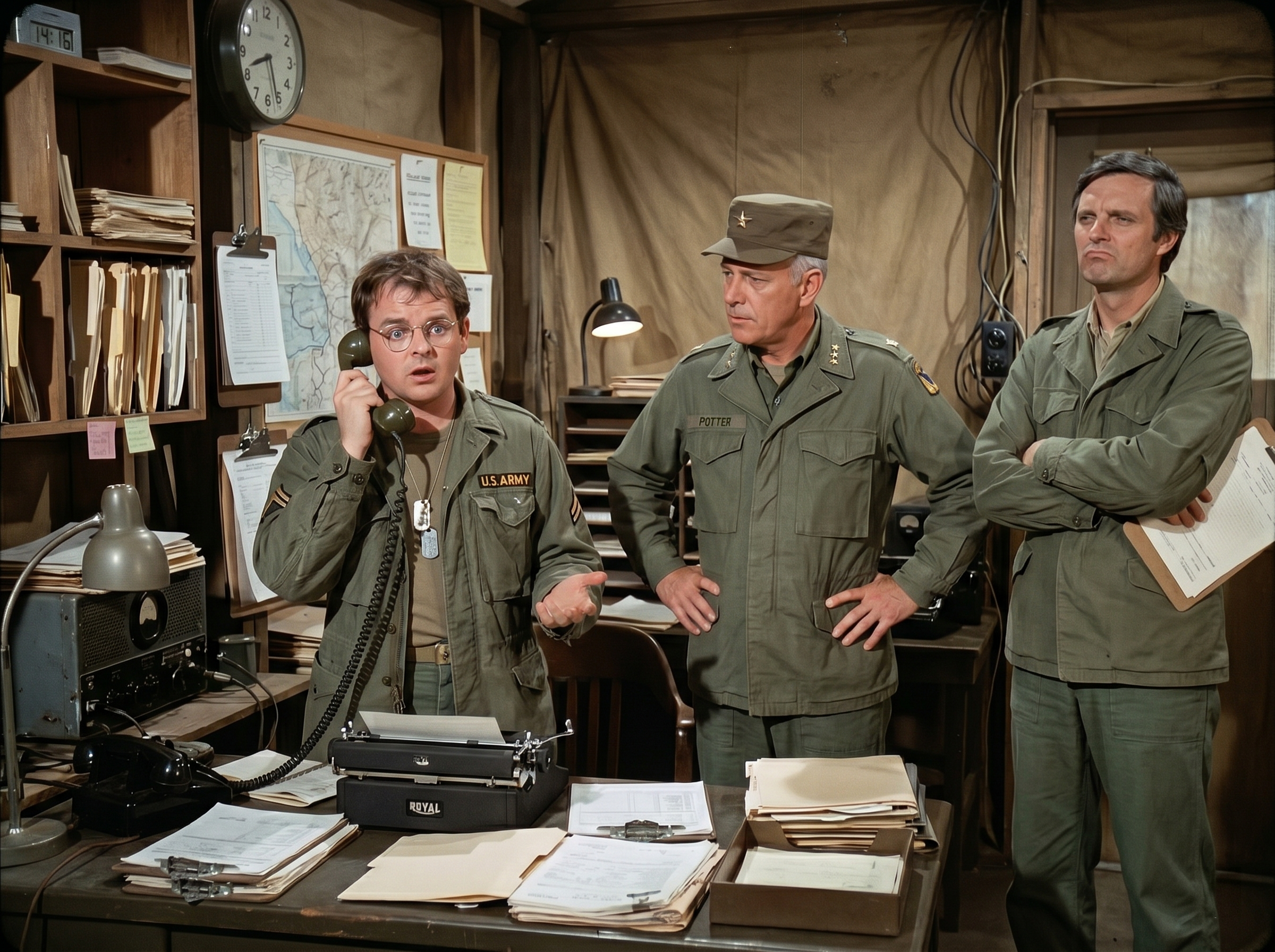
The war was always loud, but sometimes the silence inside the clerk’s office was much worse.
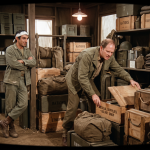
It was a Tuesday afternoon, though days of the week had long since lost their meaning at the 4077th. Inside the cramped, olive-drab sanctuary of the company clerk, the air felt heavy and thick.
The room smelled of stale coffee, mimeograph ink, and the dusty canvas of the tents. Stacks of requisition forms and clipboards teetered on the edges of the wooden desk, creating a fragile wall of paperwork against the madness outside.
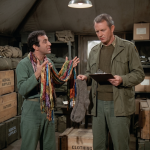
Behind the desk stood Corporal Walter “Radar” O’Reilly.
Right now, Radar wasn’t the all-knowing clerk who could hear choppers before they crossed the horizon. He was just a twenty-year-old kid from Iowa, clutching a heavy black radio headset as if it were a lifeline.
His eyes were wide behind his round glasses. His brow was creased with a deep, nervous confusion.
Standing directly in front of the desk was Colonel Sherman T. Potter.
Potter had his hands planted firmly on his hips. His posture was grounded, immovable, the stance of an old cavalry man who had spent a lifetime watching the Army trip over its own shoelaces. He looked at Radar with a look of patient, fatherly exasperation.
A few feet away, standing slightly apart from the command desk, was Captain Hawkeye Pierce.
Hawkeye had his hands tightly folded across his chest. His shoulders were stiff. He wore a look of wounded pride and deeply restrained irritation, his jaw set hard against the sheer incompetence of military bureaucracy.
They had been waiting for twenty minutes for a single, crucial radio transmission.
Post-op was full. The supply tent was nearly empty. They desperately needed a confirmation on a shipment of whole blood and broad-spectrum antibiotics from Seoul.
Without it, the next wave of wounded would be facing impossible odds.
“Well, Radar?” Potter asked, his voice a low, steady rumble in the quiet room. “Is the United States Army going to grace us with an answer, or do I need to send a telegram to Harry Truman himself?”
Radar swallowed hard. His fingers fumbled with the dials on the radio console.
“I… I had them, Colonel. I swear I had them,” Radar stammered, his voice climbing an octave. “Sparky was right there. He said he had the manifest in his hand.”
Hawkeye let out a long, sharp breath. He looked up at the canvas ceiling as if searching for patience he didn’t possess.
“Let me guess,” Hawkeye said dryly. “Sparky dropped the manifest. Or maybe the manifest was eaten by a feral jeep. Or perhaps the entire city of Seoul was just misplaced by a filing clerk in Tokyo.”
“Pierce,” Potter warned gently. It wasn’t a reprimand, just a quiet reminder to keep the lid on the pot.
“I’m just saying, Colonel,” Hawkeye muttered, his hands gripping his own arms tighter. “We can take out an appendix in the dark with a rusty spoon, but we can’t get a straight answer out of a radio that costs more than my house in Crabapple Cove.”
Radar pressed the headset tighter against his ear. He closed his eyes, leaning into the receiver as if his sheer willpower could bridge the miles of tangled copper wire stretching across the Korean peninsula.
“Sparky? Sparky, come in. This is the 4077th. Over,” Radar pleaded into the mouthpiece.
The only answer was a thick, crackling hiss of static.
Radar opened his eyes and looked up at Potter. The boyish panic on his face was heartbreaking.
“Colonel,” Radar whispered, his voice trembling. “They’re gone. The line is completely dead.”
The static filled the small office, humming like a swarm of angry bees.
For a long moment, nobody moved. The weight of the lost signal settled over the three men, heavy and suffocating.
Hawkeye finally broke the silence. He dropped his arms and took a frustrated step toward the desk, leaning over the stacks of beige paper.
“Dead?” Hawkeye asked, his voice rising with that familiar, desperate edge. “What do you mean, dead? Radar, you can hear a mosquito sneeze in Pyongyang. Find the signal.”
“I’m trying, Hawk!” Radar cried, his hands flying across the switchboard, plugging and unplugging thick black cords in a frantic dance. “There’s nothing! It’s just air!”
Hawkeye rubbed a hand over his face, exhausted. Beneath his irritation, there was a deep, gnawing fear for the soldiers lying in the post-op ward.
“This is beautiful,” Hawkeye sighed, pacing a tight circle in the small clearing of the office. “The Army has finally perfected its communication system. We just transmit pure, unadulterated silence. It’s much more efficient than lying to us.”
“Easy, Hawk,” Potter said. His voice was remarkably calm.
Potter didn’t yell. He didn’t pace. He simply stood his ground, a sturdy oak tree in the middle of a windstorm. He looked at Hawkeye, seeing right through the younger doctor’s sarcasm to the raw, bleeding empathy underneath.
“Getting your blood pressure up isn’t going to fix the phone lines,” Potter added softly.
“My blood pressure is perfectly fine, Colonel,” Hawkeye countered, though his tired eyes betrayed him. “It’s my faith in the military-industrial complex that’s currently crashing.”
Potter offered a small, knowing half-smile. Then he turned his attention back to the terrified clerk behind the desk.
Radar looked like he was about to cry. He felt personally responsible for every failed connection, every lost supply truck, every piece of bad news that came through his switchboard.
“Son,” Potter said, stepping closer to the desk. His tone shifted from commanding officer to gentle grandfather. “Take a breath.”
Radar stopped his frantic plugging. He looked up, his chest heaving slightly. “But sir, the blood…”
“I know,” Potter said. “But you can’t squeeze blood out of a radio dial. Just sit back, take a breath, and try the secondary relay through I Corps.”
Radar nodded slowly. He took a shaky breath, adjusted his round glasses, and sat down in his wooden chair. He picked up the headset again, his movements slower, more deliberate this time.
Hawkeye stopped pacing. He leaned against the wooden frame of the door, his posture softening. The anger had burned out, leaving only the bone-deep fatigue that they all shared.
“Sorry, Radar,” Hawkeye said quietly. “I know it’s not your fault. If I had my way, I’d give you a medal for putting up with us.”
Radar offered a weak, grateful smile. “That’s okay, Captain. If I had my way, I’d order us all a pizza from Chicago.”
Potter chuckled, a warm, rumbling sound. “Make it two. Extra cheese.”
The tension in the room broke, just a little. It was the magic of the 4077th—the way a shared joke or a gentle word could pull them back from the edge of despair. They were trapped in a nightmare, but they were trapped together.
Suddenly, Radar’s eyes widened. He sat up straight, pressing the headset to his ear so hard his knuckles went white.
“Wait,” Radar whispered.
Hawkeye and Potter both stepped forward.
“Sparky?” Radar practically shouted into the mouthpiece. “Sparky! You beautiful son of a gun! Where did you go?”
A tinny, faint voice leaked from the headset. Radar grabbed a pencil and yanked a clipboard toward him, scribbling furiously on the beige paper.
A massive, radiant smile spread across the young clerk’s face.
“Yes. Yes, I got it. Ten minutes? You’re kidding! Okay. Okay, thanks Sparky. I owe you a bottle of grape Nehi!”
Radar pulled the headset down, letting it rest around his neck. He looked up at Potter and Hawkeye, his eyes shining with triumph.
“Well?” Potter asked, a hopeful gleam in his eye.
“The signal didn’t die, sir,” Radar beamed. “Sparky dropped the phone because he had to run outside. He didn’t put the supplies on a truck. He talked a chopper pilot into bringing them straight here. They’ll be landing on the pad in ten minutes.”
Hawkeye closed his eyes and let out a long, trembling breath. A slow, genuine smile touched the corners of his mouth.
“Radar,” Hawkeye said softly, opening his eyes. “Remind me to kiss you when we have a free moment.”
“Uh, that won’t be necessary, sir,” Radar blushed, straightening his olive-drab cap.
Potter took his hands off his hips and clapped them together once. The grounded exasperation was gone, replaced by the steady, commanding warmth of a man who loved his people.
“Alright, gentlemen,” Potter said, turning toward the door. “We’ve got ten minutes to get a fresh pot of coffee down our necks before those supplies get here. Pierce, grab B.J. and meet me in the mess tent.”
“Yes, sir,” Hawkeye smiled, pushing himself off the doorframe. He looked back at the young man at the desk. “Good work, Radar.”
“Thank you, Captain,” Radar said proudly.
As Hawkeye and Potter walked out into the dusty compound, the office fell quiet again. But it wasn’t a heavy silence anymore.
Radar sat at his desk, surrounded by the towering stacks of paperwork and the humming radio equipment. He patted the side of the radio affectionately, feeling the warm, enduring pulse of their fragile little world.
In a place surrounded by chaos, the strongest connection they had was always to each other.