FINDING QUIET MOMENTS IN THE CLUTTER OF KOREA
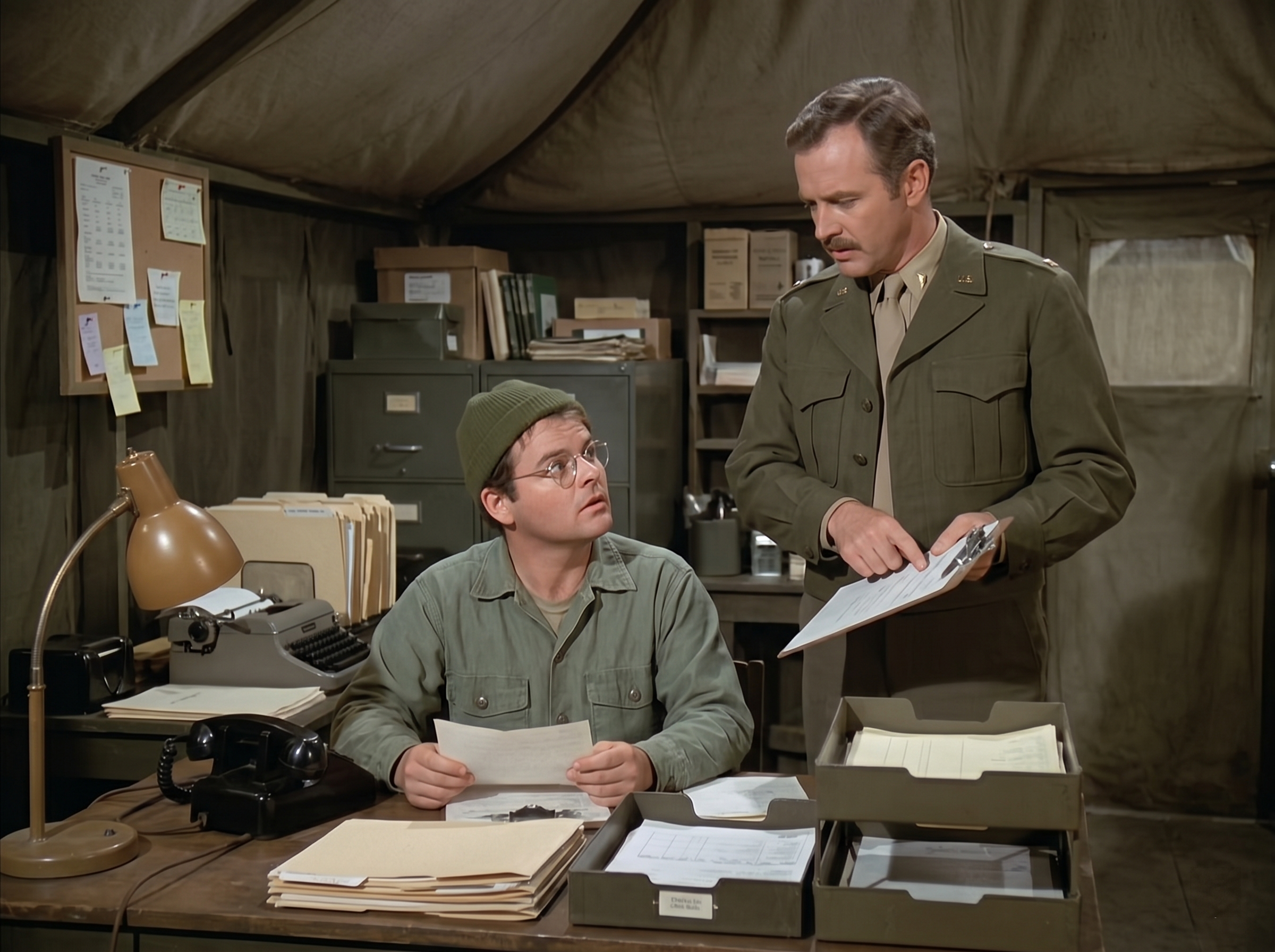
Radar’s office was always the eye of the hurricane. A rare bubble of administrative silence.
The steady, methodical clack-clack of his manual typewriter was the heartbeat of the 4077th’s operations. It was a comforting sound. It meant files were moving.
Supplies were being ordered. Somewhere, a wheel was turning that might eventually send someone home.
Radar sat beneath the warm, practical light of his desk lamp. His glasses caught the reflection of the stacked manila folders.
He adjusted his knit cap, concentrating on a complex supply manifest for specialized surgical suture that Hawkeye swore they would need by morning. The rest of the world (distant artillery rumblings, the chatter from the mess tent) was muted here.
He loved the containment. He knew where every pencil stub, every ink ribbon, and every rotary field phone was located in this clutter.
Until a shadow fell across his desk.
It was Major Charles Emerson Winchester III.
He didn’t just walk into a room; he arrived. Standing with a refined, starched posture, Winchester occupied the small space.
He wore his uniform with a tailored neatness that seemed to defy the muddy reality of Korea. He looked down at Radar with a expression of dry, controlled irritation.
“Corporal O’Reilly,” Winchester began, his voice a low, precise rumble.
He held a clipboard like a royal edict, and without a word, he pointed a single finger directly at the bottom section of a complex transfer request.
“Your signature. Here.” His gaze was unblinking.
Radar looked up, his expression a sweet, earnest open book of innocent misunderstanding. He glanced between the clipboard and his own typewriter.
“Major?” Radar asked, polite but a little overwhelmed by the sudden proximity of such intense expectation.
“You seem to have mistaken this transfer manifest for a casual suggestion form,” Winchester said.
His pointing finger tapped precisely, a controlled gesture demanding correction. His mustache bristled.
He needed a final, correct signature on an urgent requisition, and Radar, swamped with forms, had missed a critical checkbox.
“Major, I signed the copy,” Radar stammered, pulling a stack of papers from his in-tray.
“Not this copy. And this one,” Winchester leaned down, pointing his clipboard again, “This one is the original. The one that keeps the OR from turning into a butcher shop, Corporal.“
Tension gently gathered in the small canvas office. Radar began to fumble through a pile of identical beige forms, his hands shaking slightly. The silent ticking of the clock grew loud.
A distant shell landing made the desk lamp flicker, making Radar jump. Winchester didn’t flinch, his eyes just narrowed further. He didn’t speak; he just held the clipboard out, pointing, waiting.
Part 1 Ending High Point: Winchester’s silence felt heavier than the artillery. Radar looked at the forms in his hand, then up at the clipboard, and he realized he couldn’t remember which copy he had signed. He couldn’t find the pen that was just here five minutes ago. Winchester stepped even closer, his shadow completely swallowing Radar’s little corner of light. The tension was palpable.
Radar froze.
He couldn’t even blink. He looked at Winchester’s starched uniform and the clipboard pointing at him like an accusation.
He swallowed hard, fumbling for a pen in the clutter of paper trays, only to find he was holding a pencil instead.
Winchester watched the fumbling, his expression unwavering. He let out a soft, elegant sigh, a sound refined even in exasperation.
Instead of lecturing, Winchester stepped even closer. He carefully reached past the manual typewriter and picked up a black fountain pen sitting unnoticed next to the phone base.
“An astute eye is required for effective administration, Corporal O’Reilly.” The sarcasm was present, but the tone was surprisingly calm.
Winchester didn’t hand him the pen. He held it, looking from the signature box to Radar’s face.
He saw the fatigue. He saw the genuine anxiety in the eyes behind those round glasses.
Radar’s eyes, soft and polite, were usually bright with observational insight, but right now, they were heavy with the exhaustion that consumed them all.
Winchester realized the Corporal had been typing for twelve hours straight. He had managed three convoys and sorted two separate supply requisitions in the last week.
Winchester stood back up to his full, precise height, still holding the clipboard and the pen.
He pointed one final time, but the dynamic had shifted. It was no longer an accusation. It was guidance.
“Your signature is… barely a flourish, Corporal. It resembles a seismograph recording a bombardment.” He allowed a microscopic, dry smile.
“But this is the box. Right here. Press firmly.” He gently placed the pen in Radar’s hand, then held the clipboard steady on the desk.
It was a found-family tenderness, masked as sophisticated superiority.
Winchester wasn’t just a proud outsider demanding perfection. He was, in this quiet office, a skilled professional helping the camp’s young innocent heartbeat navigate the bureaucracy that tried to choke them all.
Radar took the pen, a flicker of understanding passing through his anxious expression. He carefully placed a signature exactly where Winchester’s pointed finger indicated.
“Thank you, Major,” Radar said, his voice quiet. He looked up, his expression one of relieved and sweet appreciation.
Winchester nodded once, a brief acknowledgment. He withdrew the clipboard and pocketed the fountain pen.
“I trust your penmanship will improve. The camp relies on clarity. Now, back to your… clerical duties.“
He turned on his heel and walked out of the tent, his posture still upright, leaving only the soft scent of his cologne.
Radar watched him go. He took a long breath, adjusting his knit cap.
He looked at the telephone and the typewriter. The office felt less oppressive, the clutter less chaotic.
He glanced at the bulletin board, filled with notes and photos from home.
The 4077th wasn’t just a hospital; it was a sanctuary forged in impossible conditions. The endless forms were the paperwork that kept their shared humanity moving forward.
Radar picked up a new form, and the methodical clack-clack of the typewriter began again, a steady rhythm in the Korean night.
Because sometimes, the quietest victories were just connecting the dots with the people who truly saw you. And sometimes, even Winchester knew that perfection was less important than understanding.
Because sometimes, the quietest moments of connection were the truest proof we were alive.