The Center of a Canvas World
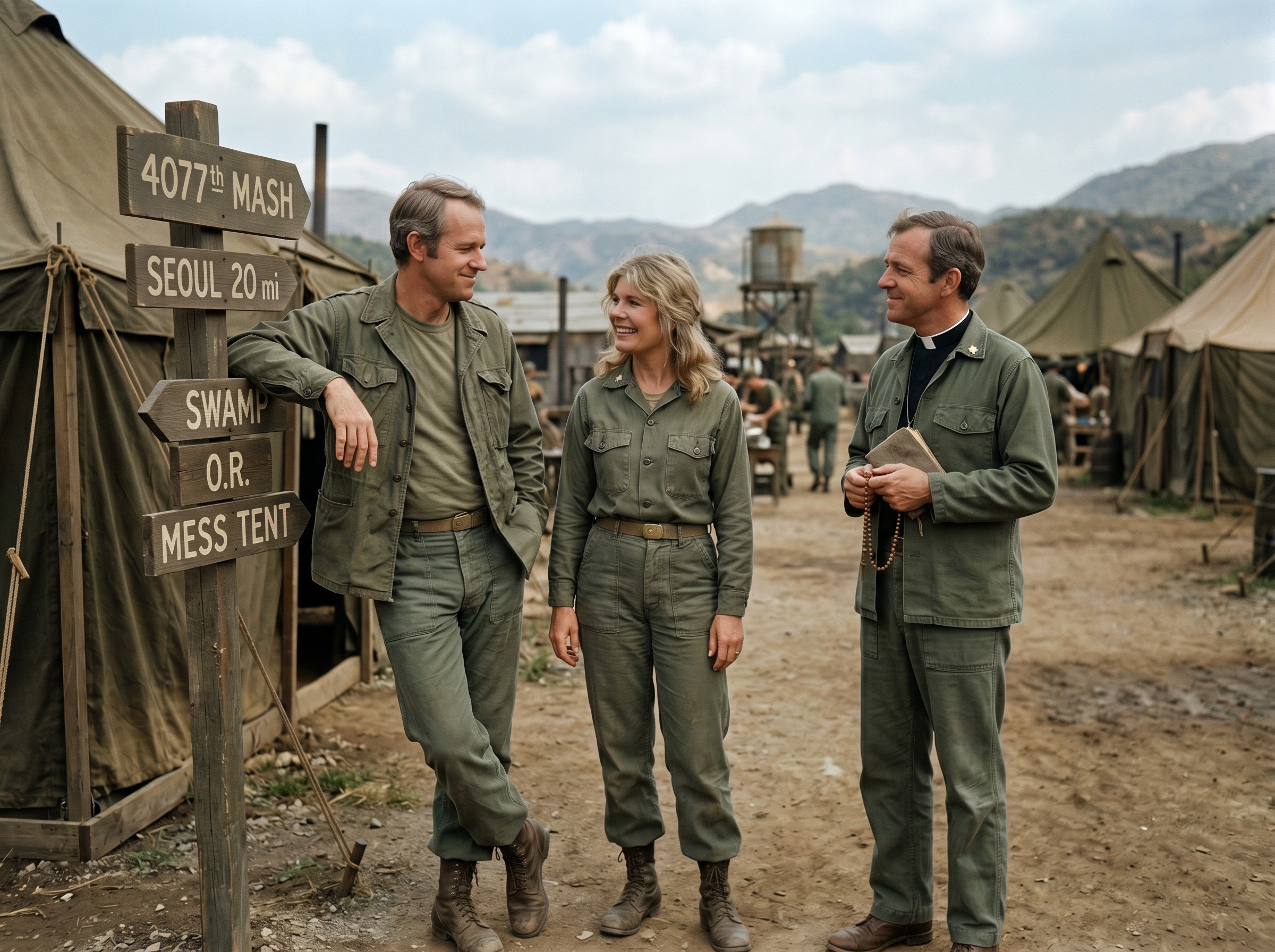
The war had a funny way of making you forget what day of the week it was, but it never let you forget exactly where you were. The fine, beige dust at the 4077th had a habit of settling into absolutely everything. It coated your boots, settled into the canvas of the tents, dusted the creases of your letters from home, and eventually, it found its way into the corners of your mind.
It was late afternoon, settling into that quiet, golden hour between the chaotic, blood-soaked rush of incoming choppers and the bone-deep chill of the approaching Korean night. The sky above was a soft, muted blue, hazy and distant, softening the harsh, jagged edges of the surrounding mountains.
It was a rare moment of peace in the outdoor compound, the kind of quiet that felt almost fragile.
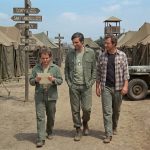
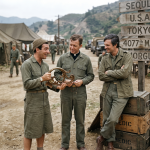
Captain B.J. Hunnicutt stood in the center of the dirt path, leaning casually against the familiar, weathered wooden directional signpost. The rough-hewn boards above his head pointed in every direction—’4077th MASH’, ‘SEOUL 20 mi’, ‘SWAMP’, ‘O.R.’, ‘MESS TENT’.
He wore his standard, lived-in green fatigues, an olive t-shirt visible at the collar, looking intensely practical and entirely at home in the dust. His hands were tucked comfortably deep into his pockets.
There was a gentle, dryly amused smile playing across his face. It was the kind of calm, easygoing expression he usually saved for a quiet letter to Peg, or for enduring a particularly absurd joke Hawkeye had just spun out of thin air.
Beside him stood Major Margaret Houlihan.
She wasn’t the strict, unyielding head nurse in this exact second. The rigid, military posture that usually defined her was noticeably softened. She stood tall with her usual upright grace, but the heavy emotional armor she wore every day had been temporarily lowered.
Her fatigue shirt and trousers were practical and worn, completely natural to the camp. Her hair caught the warm, muted daylight, and a brilliant, deeply human smile broke across her face.
It was a look of genuine, warm amusement, a rare letting down of her guard as she listened to B.J. speak.
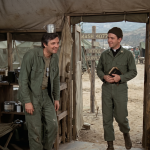
A few paces to the right, Father Mulcahy had stopped in his tracks on his way across the compound.
He was dressed in his modest green uniform, the bright white of his clerical collar standing out against the dusty backdrop. In his hands, he gently held a worn prayer book and his rosary beads, stepping softly so as not to interrupt the rare sound of unburdened laughter.
He just stood there slightly to the side, observing the two doctors with warm, quiet eyes. There was a profound, silent sadness in his gaze, born from witnessing too much pain, but right now, it was giving way to a deeply hopeful warmth.
B.J. had just finished telling a rambling, highly embellished story about a remarkably stubborn plumbing issue he’d once encountered in a neighbor’s backyard back in Mill Valley. He had delivered the punchline with that quiet, understated, dry timing of his.
Margaret had chuckled, a real, unforced sound that seemed to chase the heavy shadows out of the camp. For a fleeting second, the war simply didn’t exist.
But as the laughter drifted away into the cool afternoon air, the brutal reality of their location came rushing back.
A sudden, sharp silence fell over the three of them. The wind picked up, rattling the wooden arrows against the post, a hollow, lonely sound.
Far off in the distance, a low, ominous rumble of artillery echoed through the hills, shaking the ground just enough to be felt in the soles of their boots.
Margaret’s bright smile faltered. The warmth drained from her face, replaced instantly by a sudden, intense look of sorrow that seemed to rush up from deep within her soul.
She looked down at the dusty dirt path, her jaw tightening as her eyes abruptly filled with unshed tears. The weight of the 4077th had crashed back down onto her shoulders.
“It’s just…” Margaret started, her voice barely a whisper, catching painfully in her throat.
She wrapped her arms around herself, the sudden, raw vulnerability stark against the rugged, utilitarian backdrop of the tents.
“I just realized something terrifying, B.J.,” she breathed, staring at the ground.
B.J. straightened up immediately. The gentle amusement vanished from his face, replaced by a sharp, highly protective concern.
“What is it, Margaret?” he asked, his voice low and steady.
She looked up, her emotional guard completely shattered, exposing the sheer exhaustion underneath. “I just realized… I can’t remember what it feels like to laugh like that without feeling terribly, horribly guilty for it a second later.”
The heavy confession hung in the dusty air, feeling heavier than the canvas of the surrounding tents.
B.J. didn’t offer a quick, deflecting joke, and he didn’t reach out to pat her shoulder with empty, meaningless reassurances. He understood exactly what she meant. They all did.
B.J. shifted his weight and leaned back against the post again, letting the solid, rough wood ground him. He looked out toward the distant, muted mountains, his brow furrowing in quiet thought.
“Guilt is a funny, stubborn thing in a place like this, Margaret,” B.J. said quietly, his voice a steady, comforting rumble in the quiet compound.
“It’s exactly like this mud. It clings to your boots, it gets under your fingernails, and eventually, you get so used to carrying all that extra weight, you completely forget what it feels like to walk without it.”
Father Mulcahy stepped forward then, closing the small, dusty distance between them. The quiet sadness in his eyes had completely shifted into a deep, enduring warmth.
“Major,” the priest said softly, his voice carrying the gentle, rhythmic cadence of a Sunday morning sermon meant for an audience of one. “The Lord does not ask us to surrender our joy just because we happen to be surrounded by sorrow.”
Margaret quickly wiped at her eye, trying desperately to pull the familiar, safe armor of her military rank back around her trembling shoulders.
“It feels wrong, Father,” she confessed, her voice thick with fatigue. “We spend agonizing hours in that O.R. piecing broken, terrified boys back together. We see things no one should ever see.”
She gestured helplessly around the camp. “And then I come out here, the sun is shining, B.J. tells a ridiculous story about California, and I… I forget. Just for a second, I forget the blood.”
She looked up at the signpost above B.J.’s head, reading the distant destinations painted on the weathered wood.
“I forget where we are,” Margaret continued, her voice breaking. “And then I remember, and I feel like I’ve committed a crime against every single boy lying in post-op right now.”
B.J. took his hands out of his pockets and crossed his arms over his chest. He looked at her with a profound, quiet empathy that made him the moral anchor of the camp.
“Margaret, if we didn’t forget for a second—if we didn’t laugh at stupid jokes, or complain about the terrible powdered eggs, or stand out here in the dirt just shooting the breeze—we wouldn’t be any good to those boys at all.”
B.J. offered a small, familiar, crooked smile, trying to bring her back from the edge.
“Hawkeye always says that laughter is the only thing keeping us from screaming our heads off. I think, for once in his life, the man is absolutely right.”
Mulcahy nodded slowly in agreement, his fingers tracing the smooth, comforting beads of his rosary.
“It is a true testament to the human spirit, Margaret,” Mulcahy added gently, looking between the two doctors. “To find a little bit of light in this immense darkness is not a betrayal of the suffering. It is a necessary rebellion against it.”
The priest smiled, the crinkles around his eyes deepening with genuine, fatherly affection.
“When I look at you, and B.J., and Benjamin Franklin… I don’t see people ignoring the war,” Mulcahy said. “I see a family holding each other up so the war doesn’t crush you completely.”
Margaret let out a long, shaky breath. The rigid, painful tension in her shoulders finally began to melt away once more.
She looked at Mulcahy’s kind, earnest face, and then over to B.J., who was back to leaning against the post, radiating that quiet, unshakable steadiness he was known for.
“A rebellion against it,” Margaret repeated softly to herself, rolling the comforting words around in her mind.
She looked down at her worn boots, covered in the exact same beige dust as B.J.’s and the Father’s.
They were all standing on the exact same patch of foreign dirt, thousands of miles from the lives and the people they had left behind. But looking at the two men beside her, she suddenly felt profoundly anchored and incredibly safe.
“You know, Hunnicutt,” Margaret said, a very faint trace of her old, fiery authority returning to her voice, though the edges remained perfectly soft. “Your plumbing story wasn’t even that funny to begin with.”
B.J. gasped in mock offense, clutching a hand dramatically to his chest.
“Not funny? Major, that story was a breathtaking masterpiece of modern comedic storytelling. It had drama, it had intense suspense, it had a stubborn, rusted pipe—”
“And we get enough stubborn, rusted things around this camp every single day,” Margaret interrupted smoothly, a genuine, radiant smile finally returning fully to her face.
Mulcahy let out a joyful, bubbling laugh, the sound bright, clear, and wonderful in the quiet outdoor compound.
B.J. grinned broadly, his eyes crinkling warmly at the corners. He shifted his weight casually against the wooden signpost, settling happily back into the comfortable, easy rhythm of their banter.
The heavy, suffocating blanket of guilt had lifted. It was replaced by the warm, protective embrace of the chaotic, beautiful family they hadn’t asked for, but now desperately needed to survive.
The sun dipped a little lower behind the mountains, casting long, peaceful golden shadows across the dirt paths of the 4077th.
The war was still out there, waiting in the hills, waiting in the sky, and waiting in the inevitable thumping sound of the next chopper.
But in that small, shared patch of dirt beneath the wooden directional arrows, they were safe. They weren’t just soldiers, or doctors, or nurses, or priests.
They were simply friends, holding back the dark together, one quiet, dusty, beautifully ordinary afternoon at a time.
They were a million miles from home, yet right where they needed to be.