A Quiet Afternoon in the Canvas Suburbs
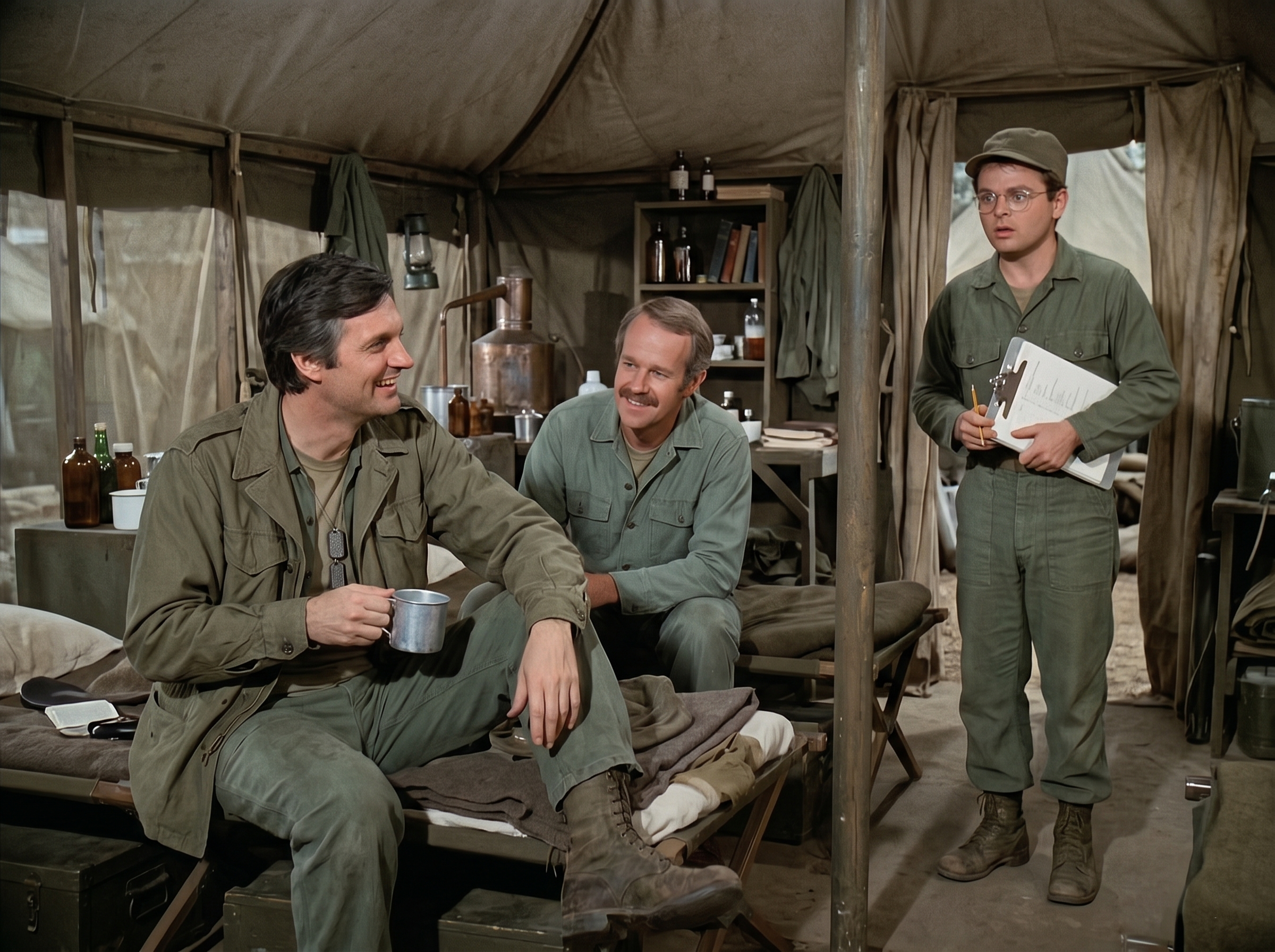
You could always measure the fragile peace of the 4077th by the sheer volume of nonsense echoing out of The Swamp.
When the OR was quiet, and the chopping rhythm of the helicopters was just a memory fading into the Korean hills, the olive-drab canvas tent became a sanctuary. It was a place where exhaustion was held back by a thin, desperate wall of humor.
The afternoon light filtered through the tent fabric, casting a soft, warm, dusty glow over the cots, the scattered footlockers, and the modest, everyday clutter of two men trying to pretend they lived anywhere else on Earth.
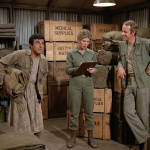
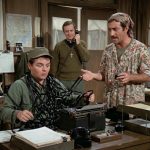
Hawkeye Pierce sat casually on his unmade cot, a picture of practiced relaxation. He wore his standard off-duty uniform: a worn green undershirt, an open fatigue jacket, and dark trousers tucked loosely into dusty boots. His dog tags rested against his chest, catching the muted light.
He slouched comfortably, leaning back against the wooden frame of his bed, holding a battered tin mug. The mug might have contained water, or it might have contained a very small, medicinal dose of the still’s latest batch. Knowing Hawkeye, it was the hope of the latter that kept him smiling.
Beside him, B.J. Hunnicutt leaned forward on his own cot, his hands resting easily on his knees. B.J. wore his fatigue shirt buttoned up, his mustache twitching with a quiet, knowing amusement. He was the perfect audience, radiating a gentle empathy that made the Swamp feel a little less lonely.
“I’m telling you, Beej,” Hawkeye said, turning his head toward the entrance with an amused, spontaneous grin. “It’s all about the supply chain. I’ve written a very polite letter to the Sears Roebuck catalog. I explained our situation. I told them we don’t need farm equipment. We need a pre-fabricated, fully staffed, air-conditioned jazz club delivered by parachute.”
B.J. chuckled softly, his eyes crinkling. “A jazz club, Hawk? In the middle of the Uijeongbu valley? The locals are going to complain about the noise.”
“The locals are going to be on the VIP list,” Hawkeye countered smoothly, taking a leisurely sip from his tin mug. “I’ve already appointed Frank as the head bouncer. He’s got the perfect personality for throwing people out into the street.”
Just as the dry joke landed, the canvas tent flap brushed open.
Radar O’Reilly paused in the doorway, half-entering the tent. He wore his standard fatigue cap and his round spectacles, clutching a wooden clipboard tightly to his chest. His boots squeaked softly against the dirt floor.
Radar had caught the very end of the conversation. His posture instantly stiffened into a state of unsure, nervous attention. His eyes went wide, darting from Hawkeye’s relaxed grin to B.J.’s amused face.
To Radar, the doctors of the 4077th were brilliant, unpredictable forces of nature. He loved them, but he also firmly believed they were capable of absolutely anything.
“A… a jazz club, sir?” Radar stammered, his voice cracking slightly with earnest confusion.
Hawkeye didn’t drop the bit. He just smiled wider, leaning toward the kid. “That’s right, Radar. The forms are in the mail. We’re expecting the saxophone section to drop in by Tuesday. I hope you cleared a landing zone.”
Radar looked down at his clipboard, his innocent face twisting in genuine distress. His mind raced, frantically trying to calculate the army regulations against importing a nightclub into a war zone.
He swallowed hard, paralyzed in the doorway. He had come to deliver official camp business, but now he was utterly convinced he was about to be an accessory to a court-martial. The weight of his clipboard suddenly felt like an anchor, and the warm banter of The Swamp collided violently with his overwhelming sense of duty.
“But… but Captain Pierce, sir,” Radar whispered, his eyes wide with impending doom. “You can’t do that. Colonel Potter… he’ll have my stripes if I sign for a saxophone!”
The silence in the tent stretched out for three long, beautiful seconds.
Hawkeye sat frozen in his relaxed slouch, the tin mug halfway to his lips. He looked at the young corporal standing in the doorway, trembling over a phantom shipment of brass instruments.
Then, B.J. broke the tension. He let out a low, warm, rumbling laugh. It wasn’t a mocking laugh; it was the comforting, grounding sound of an older brother watching a younger sibling fall for a harmless trick.
B.J. leaned further forward, his eyes softening with quiet affection. “Relax, Radar. Hawk’s just trying to furnish the camp with his imagination. We’re still thoroughly trapped in the military-industrial complex.”
Radar blinked behind his thick lenses. His shoulders dropped roughly two inches as he let out a long, ragged exhale. The rigid, military panic slowly drained from his posture, replaced by a weary, boyish relief.
“Oh,” Radar breathed, looking down at his boots. “You were making a joke.”
Hawkeye lowered his tin mug, his spontaneous grin softening into a look of genuine tenderness. The dry wit melted away, leaving behind the protective, exhausted surgeon who cared deeply for the kid at the door.
“Just a joke, Radar,” Hawkeye said gently, his tone dropping the theatrical bravado. “I promise, the only music we’re importing is whatever terrible singing I do in the shower.”
Radar offered a small, crooked smile, finally stepping completely through the tent flap and letting the canvas fall shut behind him. The Swamp immediately felt warmer, sealing the three of them inside away from the dust, the generals, and the unending war outside.
“Well, that’s a relief, sir,” Radar said, adjusting his glasses. “Because I don’t think I have the requisition forms for a snare drum. I barely have the forms for tongue depressors.”
Hawkeye gestured toward the empty chair near the small improvised table. “Come on in, sit down. Take a load off your clipboard. What horrific news does the United States Army have for us today? Are we invading Ohio?”
Radar looked down at his paperwork, remembering why he had come. “No, sir. It’s a memo from I-Corps. They’re delaying the mail truck again. The bridge at the crossroads washed out. We won’t get letters from home until Thursday.”
The lighthearted mood in the tent dimmed, just a fraction. It was a small blow, but in a place where a letter from a wife, a father, or a hometown friend was the only lifeline to sanity, it hit hard.
B.J. sighed, looking down at his hands. He rubbed his thumb across his knuckles, thinking of Peg and his daughter in California. The quiet empathy that made him such a good friend also meant he felt the weight of the distance more than most.
Hawkeye saw the shift in his friend’s posture. He looked at Radar, who looked equally crestfallen about the lack of mail.
In that moment, Hawkeye did what he always did. He took the emotional hit for the room and tried to patch it up with whatever he had lying around.
“Thursday,” Hawkeye repeated, his voice remarkably steady. “Well, that just gives the mailmen more time to practice their handwriting. I’m convinced half my letters from my dad are intercepted and rewritten by a bored corporal in Tokyo.”
B.J. looked up, a faint smile returning to his mustache. “I don’t know, Hawk. Your dad’s handwriting is pretty bad. The Army might actually improve it.”
Radar chuckled, a genuine, high-pitched sound that chased the gloom back into the corners of the tent. He looked at the two doctors, his wide-eyed earnestness settling into a comfortable, trusting gaze.
“Can I… can I sit for a minute, sirs?” Radar asked softly, gesturing to the edge of an empty footlocker. “The Colonel is taking a nap, and Klinger is trying to invent a new holiday so he can go on leave.”
“Take a seat, Radar,” B.J. said warmly, nodding toward the trunk. “You’re safe here. No officers, no jazz bands. Just us.”
Radar sat down, resting his clipboard carefully on his lap. He looked around the messy, familiar tent. It wasn’t home. It wasn’t Iowa, and it wasn’t Maine or California. It was just canvas, wood, and the smell of antiseptic and dust.
But as Hawkeye took another slow sip from his tin mug, and B.J. leaned back to ask Radar about his animals, the tent felt like the safest place in the world.
They were tired, they were far from the lives they wanted, and they were trapped in a war that made no sense. But right then, in the golden light of an ordinary afternoon, they had each other.
And for the 4077th, that was always just enough to survive another day.
In a world painted entirely in faded olive drab, the brightest colors they had were always each other.