The Weight of an Orange: A Day When God Watched Klinger and Father Mulcahy
If there’s one thing you could count on at the 4077th, it was the sound of the chopper blades. Some days they were a faint heartbeat on the horizon; other days they were a deafening thunder that meant a long night ahead in OR. But even when they weren’t spinning, the *memory* of them lingered in the air, a permanent, phantom vibration in your teeth.
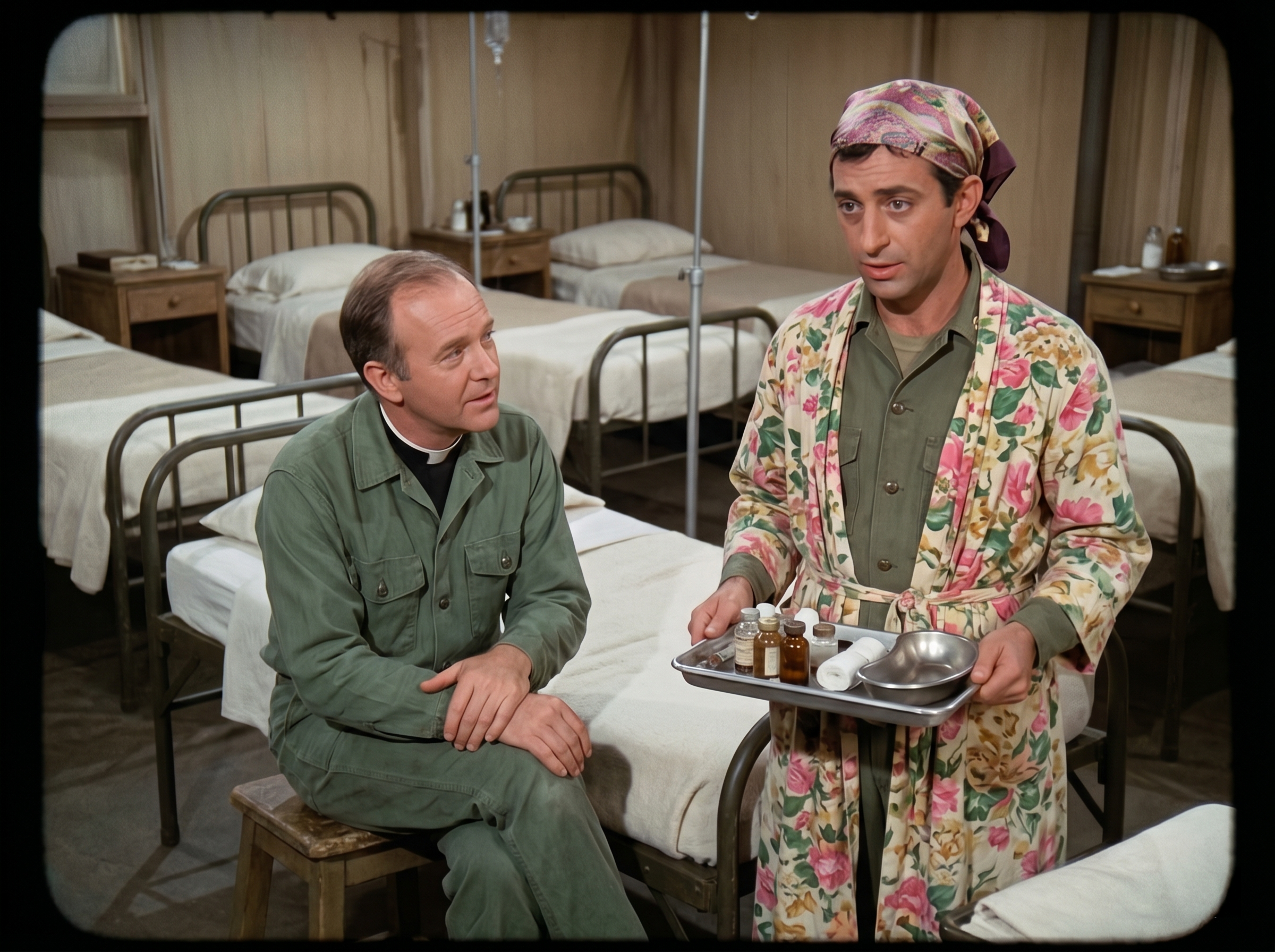
Then there were the quiet days. The deceptively peaceful days. The kind of days where the heat was your main enemy, and the biggest problem on your plate was finding a clean sock or a decent cup of coffee. It was on one of these silent, humid afternoons that Corporal Maxwell Klinger, clad not in his finest chiffon but in a surprisingly vibrant floral silk bathrobe and matching headscarf over his uniform, was walking—or rather, slinking—through the Post-Op ward.
He wasn’t exactly on the job. His main priority this afternoon was making his way to the Swamp before Hawkeye and B.J. noticed he was missing. Klinger, a man known to wear feather boas to staff meetings, was surprisingly nimble when it came to avoiding work, especially the kind that involved mopping the Swamp, which he suspected the doctors only invented to torture him.
But luck, as it so often did for Klinger, took a sharp left turn. Directly in his path, seated calmly on a simple wooden stool next to an empty bed, was Father Mulcahy.
The Father was just sitting there, quietly mending a worn sock. His brow was slightly furrowed with concentration, his collar impeccably pressed despite the sweltering heat, and he looked up as Klinger approached, his gentle smile instantly dissolving any hope of an easy escape.
“Afternoon, Klinger,” Mulcahy said, his voice soft and kind, cutting right through Klinger’s momentum. “Are you coming from the operating room?”
Klinger froze, mid-stride. He could have sworn the floral pattern on his bathrobe shifted with embarrassment. He wasn’t coming *from* the operating room, of course. He was coming *away* from it.
But Klinger, ever the quick thinker, pivoted instantly. He smoothed down his colorful robe, stood a little straighter, and offered his best, slightly-too-earnest smile. He couldn’t just *be* caught shirking. He had to be caught *being useful*.
“Actually, Father,” Klinger said, his voice dropping an octave, “I was just doing a little inventory. Checking on supplies. You know, making sure the doctors have everything they need to… save lives. It’s a dirty job, but someone’s got to do it.” He held up a metal kidney basin he was holding, which currently contained a small glass bottle of eye drops, a roll of gauze, and one remarkably sad-looking, slightly soft orange.
Mulcahy looked from Klinger’s elaborate floral attire to the solitary, bruised orange in the basin, his expression neutral. The Father, of course, knew Klinger better than Klinger knew himself. He knew about the Section Eight attempts, the dresses, the scarves, and the absolute refusal to accept the reality of the war. But he also knew about the fierce, unexpected loyalty, the moments of surprising competence, and the genuine heart buried beneath all that polyester.
“Ah,” Mulcahy said, his eyes crinkling. “A thorough inventory, indeed. Tell me, Klinger, does that single, somewhat listless orange hold a strategic military significance that I’m unaware of?”
Klinger glanced down at his tray. For a second, he looked genuinely distressed. “Well, no, Father. I mean, yes. I mean… it’s for moral support. You know, vitamin C. A little taste of home. I was going to… give it to… someone.”
“Someone?” Mulcahy prompted, his head tilted slightly to the side.
Klinger looked at Mulcahy, and in that moment, the elaborate fabric of his daily charade began to fray. He looked around the Post-Op ward, at the empty beds, at the silent machinery, at the quiet sunlight filtering through the window, highlighting the dust motes in the air. This place—this whole, impossible, beautiful, awful place—felt suddenly heavy. He wasn’t just a guy in a dress avoiding work. He was a guy *here*, in a war, surrounded by broken bodies and broken dreams, clinging to a slightly soft orange like it was a lifeline.
Klinger felt the Father’s kind eyes watching him, waiting not for a lie, but for the truth that Klinger himself only just realized. The defense, the swagger, the easy humor—it all evaporated.
He looked back down at the tray, at the sad little orange. “Father,” Klinger said, his voice quiet, almost cracking, “I just… I just wanted to feel like I was *doing* something. Not just… waiting. Waiting for the choppers. Waiting for the next wounded. Waiting for a letter from my mother, which, by the way, still hasn’t come.”
He took a breath. “Yesterday, a boy came through. Nineteen years old. From Toledo. He was delirious, calling out for his wife, and all he could talk about was how he’d just planted an orange tree in their backyard before he left. He said he promised her he’d be back before it bore its first fruit.”
Klinger’s hand, which was holding the tray, was trembling slightly. The floral pattern of his robe didn’t look vibrant anymore; it looked like a cry for help. “I just found this orange in the supply tent. It’s not much. It’s practically bruised. But for a minute, when I picked it up, it felt like… it felt like hope. Like the world hadn’t completely fallen apart. Like somewhere, there was still sunlight and growing things, and not just mud and blood and the constant stink of antiseptic.”
He looked up at Mulcahy, his eyes bright with unshed tears, completely exposed. “I know I’m a joke, Father. I know I wear these clothes and I make a fool of myself, and all I talk about is leaving. But sometimes… sometimes it’s just so hard. To remember that we’re human. To remember that there is something *else* waiting for us, if we can just hang on long enough.”
He gestured with the tray towards the empty beds. “I wanted to give this orange to the boy from Toledo. But he didn’t make it. The choppers were too late.”
The silence that followed was absolute. The soft whir of the ceiling fan felt deafening. Father Mulcahy looked at Klinger, seeing past the floral robes, past the scarf, past the bravado. He saw a man struggling, a man who, like all of them, was just trying to keep his head above water in a sea of impossible sorrow.
Mulcahy stood up slowly, putting down his mending. He didn’t offer platitudes or easy prayers. He walked the few steps over to Klinger, who was now holding the tray with both hands, his head bowed.
Gently, Mulcahy reached out and took the tray from Klinger’s hands. He set it down on the empty bed nearby. Then, he picked up the bruised orange. He looked at it, feeling its soft skin, seeing its imperfection.
“Klinger,” Mulcahy said, his voice low and steady, “you are not a joke. You are a man who cares. Deeply. And that, in this place, is perhaps the most dangerous and brave thing you can be.”
Mulcahy rolled the orange gently between his palms. “We all find our ways to cope. Some of us hide behind humor. Some behind scotch. You hide behind silk and chiffon. But you are not hiding from your heart.”
He offered a soft smile. “You were trying to bring a moment of peace to a dying boy. You wanted to give him a taste of the future he would never see. That is not a small thing, Klinger. That is a truly merciful act.”
The Father took the orange and held it out to Klinger. “Keep it. Don’t give it to anyone. Let it remind you that even in the midst of this darkness, there is still sweet fruit to be found, and people who care, and a future to look forward to. And perhaps, the next time the choppers come, you can look at this orange and know that the world is still turning, and that we must all hold on.”
Klinger looked at the orange in Mulcahy’s hand, then up at the Father’s kind, wise eyes. A tear finally escaped, tracing a path through the dust and fatigue on his face. He slowly reached out and took the orange, cradling it in his hand as if it were made of glass. It wasn’t soft anymore. It felt heavy, and solid, and real.
He took a deep, shuddering breath and managed a small, genuine smile. “Thank you, Father. I will.”
Mulcahy nodded once, a gesture that was both a reassurance and a gentle command to carry on. He went back to his wooden stool and picked up his mending.
Klinger stood there for a moment longer, alone in the Post-Op ward, holding a bruised orange. He smoothed down his colorful robe, tucked the orange into a hidden pocket, and walked out. But he didn’t slink. He didn’t look like he was avoiding anything. He walked with purpose, back towards his post, and for the first time in a long time, the weight of the world felt just a little bit lighter, and the phantom sound of the chopper blades a little less deafening, for in a quiet corner of the war, God was watching, and he knew they were just doing their best to hold on.
In the end, all we have is each other, and the small, brave acts of hope we choose to share.