The Soft Chime of a Dented Metal Cup
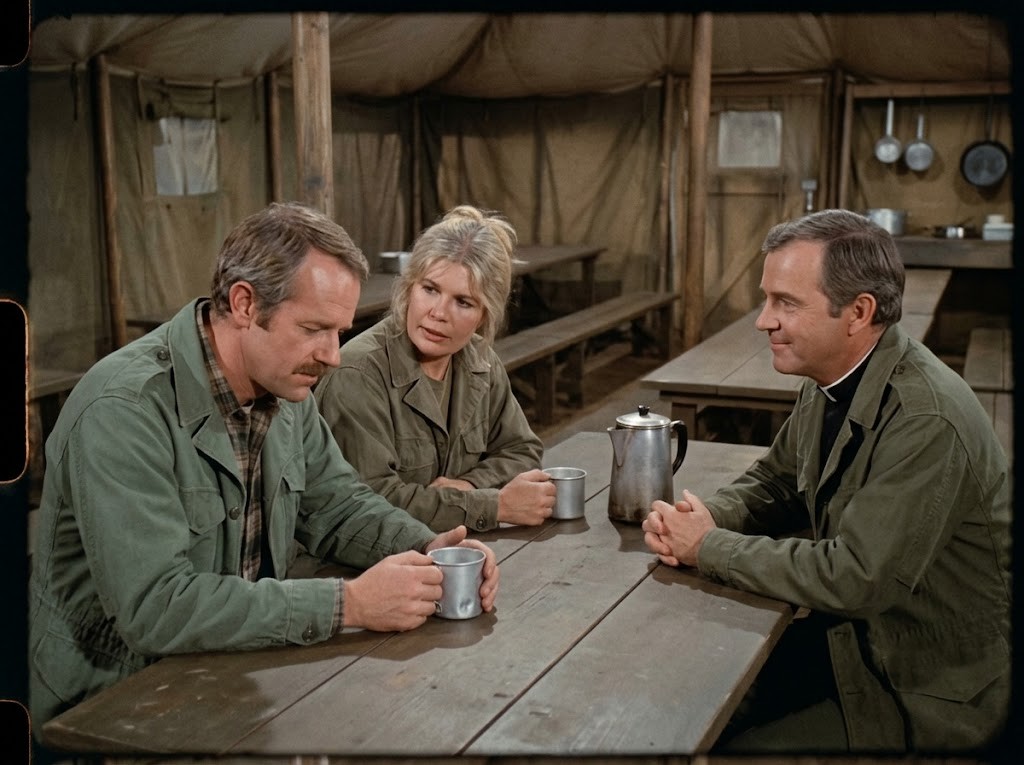
The rain had finally stopped, leaving behind that thick, heavy silence that always seemed to settle over the 4077th after a grueling forty-eight-hour shift in Post-Op. Inside the mess tent, the air smelled of stale, burnt coffee and damp canvas. The benches were mostly empty, save for three figures clustered at the end of a long wooden table, huddled around a single battered tin percolator like it was an ancient camp fire.
B.J. Hunnicutt stared down at his metal mug, his fingers wrapped tight around its dented rim. His eyes were heavy, framed by the deep, dark lines of exhaustion that no amount of sleep could quite wash away. Next to him, Margaret Houlihan sat with her jacket collar turned up, her blonde hair pinned back loosely, lacking its usual crisp, military perfection. Across the table sat Father Mulcahy, his gentle face wearing a soft, knowing smile that always seemed to offer comfort, even when he hadn’t spoken a single word.
They had been sitting in total silence for twenty minutes, too drained to speak, too tired to even walk back to their tents.
“You know,” B.J. muttered, his voice barely louder than a whisper, his thumb tracing a deep nick in the aluminum. “Back in Mill Valley, a cup of coffee meant something completely different. Peg would buy these whole beans. We’d grind them by hand on Saturday mornings, and the whole kitchen would smell like a future you actually wanted to live in.” He paused, staring into the dark, murky liquid. “This stuff just tastes like melted jeep tires.”
Margaret looked up, her expression softening as she studied the slump of B.J.’s shoulders. The usual sharp, commanding edge of Major Houlihan was entirely absent, replaced by the quiet vulnerability she only showed to the few people who truly knew the weight she carried. “It’s the water, Honeycutt,” she said softly, her voice lacking any of its usual regulatory bite. “The local water has too much sulfur. Even the mess cooks can’t completely boil the war out of it.”
Father Mulcahy folded his hands on the table, looking between the two of them with immense tenderness. “I often think it’s not the coffee itself, but the company that saves it,” he remarked, his voice a steady, calming anchor in the quiet tent. “In the parish back in Philadelphia, the ladies of the altar society would make a brew so terribly weak you could read the parish bulletin right through the bottom of the porcelain cup. But nobody ever complained. They came for the fellowship. They came to feel like they belonged to something larger than their own small troubles.”
B.J. let out a dry, breathy chuckle, though his eyes remained fixed on his hands. “Fellowship is fine, Father. But right now, I’d trade my soul for a clean ceramic mug and a piece of my wife’s crumb cake.” He sighed, his grip tightening. “Sometimes, you look down at a piece of metal like this, and you realize everything out here is temporary. Everything is dented. Everything is just waiting to be scraped down or discarded.”
Margaret reached out, her hand resting on the wooden table just inches from B.J.’s cup. “Don’t talk like that, B.J. We aren’t discarded. We’re just holding the line.”
“Are we?” B.J. asked, finally raising his eyes to meet hers. His gaze was bright with an unspoken, heavy grief that had been building since the last chopper landed at dawn. “Because this morning, when we were closing up that boy’s chest… I looked at his chart, Margaret. He was born in 1934. He’s just a kid. And I looked down at my hands, and for a split second, I couldn’t remember what my daughter’s face looked like without looking at the photograph in my wallet.”
The admission hung in the damp air of the mess tent, heavy and suffocating. Margaret froze, her lips parting slightly, her professional armor completely slipping away as she saw the sheer depth of the fracture in B.J.’s usually unshakeable demeanor. Even Father Mulcahy’s smile faded into a look of profound, aching concern as B.J.’s hands began to tremble slightly against the cold, gray metal of the mug, threatening to spill the bitter coffee across the scarred wood.
The silence that followed was different from the one before; it was the fragile silence of a dam about to burst. Margaret looked away for a second, her own eyes blinking back a sudden, fierce sting of tears. She knew that feeling—the sudden, terrifying void where home was supposed to be, swallowed up by the endless, repetitive rhythm of the scalpels and the stretchers.
Before the tension could break into tears, Father Mulcahy reached across the table. With a deliberate, gentle movement, he tapped the side of his own tin cup against B.J.’s.
*Clink.*
The small, metallic sound echoed cleanly through the empty mess tent. B.J. blinked, startled out of his dark thoughts by the sudden noise. He looked up at the priest.
“A simple reminder,” Mulcahy said, his voice ringing with a quiet, undeniable strength. “That cup is dented, Captain, because it has been used to keep a man warm. It has survived the journey here, just as you have. And the dents don’t make it less useful; they just prove it has a history of service.”
B.J. looked down at the mug, then back at Mulcahy. A faint, rueful smile began to tug at the corner of his mustache. “Did you learn that in seminary, Father, or do you just make it up as you go along?”
“A little of both,” Mulcahy admitted, his gentle smile returning, crinkling the corners of his eyes. “Though I believe Saint Augustine had a few thoughts on the resilience of old kitchen utensils, if one reads between the lines very carefully.”
Margaret let out a genuine, soft laugh, the tension leaving her shoulders in a long, slow breath. She picked up her own cup, raising it an inch off the table. “To the 4077th,” she said, her voice steady and clear. “Where the coffee is terrible, but the people are entirely irreplaceable.”
B.J. looked at Margaret, seeing the fierce, protective loyalty in her eyes—the same loyalty that kept her standing over operating tables until her ankles swelled, ensuring every single nurse under her command did their duty with pride. He looked at Mulcahy, whose quiet bravery was the invisible spine of the entire camp, absorbing everyone else’s sins and sorrows without ever asking for anything in return.
He realized then that he hadn’t forgotten Erin’s face at all. The love he felt for his family back in California wasn’t fading; it was the very thing driving the exhaustion, the very thing making the pain hurt so deeply. And these people sitting with him in the damp canvas tent were the ones keeping that love alive, shielding the spark when the wind blew too hard.
B.J. raised his cup, his hand completely steady now, and tapped it against Margaret’s, then against the Father’s.
“To the 4077th,” B.J. echoed, his voice warm and grounded once more. “May we all live long enough to drink out of porcelain again.”
They drank their bitter, sulfur-tainted coffee in a new kind of silence—a comfortable, shared warmth that didn’t need words to fill the spaces. Outside, the distant, faint rumble of artillery could still be heard along the hills, a reminder of the world they were trapped in. But inside the mess tent, around a battered wooden table, three friends sat close together, finding a strange, beautiful kind of home in the very worst place on earth.
Pull up a bench, pour yourself a cup of whatever is in the pot, and remember that we never truly walk through the mud alone.