The Small Truth Beneath the Paper Mountain
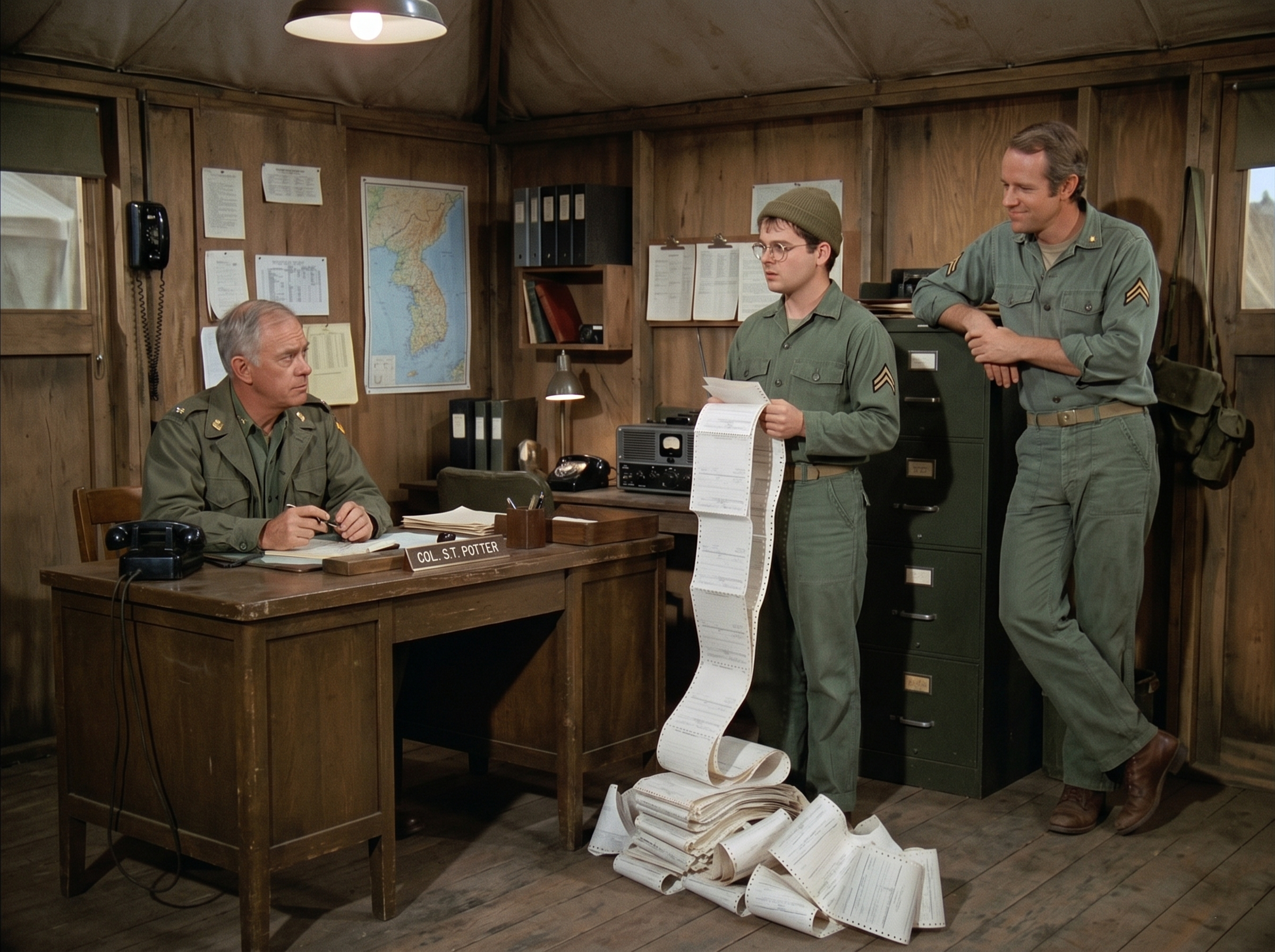
If there was one thing you could count on at the 4077th, besides the endless stream of wounded and the questionable quality of the gin, it was that bureaucracy always found a way to become an architectural marvel.
It usually started with a small, innocent query from Seoul or Tokyo.
This time, it was a teletype that required immediate and comprehensive inventory and usage reporting.
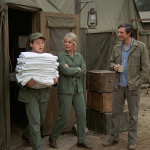
That morning, Radar O’Reilly found himself standing in Colonel Potter’s office, clutching a paper avalanche that seemed determined to reclaim the landscape of Korea.
It was a continuous feed printout, a massive, uncooperative beast of paper that piled from the teletype machine onto the wooden plank floor.
It formed a respectable, and entirely ridiculous, mountain range between Radar and the Colonel’s desk.
Radar was holding the first few yards, his small hands dwarfed by the sheer volume.
His glasses slid down his nose as he looked from the stack to the Colonel.
“It’s… quite detailed, sir,” Radar managed to say, his voice lacking its usual efficiency.
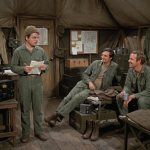
Colonel Potter sat behind his nameplate, his jaw tight. He looked tired, his gaze moving between the map of Korea on the wall and the paper mountain.
He had expected a report, but not an archive.
He had a pen in hand, as if ready to sign off on the war, but now he just looked defeated.
Leaning casually against the filing cabinets, watching the spectacle with a faint smirk, was Captain B.J. Hunnicutt.
He’d arrived for his own dose of daily bureaucratic purgatory, only to find Radar in a papier-mâché pickle.
He crossed his arms, enjoying the absurdity of it, but also sensing the creeping fatigue settling over Potter.
“A few months of data, I thought, maybe a few weeks,” Potter grumbled. “What is this, O’Reilly, the entire history of cotton swabs since 1912?”
Radar didn’t know whether to salute or apologize. He stood there, frozen.
The paper mountain gave a soft, ominous crinkling sigh.
B.J. finally broke his silence. “I think the teletype machine just achieved sentience and decided to write a epic poem about paper clips, Colonel.”
The tension in the small, canvas-ceilinged office was thick with the scent of old paper and dust.
Potter squeezed the bridge of his nose. “Just read me the high points, O’Reilly. Or better yet, tell me there’s a typo and this is the entire supply list for the 1st Cavalry.”
Radar didn’t move. He looked down, his knuckles white, and that’s when the paper mountain gave a final, fatal crumple.
The resulting paper slide was soft and pathetic, yet it felt like a total collapse.
A large section of the teletype ream folded in on itself and spilled closer to the desk, covering the floor in another layer of bureaucratic dread.
B.J.’s smile faded. He saw the sheer weight of work it represented for Potter.
Colonel Potter stared at the pile, then at Radar, and a long, tired exhale escaped him.
“Alright, son, let’s take a look. But if this list requires me to inventory the different kinds of mud on my boots, I’m declaring this teletype a casualty.”
Radar tentatively moved around the new pile.
He found the very end of the roll, which was surprisingly manageable.
It didn’t contain an endless list.
It was a single page, a summary attached to the massive, context-building bulk.
He adjusted his beanie and his glasses. “Sir… I think this might be it. The summary paragraph.”
Potter leaned forward. “Let’s hear it. And make it quick. My coffee is getting cold.”
” ‘SUMMARY OF REPORT PROTOCOLS AND ADMINISTRATIVE CHANGES AS PER THE ABOVE-MENTIONED VOLUME:’ ” Radar read with earnest gravity.
” ‘1. All personnel are reminded to use both sides of official forms when possible. 2. Jeep windshields should be washed weekly. 3. Please submit all data analysis by noon tomorrow. Signed, I-Corps, Administration.’ ”
He finished and looked up at the two officers, the massive context for those three bullet points still piled on the floor.
The silence that followed was heavy with a profound and specific kind of bureaucratic exhaustion.
B.J. broke it with a slow, wry chuckle that started in his chest.
Potter’s face went through three distinct expressions of disbelief, frustration, and final acceptance.
He finally just leaned back, a small, weary smile breaking through his serious expression.
He looked at B.J. and then back to Radar.
“So, the teletype machine didn’t want a poem, Hunnicutt. It just wanted us to know that paper has two sides. A lesson I’m sure it learned itself.”
He looked at the mountain of paper on the floor. “Radar, use this… context… for whatever you want. Wrap sandwiches. Cover the operating room floor. Just make it disappear.”
The moment was a quintessential 4077th scene.
They’d found a single, small bean of useful administrative change amidst a vast field of bureaucratic waste.
They hadn’t won a battle or solved the war, but they had shared a moment of human fatigue and shared humor.
A moment of tenderness as Radar folded the single sheet of the ‘important’ stuff, and B.J. gave a silent nod of acknowledgement to Potter.
The war would continue, but they had handles on this problem. Together.
The sun was high outside, but in that office, the single bare bulb still cast warm, nostalgic light on the paper mountain and the small, human victories that made life at the 4077th possible.
It was just a Tuesday, but it felt like a victory.