The Quiet Ache of Meatloaf on Tuesday
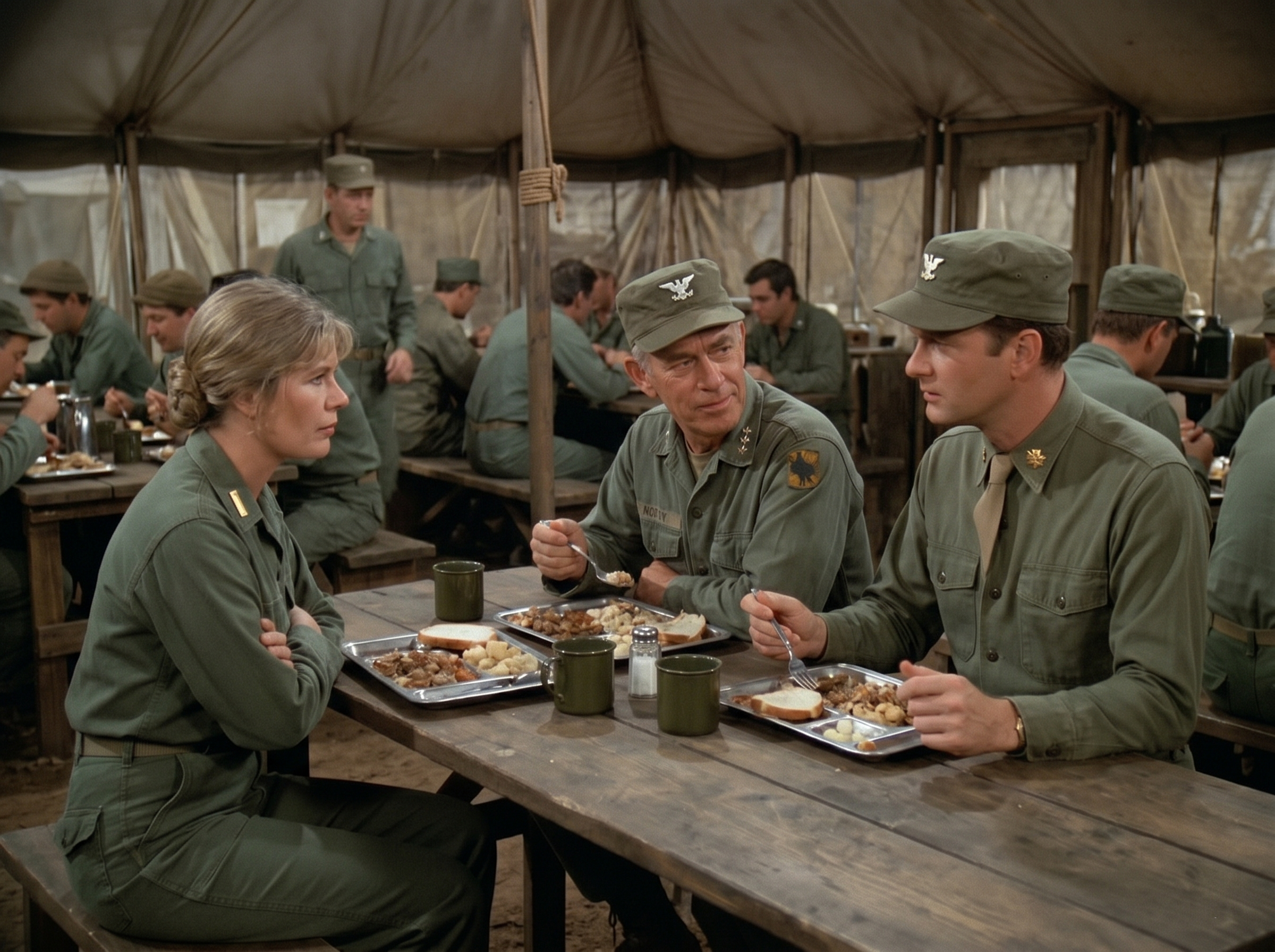
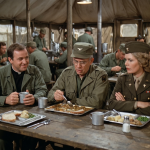
The air in the mess tent always hung heavy, a thick blanket woven from the smell of burnt coffee, stale bread, and the collective fatigue of a hundred weary souls.
It was Tuesday, which meant meatloaf, an culinary event that ranked somewhere between a hangnail and artillery fire on the camp’s morale index.
The constant hum of conversation, punctuated by the clatter of metal trays and the occasional bark of laughter, provided a familiar backdrop to the night.
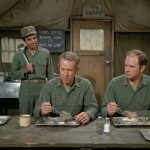
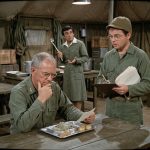
A camera, if one were rolling, would capture a rare still moment amidst the chaos, focusing on one table where the weight of command sat breaking bread.
Colonel Sherman Potter sat at the head, the eagle on his cap slightly askew from a twelve-hour shift that had only just ended.
Opposite him was Major Margaret Houlihan, her posture as sharp as a scalpel despite the exhaustion etched around her eyes, arms crossed tightly over her chest as if holding herself together.
And to his right sat Major Charles Emerson Winchester III, his expression caught between existential dread and a detailed critical analysis of the ‘beef product’ on his tray.
They were a found family of high-ranking misfits, bonded by proximity and the relentless demand for their surgical skills, now simply trying to replenish their reserves.
Potter had been speaking, his voice a low rumble that usually carried a comforting predictability.
But tonight, his tone was different, carrying a resonance that cut through the background static of the tent.
He wasn’t talking about logistical snafus or the rising casualty counts that defined their existence.
He was talking about silence.
“You know, when I first got my commission,” Potter said, gesturing with his fork, “I thought leadership was about filling the quiet.“
“Giving orders, making noise, making sure everyone knew you were the one driving the bus.“
He paused, looking not at his companions, but through them, past the canvas walls toward something only he could see.
“But in this place… I’ve learned that the hardest thing to lead is yourself when the quiet hits.“
Margaret uncrossed her arms slightly, her gaze dropping to her tray.
Charles, who had been readying a sarcastic rejoinder about the ‘leadership required to stomach this meal,’ went silent instead, the retort dying on his lips.
The background noise of the mess tent seemed to recede, leaving only the soft hiss of the Coleman lanterns illuminating their faces.
They all knew the quiet Potter was referring to—the devastating lull that followed a heavy OR shift, when the adrenaline faded and the humanity rushed back in.
“That last boy,” Margaret whispered, her voice uncharacteristically small. “He just wanted his mother. Not a doctor. Just his mother.“
Charles cleared his throat, a sudden, sharp sound.
“Yes, well,” he said, the haughty edge softer than usual, “I believe the young man is comfortable, Houlihan. Thanks to our… acceptable efforts.“
Potter just looked at them, his eyes steady, seeing right through their defenses, knowing that Margaret was holding back tears and that Charles was hiding his own empathy behind his arrogance.
“Comfortable,” Potter repeated softly. “We gave him that. But who gives it to us?“
The question hung over the table, heavier than any artillery shell, breaking the fragile truce they maintained with their own emotions.
The silence deepened, stretching taut between them until it threatened to snap.
Potter didn’t rush to fill it this time; he simply waited, a father giving his children the space to process what they were all feeling.
Margaret stared at her untouched meal, her lips pressed into a thin, tight line.
She hated showing vulnerability, hated that a simple question from the Colonel could strip away the Major Houlihan facade so easily.
She was the Head Nurse, the steel girder of the 4077th, and girders did not crack over meatloaf on Tuesdays.
“We find it where we can, Colonel,” she finally said, her voice stronger now, though still tinged with weariness.
She finally picked up her fork, stabbing at a potato with a little too much force.
“Sometimes, it’s just knowing the shift is over. Or seeing the supply truck bring in a new batch of penicillin.“
“Or sometimes,” she admitted, risking a fleeting glance at both men, “it’s just sitting here. Not having to explain why my hands are shaking.“
Charles watched her, his complex expression softening further.
He despised the mediocrity of his surroundings, the unrelenting dust, the abysmal food, and the lack of proper intellectual stimulation.
But he did not despise the people sitting with him, though he would sooner eat this entire tray of meatloaf than admit it to their faces.
“Well said, Houlihan,” Charles murmured, dropping the ‘Major’ as he often did in these quiet, late-night detentes.
He finally brought his own fork to his mouth, tasting the food with visible disdain, though he swallowed it without complaint.
“If one must endure this barbarism, at least one is doing so in… non-barbaric company.“
It was a classic Winchester compliment, wrapped in layers of condescension, but coming from him, it was a profound statement of loyalty.
Potter smiled, a tired but genuine expression that crinkled the corners of his eyes.
“That’s just it, isn’t it? The quiet is terrifying because it forces us to remember what we’re missing.“
“But the noise… the noise is what keeps us sane. This noise.” He waved his hand, including the whole rowdy tent.
“Knowing that we aren’t alone in this muddy hellhole.“
The background chatter of the mess tent swelled around them again, transforming from a simple annoyance into a comforting chorus.
A waiter dropped a tray nearby, the clatter startling a few soldiers, who immediately began jeering good-naturedly.
In the distance, they could hear the distinctive laugh of Hawkeye Pierce, loud and abrasive, probably telling a joke that was entirely inappropriate for a superior officer to hear.
It was chaotic and vulgar, and utterly beautiful.
“It’s a strange comfort,” Charles mused, swishing the lukewarm coffee around in his green plastic mug.
“One trades the refined silence of Boston for the cacophony of Korea, only to find solace in the very disruption.“
“Nonsense, Charles,” Potter replied, finally taking a real bite of his dinner. “It’s not the noise, it’s the heartbeat.“
“This place has a heartbeat, louder than any artillery. And as long as we can hear it, we know we’re still alive.“
Margaret looked from Potter to Charles, a subtle, relaxed shift settling in her shoulders.
For the first time in hours, the tension on her face truly cleared.
She picked up her own mug, offering a silent toast that needed no words.
“To the heartbeat,” she said softly, just loud enough for the two men to hear.
“To the heartbeat,” Potter and Charles responded in unison, their voices blending for one brief, harmonious moment.
They finished their terrible meal in silence, but it was a different silence than before—not empty and cold, but shared and warm.
The camera, if it were rolling, would capture them returning to the roles they were expected to play as they finally rose from the table.
Margaret checking her watch, her commanding posture returning.
Potter adjusting his cap, the fatherly wisdom receding behind the shield of a Colonel.
Charles dusting a non-existent speck from his fatigue jacket, already preparing a complaint about the upcoming opera schedule.
They would return to their tents, to the memories of patients they saved and patients they lost, and the ever-present ache for home.
But tonight, for a few precious minutes amidst the smell of bad meatloaf and canvas, they had remembered the most important lesson the 4077th had to teach them.
That humanity, like water, always finds a way, even in a desert of dust and despair.
They say you can never go home again, but sometimes, for a few fleeting minutes, home was exactly where you were needed most.