A Quiet Page of Peace in the Mess Tent
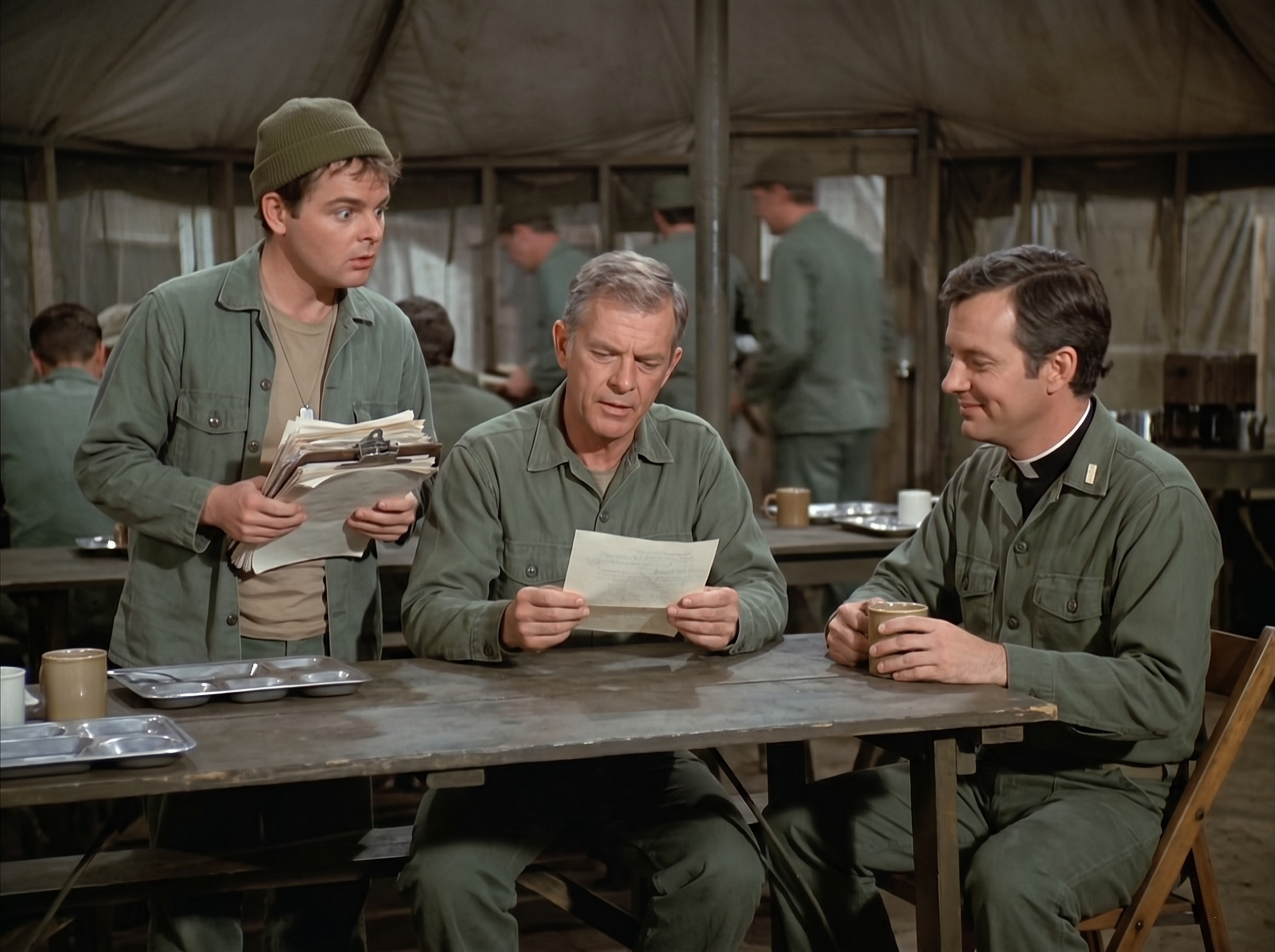
If there was one time of day you could almost set your watch by at the 4077th, it was the brief lull between breakfast and the start of the morning shift. The frantic energy of the day was still gathering, leaving only the clatter of the kitchen and the hushed murmurs of the truly exhausted. At one specific table, the heart of the camp beat in a quiet, synchronized rhythm that nothing else in Korea could touch.
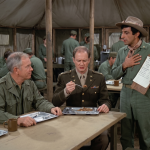
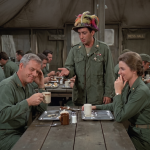
Colonel Potter sat with his back to the wall, his steady hands holding a cup of the lukewarm, grey coffee that defied both nature and human effort. Father Mulcahy was beside him, his gaze soft as he watched the few other soldiers drift through the room. They weren’t speaking; they rarely had to. In these minutes, the silence itself was a comfort, a shared sanctuary built of mutual understanding.
“I think the cook is trying a new technique this morning, Colonel,” Mulcahy said, his voice just above a whisper, breaking the quiet tenderness. “The oatmeal seems… distinctly translucent.”
Potter’s face, etched with decades of military life, barely twitched. “God help the men if he starts focusing on clarity rather than nutrition, Father. We may all just vanish into our uniforms.”
Their quiet exchange was broken by the sound of boots on the canvas floor. It was a familiar, eager gait that only one person in the camp possessed. Radar O’Reilly was approaching from the back of the mess tent, moving with his trademark focus. The usual stack of clipboards was tucked securely under his arm, and his khaki beanie was adjusted just so.
He was looking down as he walked, his brow slightly furrowed in deep concentration. Then, without warning, his entire being changed. It was as if a bolt of electricity had traveled straight through his body. His eyes went wide with a specific kind of stunned surprise that was instantly recognizable to anyone who knew him. He looked up at Colonel Potter with a look that was part shock, part absolute wonder.
“Radar, son,” Potter said, watching him. “Is something wrong? Did the supply sergeant finally crack and try to pawn off the entire stock of powdered eggs?”
Radar stopped at the edge of the table. He stood there, his arms rigid as he held the stack of papers, his wide eyes glued to a single sheet at the top of the bundle. His mouth was open slightly, but no sound was coming out. He looked absolutely speechless, which was the most terrifying state a Radar could be in.
Mulcahy leaned forward slightly. “Corporal? You look as though you’ve seen a ghost.”
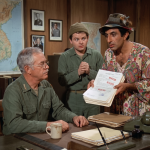
Radar finally found his voice, but it was just a shaky squeak. “Colonel… I think… I think it’s finally happened.” He lifted the top clipboard and extended it toward Colonel Potter with a trembling hand, the paper rustling in the stillness.
Colonel Potter hesitated for only a fraction of a second. He read Radar’s face, and what he saw there gave him pause. This wasn’t the look of bad news or an upcoming crisis. This was different. He reached out and gently slid the single piece of paper from Radar’s hand.
It was a standard-issue military document, stamped and signed in triplicate, just like the thousand other papers that crossed his desk every month. The ink was faded and the corners were slightly curled, but the words were perfectly legible. Colonel Potter held it up, adjusting his gaze. He began to read, his eyes moving quickly across the simple lines of text.
His face softened. The lines of frustration that often settled in his brow seemed to smooth themselves out. For a brief, surreal minute, the war and the camp didn’t seem to exist. The look that replaced it was one of pure, quiet joy.
Mulcahy watched him intently, his own face mirroring the growing softness he saw in the Colonel’s. “What is it, Colonel?” he asked, his voice low and respectful.
Potter didn’t answer immediately. He seemed to need a moment just to absorb what he was reading. He looked up, first at Mulcahy, then back at Radar, whose own expression was still one of wide-eyed astonishment. A slow smile spread across Potter’s face, one of the genuine smiles he saved for his best men.
“This is it, Father,” he said quietly. “It’s a directive from General Clayton’s office.”
Radar was now bouncing slightly on the balls of his feet, unable to contain his excitement. “Yes, sir!” he chirped, finding his normal high-octane energy. “It’s the experimental requisition form! The one we filed eight months ago!”
Potter looked at Mulcahy again, his expression priceless. “Eight months,” he said, shaking his head. “And what do you suppose it is? New surgical gloves? Fresh plasma bags? Better anesthetic?”
Mulcahy looked genuinely curious. “I’m almost afraid to ask.”
Potter’s smile widened as he held the paper up to his face again. “None of the above, Father. According to this signed and authorized order, the U.S. Army, in its infinite wisdom, has officially shipped us… six very specific packages of Grape-Nuts cereal.”
There was a moment of silence in the mess tent. Mulcahy blinked, then his eyes twinkled with a warm, gentle humor. He leaned back, his gaze shifting from the Colonel to Radar. The sheer absurdity of the whole thing was perfect. Eight months of red tape for cereal.
“I can almost taste the gravel now,” Potter said, his voice a rich chuckle. “But after all this time, the bureaucracy finally delivered exactly what we asked for, with no substitutions.”
Radar was grinning from ear to ear. “I already found ‘em, Colonel! They’re down in the supply room! They’ve been sitting there since last Thursday, but nobody knew what to do with the paperwork! I have one package here!” He patted his stack of clipboards as if the cereal box were tucked underneath.
Potter sat back, his hand relaxing and the paper resting on the table. The image of those six packages, sitting in a cold tent, was a ridiculous victory. It wasn’t about the cereal, of course. It was about the unexpected warmth of that small, pointless act of delivery. It was about the fact that they could still laugh about the very silliness of the army that was fighting the war around them.
The tension in the tent was gone, replaced by a quiet, shared feeling of tender companionship. Mulcahy chuckled warmly. “I believe that is the closest we will come to a miracle today, Colonel. And on a Monday morning, no less.”
Potter reached out and lightly tapped the paper on the table. “You know, Radar,” he said, his voice filled with an unexpected quiet tenderness, “it’s a very small thing in the grand scheme of the universe. But right now, on this specific morning, in this specific tent? Those six packages of Grape-Nuts feel exactly like a victory.”
Radar just nodded, his smile soft and genuinely happy. He knew exactly what the Colonel meant. He put his clipboards under his arm and made to leave the table, heading back to his office. He’d probably spend the rest of the day finding the absolute perfect place to hide the cereal until they were ready to eat it.
Father Mulcahy picked up his coffee cup and took a long, thoughtful sip. “It’s good to remember that even in a place like this, some things are worth waiting eight months for.”
Colonel Potter didn’t say a word. He just picked up his own grey coffee, held it steady, and shared a look with Mulcahy that said everything that needed to be said. And for that moment, in the middle of a war, that little page of paper was all the comfort they needed.
It was just a piece of paper, but it proved that even in Korea, the warmth of human connection was always closer than it seemed.