The Map and the Mug: A Quiet Hour at Rosie’s
If there was one thing that tied this entire sprawling madhouse of a camp together, it wasn’t the OR, the jeep engines, or even Klinger’s collection of evening gowns.
It was the dust. The fine, grey dust of Korea, a pervasive presence that seemed to have a personality of its own.
In the 4077th, that dust was a stubborn roommate. You couldn’t sweep it out, you couldn’t scrub it off, and you couldn’t ignore it. It settled on the surgical masks, coated the inside of the coffee cups, and clung to everything—and everyone—like a shadow.
And nowhere was it more present, or perhaps more appreciated, than in Rosie’s Bar. Rosie’s wasn’t just a watering hole; it was a sanctuary. The simple, plank-board interior felt familiar, smelling of stale beer and old wood.
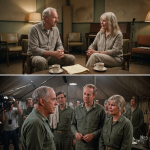
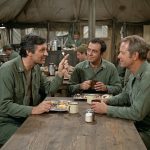
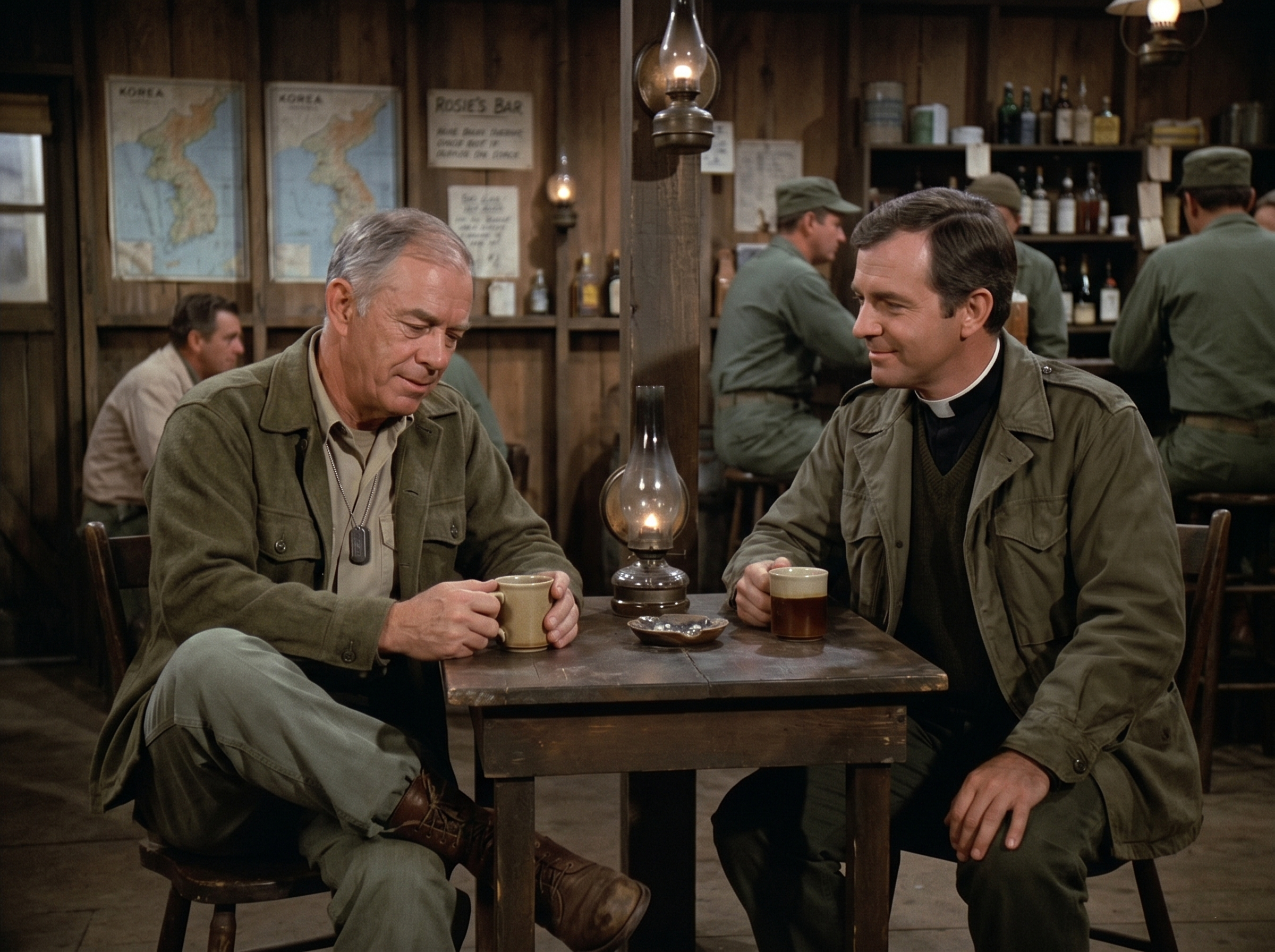
Tonight, the dust was settling in after another chaotic day. Colonel Sherman Potter sat at a sturdy wooden table, his worn face relaxed, his grey hair neatly swept. He wore his utility jacket, the fabric soft from years of use, and a few ribbons pinned to his collar.
He leaned slightly on one elbow, looking down at his coffee mug as if analyzing its contents. Opposite him, with a calm, patient smile, sat Father Francis Mulcahy. The priest wore his uniform jacket open, revealing the clerical collar underneath, and cradled his own ceramic mug.
Between them, on the rough-hewn table, sat a lit kerosene lantern, casting a soft, amber glow. It was a simple object, the lantern, yet in this dimly lit bar, it was a profound symbol of the humanity they were trying to protect. The glass chimney was a little smoky, catching the light in a warm, comforting way.
“This stuff,” Potter said, gesturing towards the liquid in his mug with a nod of his head. “Tastes exactly like the oil from my first Harley-Davidson.” He gave a dry chuckle.
Father Mulcahy laughed softly. “I’m sure it’s not that bad, Colonel. The water is filtered, I believe.”
“Believe whatever you need to, Father,” Potter said, finally picking up his mug. He caught a glimpse of the worn “ROSIE’S BAR” sign behind them and the maps of Korea pinned on the wall. “The only reason I drink this sludge is because I’m afraid what I might find in the bottom if I actually looked.”
He took a sip, then looked back at the maps. A quiet sigh escaped his lips. “Maps,” he muttered, shaking his head. “They tell you where you are, but never where you’re going.”
That was the thing. The maps were useful, showing supply routes and enemy lines. But they couldn’t map out tomorrow. They couldn’t show you the end of the war, the return home, or the moment the quiet would come back to their lives. The map was static, but the lives and the worry were constantly in motion.
“It’s difficult, isn’t it?” Father Mulcahy said gently. “Knowing everything you should, yet feeling so… uncertain.”
“Uncertainty is my job description, Father,” Potter replied, looking into the warm flame of the lantern. “That, and keeping this circus running. These kids…” He drifted off, his thoughts on the young faces he’d seen today. The fatigue, the fear, the humor that often masked it.
Just then, the door to Rosie’s swung open, and the general cacophony of the camp—a distant truck, the sound of laughter from the latrine—seemed to enter the room. Radar, looking small and earnest in his oversized jacket, rushed inside. He was carrying a clipboard and looking nervous, as only Radar O’Reilly could when delivering news.
His eyes scanned the bar, landing instantly on Potter and Mulcahy. He walked quickly to their table, standard-issue boot heels tapping on the floorboards.
“Colonel! Father! Sorry to interrupt,” Radar stammered, pulling a small, slightly crumpled piece of paper from his pocket. He placed it carefully on the table, right next to the lantern.
“Well, what is it, son?” Potter asked, his voice steady but a new tension tightening his shoulders. He didn’t touch the paper. Radar never brought non-urgent items to Rosie’s.
Radar looked from the Colonel to the Father, his expression open and worried. He opened his mouth, then paused. The quiet that settled over the table in that moment was profound, contrasting sharply with the energy in the rest of Rosie’s. It was the quiet that always came just before a storm.
Potter and Mulcahy held their breath. Everyone at the bar—Hawkeye and B.J. in the background, a few other soldiers—all of them seemed to sense the change in the air. The small light of the lantern suddenly felt very bright, and very fragile.
Radar looked at the crumpled piece of paper, the simple white rectangle resting by the light, and his words stuck in his throat. This wasn’t bad news, not really. This wasn’t about a casualty list or an ammo shortage.
But it was news that mattered. Radar swallowed hard, looking the Colonel in the eye, and whispered, “Colonel, they just posted the mail list.”
Potter felt a sensation wash over him—a weird mix of anticipation and dread that only the mail could deliver in this godforsaken place. The mail was a bridge to home, and home was a very complicated thought.
Radar, as if he needed to finish what he started, said, “Your wife, Missus Potter, her name is on the list, sir. And Father, you also have…” He looked at Mulcahy, the tension breaking just enough for him to smile slightly, “…well, looks like there’s something from your family too. And maybe a letter from a certain sister…”
He let the sentence hang, not quite managing the word ‘girlfriend’ in front of the Father. Radar always tried to maintain the appropriate level of awkwardness.
For a moment, the three men simply sat, the silence returning, but this time it was filled with the collective breath of their hidden hopes. The mail. It was a lifeline and a weapon, simultaneously. A letter from home could lift you off the floor, or it could deliver a blow from which you might not recover all week.
Hawkeye, standing at the bar, watched this exchange with keen eyes. “A mail list?” he said, his voice unusually subdued. He shared a look with B.J., who was rubbing his neck, looking tired but suddenly energized. “Well, that explains why I can’t stop my stomach from doing the jitterbug. Mail call.” He almost whispered the last word.
B.J. nodded. “Always a gamble, Hawk. One roll of the dice, and your world either spins forward or comes to a grinding halt.”
Back at the table, Colonel Potter cleared his throat. He picked up his mug again, the coffee now cold, and stared into the dark liquid. “The mail,” he said softly, a trace of warmth returning to his eyes. “Sometimes, Radar, you have a way of delivering exactly what’s needed, even if you do sound like a nervous chipmunk.”
Radar smiled, genuinely relieved. “Thank you, sir. I’ll just… get these forms filled out and… leave you two alone.” He saluted, a quick, earnest gesture, then retreated from the sanctuary of Rosie’s, leaving the clipboard, the paper, and a sudden sense of focus on the table.
Father Mulcahy picked up the small piece of paper Radar had left. It was a list, simple names and numbers, of people who were about to connect with home. He looked at his own name, then at Potter’s.
“It’s remarkable,” Mulcahy said, his voice hushed, looking back at the map pinned on the wall. “This piece of paper, this list, is arguably more important to us in this moment than that entire grid system. The maps show us the physical space, the territory. But this,” he tapped the list with his index finger, “this is our human terrain.”
Colonel Potter nodded, a rare, reflective smile finally breaking his professional mask. He looked at the lantern again. The smoke was still curling, the light still steady. “Well said, Father. Well said.”
He picked up the coffee mug, raising it in a small, symbolic toast towards the priest, towards the list, and perhaps, towards the maps. “To the human terrain,” Potter said quietly, clinking his mug against Mulcahy’s. “May it guide us all home, eventually.”
“To home,” Father Mulcahy echoed, his smile warm and nostalgic. “God willing, to all our homes.”
They drank their cold coffee in comfortable silence. Around them, Rosie’s Bar buzzed with the new energy that always accompanied the news of the mail list. Friends argued playfully over who would get the best package. Someone finally cracked a joke about Klinger’s latest dress, the laughter now light and easy.
B.J. and Hawkeye, still at the bar, clinked their own beer bottles together, their conversation a little brighter. The tension of the day, the dust, and the war were all still present. But in that moment, the mail list offered a beacon. It was a reminder of why they were here, and why it was worth trying to keep the dust—mental and physical—out of their coffee and out of their hearts.
The soft light of the lantern continued to burn, an unchanging presence in the face of uncertainty. The map of Korea, with its rivers, mountains, and dotted lines, remained tacked to the wooden wall, as static as ever. But in that small corner of Rosie’s Bar, in the company of a shared moment, the uncertainty didn’t feel so insurmountable.
It was just another day at the 4077th. But it was a good day. And tomorrow, with luck, a letter from home would make it even better.
Potter set down his mug, the contents empty now. He stood up, the old aches of a general-officer-turned-camp-commander flexing. “Well, Father. I believe my Harley-Davidson is calling me.” He looked back at the table. “Don’t forget the list.”
Father Mulcahy stood too, picking up the piece of paper and tucking it into his pocket, treating it with a sanctity that only the 4077th could truly understand. “Indeed, Colonel. A small piece of grace, delivered just in time.”
They walked out of Rosie’s, back into the night, back into the dust, but carrying a quiet hope that the simple warmth of a lamp, the comfort of a friend, and the promise of a letter would be enough to see them through.
Because sometimes, in the heart of a dust storm, all you need to keep going is a familiar light, a full mug, and a map to remind you where home used to be.