A Patch of Spring in the Post-Op Ward
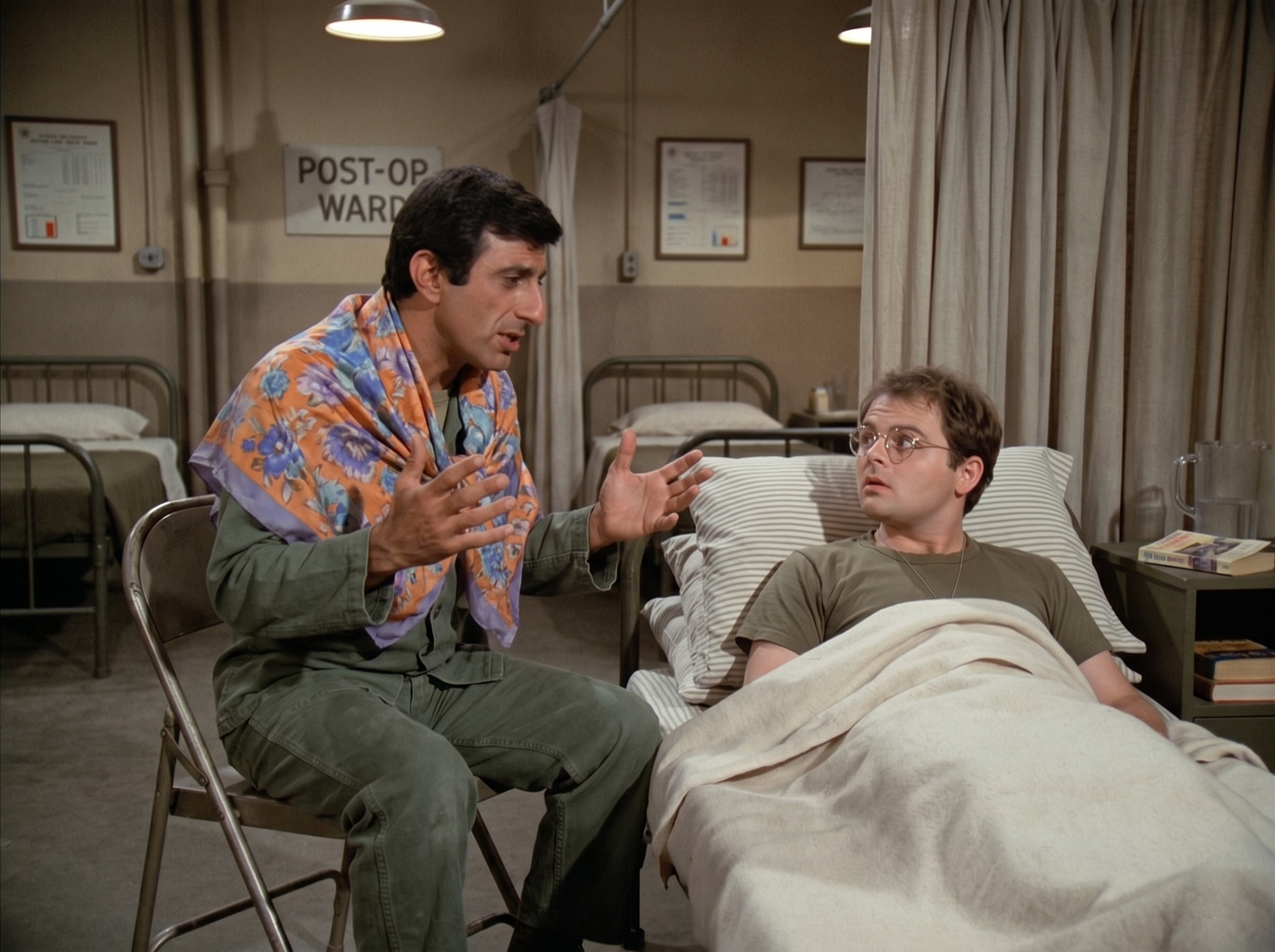
The Post-Op Ward was, by definition, the most silent room in the 4077th.
The silence wasn’t restful; it was a precarious ceasefire holding together the exhausted hopes of the wounded.
Usually, you could only hear the *thrum* of an overhead light or the ragged breathing of a kid fighting a fever.
Tonight, it was different.
The silence had been broken, but it wasn’t a medical emergency.
It was a philosophical argument, delivered with grand hand gestures and a very suspicious fashion accessory.
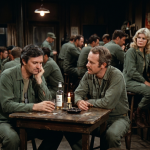
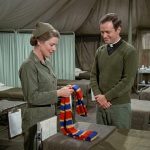
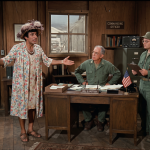
Max Klinger, dressed in full O.D.s except for a flowing, silk scarf patterned with spring flowers (retrieved from God-knows-where), was leaning in, his whole body an exclamation point.
“You’re missing the psychological subtlety, Radar! The *profound* statement this scarf makes!” Klinger whispered, his voice still a powerful bellow filtered down to a desperate intensity.
Radar O’Reilly, recently out of surgery and tucked under a pale blanket, looked absolutely flummoxed.
His round spectacles reflected the dim light, and his innocent face held a look that was pure, baffled innocence.
Radar wasn’t arguing; he was *surviving* an argument.
“Klinger,” Radar croaked, his voice reedy, “I don’t see any psychological subtlety. I see a flower garden trying to strangle a soldier.”
Klinger didn’t miss a beat. “It’s juxtaposition! Nature’s delicate bloom versus the harsh machinery of war! It says, ‘The enemy may shell our base, but they cannot bomb the human spirit’s need for floral prints!’”
Radar just stared. “I think it says you’re trying to get a Section 8 by making the birds and bees nervous.”
Just then, B.J. Hunnicutt walked in, a chart in his hand and a tired smile ready.
He stopped, seeing the two of them—Klinger performing a modern dance with his hands, Radar trapped like a confused hamster.
“Is this a consultation, gentlemen?” B.J. asked, his quiet voice immediately commanding the room.
Klinger spun around on his folding metal chair. “Captain Hunnicutt! Tell this brave farm boy that my presentation of floral solidarity is not, repeat NOT, an act of subversion against the military uniform, but an expression of hope!”
Radar raised an weak hand. “Captain, he’s been lecturing me on the emotional frequency of hydrangeas for twenty minutes.”
B.J. walked over, reading Radar’s chart. “Hydrangeas, huh? Well, Klinger, I can’t speak to their emotional frequency. But I can tell you that Radar’s priority right now is rest. We patched his side, not his soul.”
Klinger paused, looking deflated. The floral scarf settled against his chest.
“I know, Captain,” Klinger said softly, his voice dropping an octave. “I just… the kid looked so lonely. I thought… well…”
He trailed off, looking at Radar.
B.J. saw it then. It wasn’t about the Section 8. Not tonight.
Tonight, it was about something else. The tension broke, replaced by a quiet, shared moment that went deeper than words.
Klinger’s performative act hadn’t been about escaping. It had been about distracting.
He had looked into the Post-Op ward and seen Radar O’Reilly, the human radar dish, the camp heartbeat, looking entirely, painfully, small.
Radar, the boy who could sense incoming choppers and anticipate Col. Potter’s orders, was usually in the center of the storm.
In this bed, in this silent room, he was isolated.
Klinger, a master of finding leverage, had seen a man who needed leverage over silence. And he used hydrangeas.
B.J. pulled up a second metal stool, sitting opposite Klinger.
“The kid looked so lonely,” Klinger repeated, almost to himself.
“He’s not lonely,” B.J. said gently, checking Radar’s pulse. “He’s recovering. He’s just… quiet.”
Radar whispered, “I am quiet. I like quiet.”
“Nobody likes *this* quiet, kid,” Klinger argued, “except maybe Major Winchester, but that’s because it lets him hear the inside of his own head. Normal people need noise! Life! Flowers!”
He gestured wildly, and the scarf caught a gentle ripple from the movement.
For a second, the ridiculous floral print was the only color in the drab room.
A ghost of a smile touched Radar’s lips, just briefly.
“I have some letters,” Radar offered, nodding weakly toward the nightstand with the books and the pitcher of water. “From Iowa. They haven’t been read yet.”
B.J. picked them up, handing them to Radar.
Radar pulled the blanket higher. He was too weak to read them.
“Maybe Captain Hunnicutt could read one,” Klinger suggested, his eyes fixed on B.J. with an unusual intensity.
B.J. understood. The Post-Op ward needed noise, but it didn’t need the grand philosophical theories of a Toledo salesman in drag. It needed familiar sounds. Home sounds.
“Alright, Radar,” B.J. said, opening the first letter, which had “O’Reilly Family Farm” scrawled on the back. “What’s the word from Ottumwa?”
Klinger leaned back, folding his arms across the bright scarf, a look of profound satisfaction settling on his face. He became a respectful, if floral, silent witness.
As B.J. read the letter in a soothing, measured cadence, describing the prize hog situation and Aunt Martha’s latest recipe for plum preserves, the real magic happened.
The tension left Radar’s shoulders. His eyelids grew heavy. The silence of the Post-Op ward ceased to be the silence of absence.
It became the silence of peace, filled by a story from a place far away.
When B.J. finished the letter, Radar was fast asleep.
B.J. smiled at Klinger. Klinger stood up, silent and precise, his earlier theatricality gone.
He carefully tucked the ends of the silk scarf *under* Radar’s pillow, just leaving a small patch of bright blue and orange flowers peeking out.
“A little spring,” Klinger whispered, patting B.J. on the shoulder.
They left together, closing the door on the ward that was finally, genuinely, at rest.
Because sometimes, the best medicine wasn’t penicilin, but a silk flower garden and a letter from home.