The Inkwell, the Colonel, and the Corporal’s Clipboard
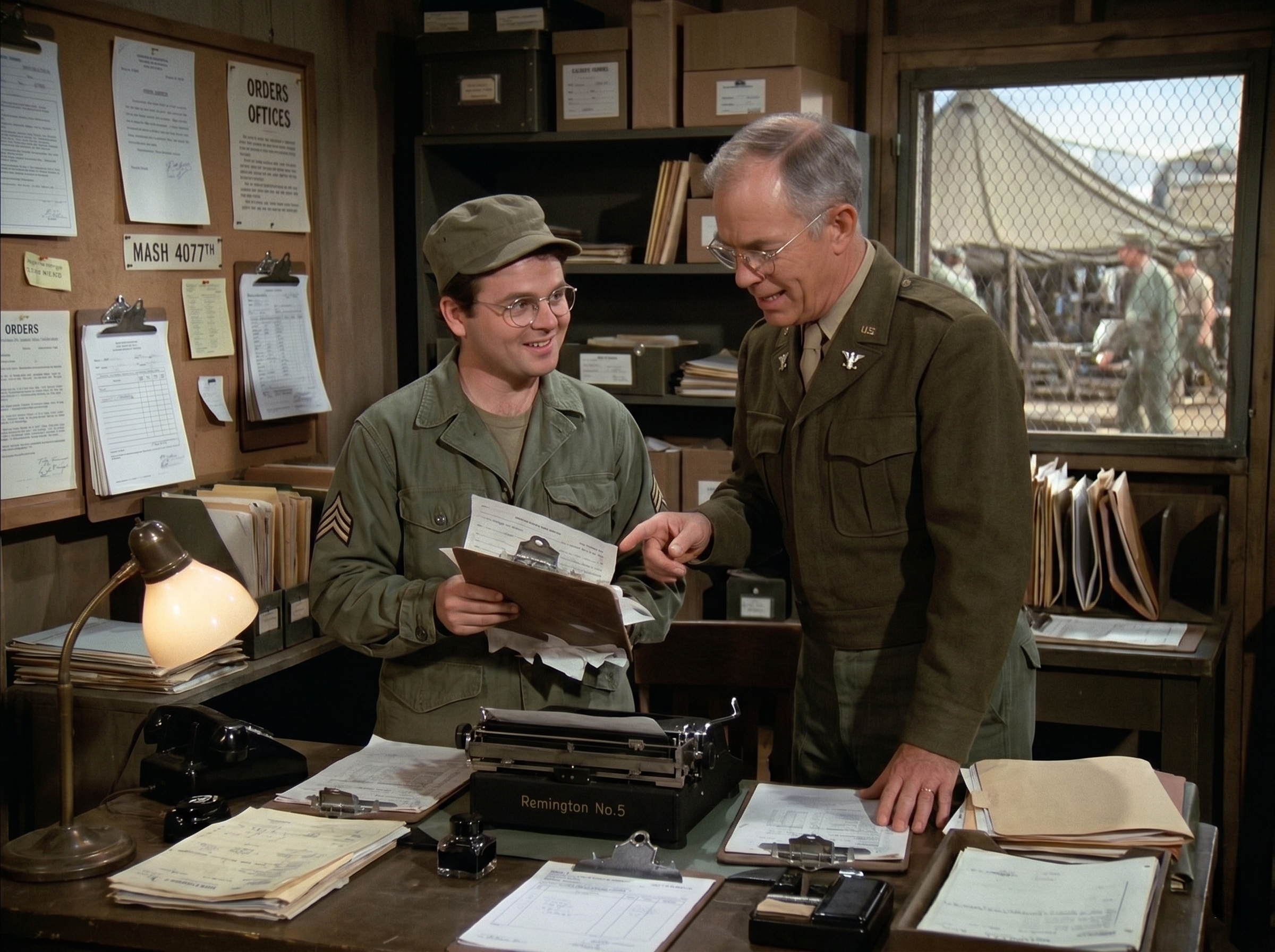
If you wanted to understand how the Korean War was truly fought, you didn’t look at the front lines, and you didn’t look at the map board in the General’s tent. You looked at the paperwork.
The United States Army did not move on rations or fuel. It moved on carbon paper, requisition forms, and the endless, mind-numbing power of triplicate.
Here at the 4077th Mobile Army Surgical Hospital, the true nerve center wasn’t the operating room. It was the small, cluttered clerk’s office just inside the commanding officer’s quarters.
It was a Tuesday afternoon, and the camp was caught in that quiet, heavy lull between incoming choppers. Outside the mesh screen window, the dusty compound was a blur of olive drab tents and the slow, tired shuffling of personnel trying to find a patch of shade.
Inside the office, the atmosphere was entirely different. It was an oasis of administrative chaos, lit by the soft, warm, golden glow of a brass-necked desk lamp.
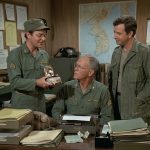
The light spilled across the wooden desk, illuminating a heavy black rotary phone, a small glass inkwell, and the sturdy, black metal frame of a Remington No. 5 typewriter. It was a space that felt thoroughly lived-in, worn down by thousands of hours of typing, stamping, and desperate problem-solving.
Behind the desk stood Corporal Walter “Radar” O’Reilly. He was wearing his standard olive drab fatigues, his round wire-rimmed glasses pushed up on his nose, and his cap pulled down tight.
Usually, Radar was a symphony of efficiency. He knew what you wanted before you asked for it, and he knew when the brass was coming before the telephone even thought about ringing.
But today, something had gone wrong. A small gear in the massive machine of Radar’s unofficial camp logistics had slipped.
He stood behind his desk, clutching a battered wooden clipboard like it was a shield. The papers clipped to it were a disaster—crooked, heavily stamped, with carbon copies peeking out haphazardly from the edges.
He wore a sheepish, nervous smile. It was the distinct look of a farm boy from Ottumwa, Iowa, who had just been caught trying to smuggle a stray calf into the farmhouse kitchen.
Standing opposite him, leaning slightly forward with his knuckles resting on the edge of the desk, was Colonel Sherman T. Potter.
Potter still wore his service tie tucked neatly into his wool shirt, his silver colonel’s eagles gleaming faintly in the lamplight. He had stepped out of his office to check the afternoon duty roster, but his sharp, veteran eyes had immediately locked onto the messy clipboard in his clerk’s hands.
The Colonel didn’t look angry. Instead, his face was set in a masterpiece of dry, fatherly exasperation. It was a look that said he had seen three wars, thousands of soldiers, and an infinite number of bad excuses, and he was currently evaluating where Radar’s current situation fit into that rich history.
Potter raised his right hand and pointed a single, steady finger directly at the chaotic stack of forms.
“Corporal,” Potter said, his voice a low, gravelly drawl that carried the weight of the regular army but the warmth of a grandfather. “I have been in this man’s army since horses were our primary mode of transportation. I have read reports that would make a sane man weep.”
Radar swallowed hard, his nervous smile freezing in place. “Yes, sir. I know, sir.”
“So,” Potter continued, leaning just an inch closer, his eyes narrowing playfully behind his own wire-rimmed spectacles. “I want you to look me in the eye, son. And I want you to explain to me exactly why my signature is currently resting at the bottom of a Form 312-B.”
Radar’s eyes darted wildly around the room, looking anywhere but at the Colonel.
“Because, sir,” Radar squeaked, his voice cracking slightly. “That’s the form for… um… standard unit resupply.”
Potter tapped the paper with his index finger. The sound was loud in the quiet office. “I am aware of what a 312-B is, Radar. What I am not aware of, is why the 4077th MAS*H—a medical unit located three miles from the front lines of a landlocked peninsula—is urgently requisitioning forty-two pounds of ‘Marine-grade nautical rigging and barnacle sealant.'”
Radar pulled the clipboard a little closer to his chest, the edges of the paper crinkling under his tight grip. The gig was up.
“Well, sir,” Radar began, his voice dropping to a conspiratorial whisper. He shifted his weight from one foot to the other. “It’s… it’s a matter of translation, sir.”
Potter arched an eyebrow, keeping his finger planted on the offensive document. “Translation. From what language, Corporal? Navy to gibberish?”
“No, sir. From Army to Army,” Radar explained earnestly. He adjusted his glasses, looking up at Potter with that innocent, pleading expression that had gotten him out of a hundred scrapes before. “You see, sir, if I order medical-grade heating coils for the sterilizer in the OR, Supply Sergeant Zale down in Seoul says they’re on backorder for six months.”
Potter’s face softened just a fraction, the amusement still dancing in his eyes. He didn’t move, letting the boy spin his web. “Go on.”
“But,” Radar continued, gaining a little confidence, “I found out that the Navy depot in Inchon has a massive surplus of this barnacle sealant. And it just so happens that the quartermaster over at the Greek battalion really, really loves the smell of it. Says it reminds him of the docks in Piraeus.”
Potter took a slow, deep breath, letting it out in a long, steady sigh. He could see exactly where this was going, and it terrified him as much as it impressed him.
“Let me guess,” Potter said dryly. “If we give the Greeks the barnacle sealant…”
“They give us three crates of cured olives and a surplus Jeep alternator,” Radar finished, nodding rapidly. “Which I then trade to a bomber crew over at Kimpo Air Base, who fly the olives to a guy in Tokyo, who then ships us the exact medical heating coils we need, plus two tins of actual, real coffee for the mess tent.”
Silence fell over the small office. The only sound was the distant, muffled shout of someone across the compound, and the quiet hum of the desk lamp heating up the air around it.
Potter looked at the messy clipboard. He looked at the typewriter. He looked at the ridiculous, beautiful, convoluted web of lies and logistics that this young man had spun just to make sure the surgeons could clean their instruments.
The Colonel stood up straight, his joints popping slightly as he stretched his back. He crossed his arms over his chest, looking down at his clerk.
The exasperation on Potter’s face melted away, replaced by a quiet, profound tenderness. He saw right through the nervous smile and the messy paperwork.
He saw a kid who was thousands of miles away from his mother, working eighteen-hour shifts, listening to the agonizing sounds of the operating room, and carrying the administrative weight of an entire hospital on his narrow, sloping shoulders. Radar didn’t do this for profit. He didn’t do it for glory. He did it because these people were his family, and a family needed taking care of.
Potter reached out and took the clipboard from Radar’s hands. Radar winced, fully expecting the paper to be torn to shreds.
Instead, Potter pulled a fountain pen from his breast pocket. He unscrewed the cap with a practiced flick of his thumb.
“Radar,” Potter said softly, his eyes scanning the incredibly messy, forged, and frankly illegal document.
“Yes, Colonel?” Radar asked, his voice barely a squeak.
“Next time you requisition barnacle sealant…” Potter dragged the nib of the pen across the bottom line, adding a heavy, authoritative flourish to his already forged signature. “…make sure you specify the heavy-duty kind. I hear the Greek quartermaster prefers the tar-based brand.”
Radar’s eyes went wide. His shoulders dropped three inches as the tension left his body. The nervous smile transformed into a genuine, beaming grin.
“Yes, sir! Heavy-duty, sir. I’ll make a note of it.”
Potter handed the clipboard back. Our fingers brushed against the rough wood, a silent transfer of trust and mutual understanding.
“And Radar?” Potter added, turning back toward the door of his inner office.
“Sir?”
“When that real coffee comes in from Tokyo,” Potter said, not looking back, a small, warm smile playing on his lips. “I expect a fresh cup on my desk before the morning briefing. God knows we’ll need it.”
“You bet, Colonel. Two sugars, just the way you like it.”
Potter disappeared into his office, the door clicking gently shut behind him.
Radar stood alone in the warm light of the desk lamp. He looked down at the messy clipboard, tapped it affectionately against the top of the Remington typewriter, and went back to work, fighting the war the only way he knew how.
In the heart of the 4077th, survival wasn’t just about medicine; it was found in the quiet grace of looking the other way, one forged form and one fatherly smile at a time.