A QUIET KIND OF GRACE IN POST-OP
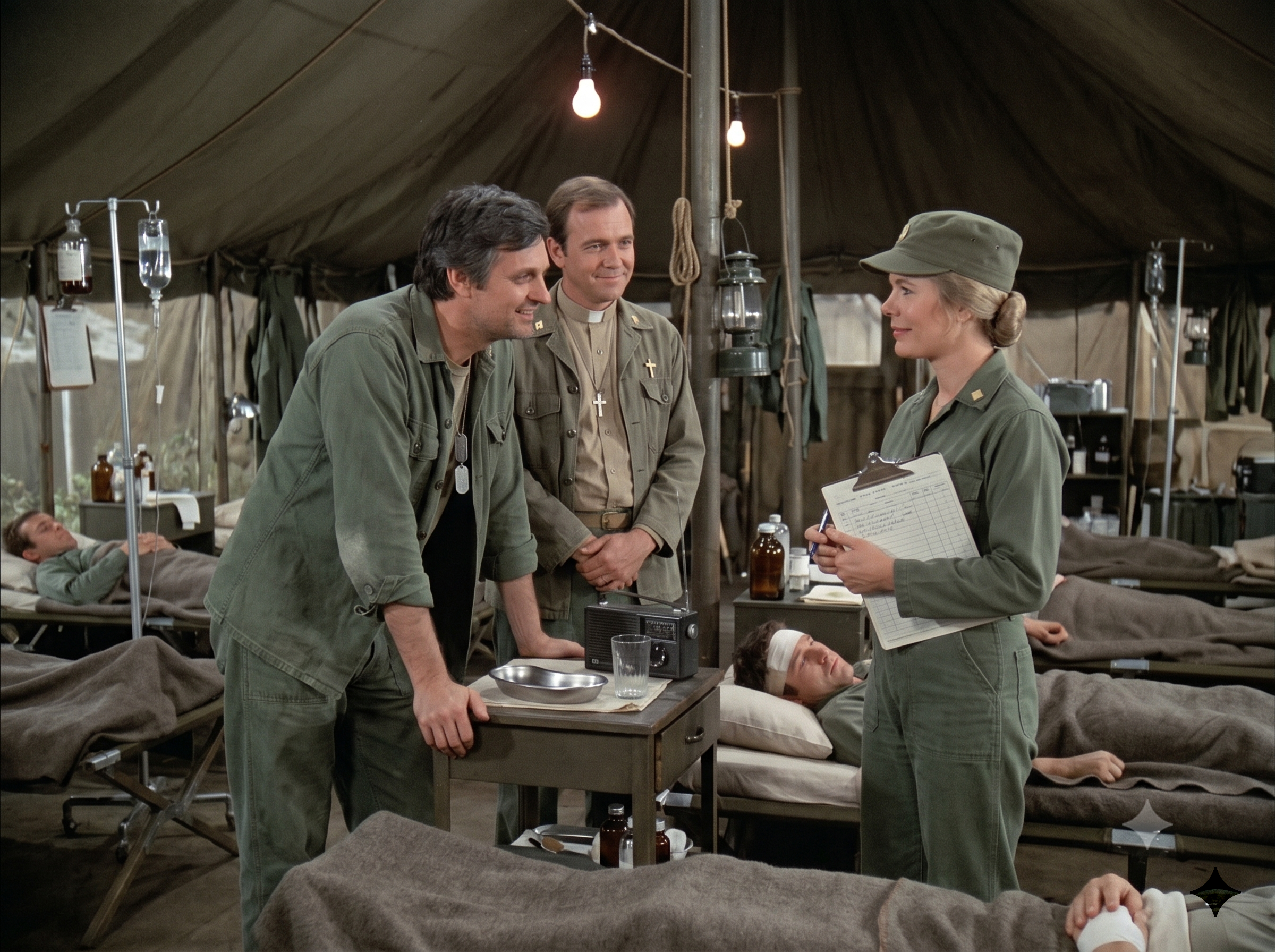
The post-op ward of the 4077th possessed a sacred, heavy silence that only arrived after a marathon session in the OR.
It was a fragile quiet, built on the rhythmic drip of saline and the slow, shallow breathing of wounded men. The air always smelled faintly of iodine, damp canvas, and the bitter instant coffee that kept the surgeons on their feet.
Beneath the muted green roof of the tent, the rows of canvas cots stretched out like a grim hotel. The woolen blankets were a faded, muted white, tucked perfectly around the battered boys who had arrived by helicopter just hours before.
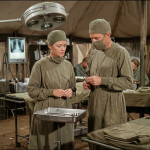
Major Margaret Houlihan stood near the foot of bed number three. She held a medical clipboard pressed against her crisp, olive-drab fatigue shirt.
Her posture was, as always, parade-ground perfect. But the edges of her professionalism were frayed.
It had been thirty-six straight hours of meatball surgery. Her eyes were rimmed with exhaustion, and the familiar, rigid armor she wore to survive the war was starting to crack under the weight of the endless casualties.
In the bed lay Private Miller, a nineteen-year-old kid from somewhere in the Midwest. His head was heavily wrapped in pristine white gauze, leaving only his terrified eyes and a bruised jaw visible.
He was awake, staring up at the bare lightbulb hanging from the tent pole.
Margaret checked his chart, her pen hovering over the paper. “Your vitals are stabilizing, Private,” she said, her voice attempting its usual brisk authority. “You’re going to be on the first bus to Seoul tomorrow morning. From there, you’re going to Tokyo. Then, home.”
It was the best news a soldier could hear in this godforsaken place. It was the million-dollar ticket out of the mud and the madness.
But Miller didn’t smile. He didn’t cheer.
Instead, a slow, ragged breath rattled in his chest. “I can’t go, Major,” he whispered, his voice cracking.
Margaret paused, her pen freezing on the clipboard. “Nonsense. The doctors did a fine job. You have a mild concussion and a shrapnel wound that’s been cleanly closed. You are medically cleared for evacuation.”
“You don’t understand,” Miller choked out, his hands gripping the edge of the blanket until his knuckles turned white. “My unit… they’re still up there. On the ridge. I got hit right when the barrage started. If I go home… I’m leaving them behind.”
The tears began to fall then, silent and hot, soaking into the white bandages wrapped around his head.
It was the crushing, suffocating weight of survivor’s guilt. It was an injury that didn’t bleed, one that couldn’t be stitched or clamped or cut out in the sterile light of the operating room.
Margaret stood completely still.
She was trained to pack wounds, administer morphine, and command nurses with iron discipline. She was not trained to mend a nineteen-year-old’s breaking heart.
She looked down at the boy, and for a terrifying second, the strict, unyielding Major Houlihan vanished entirely. Her throat tightened.
She wanted to reach out, to stroke his shoulder, to tell him that simply surviving was enough. But the emotional weight of the room was sudden and paralyzing.
The silence in the tent grew agonizingly loud, heavy with the boy’s muffled sobs and Margaret’s own desperate, unspoken heartbreak.
She was trapped in the grief, unable to retreat into her military protocol, yet terrified to drop her guard and let her own tears fall.
“Are you kidding me, kid?”
The voice was a dry, gravelly drawl that instantly pierced the heavy, suffocating air of the tent.
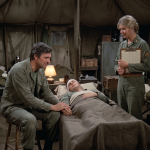
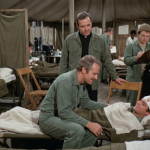
Captain Benjamin Franklin Pierce stepped fully into the soft, warm light of the bare bulbs. He moved with the slow, aching stiffness of a man who hadn’t slept in three days, his green fatigues rumpled and thoroughly lived-in.
Hawkeye slouched toward the bed and casually leaned his weight against the small wooden bedside table.
His dog tags clinked softly against his chest. He rested his arm near a small portable radio, an empty drinking glass, and a metal kidney basin, making himself entirely at home in the middle of the crisis.
Father Mulcahy stepped up just behind him, hands folded gently at his waist. The chaplain wore his small silver cross over his wrinkled fatigue shirt, his expression holding a look of deep, gentle concern as he observed the scene unfold.
Hawkeye looked down at the crying private and offered a teasing, charismatic smile. It was a smile that hid a thousand miles of fatigue and a deep, aching empathy.
“You’re complaining about going home?” Hawkeye asked, his tone dripping with theatrical disbelief. “Do you have any idea how much paperwork you’re saving me by leaving? If you stay, I actually have to pretend to be a doctor for another week.”
Margaret’s head snapped up.
She reacted sharply, her military bearing instantly snapping back into place. “Captain Pierce,” she hissed, her voice a warning whip crack. “This is a recovery ward. The patient is under severe distress.”
Hawkeye didn’t blink. He just kept his weary, smiling eyes on the kid.
“Listen to her, Miller,” Hawkeye said smoothly. “She’s trying to act tough, but secretly, she’s thrilled you’re leaving. If you stay one more day, Major Houlihan is required by Army regulations to make you polish these IV poles until you can see your own bruised face in them.”
Margaret bristled, her grip tightening on the clipboard. “I do not make my patients polish equipment!”
“See?” Hawkeye grinned, leaning closer to the boy. “She’s getting defensive. That means I’m right. It’s a textbook psychological tell.”
Private Miller sniffed loudly. He looked from Hawkeye’s tired, joking face to Margaret’s rigid stance.
A tiny, unexpected bark of a laugh escaped the boy’s lips.
The spell of crushing grief was broken. The suffocating tension in the room suddenly evaporated, replaced by the familiar, ridiculous, grounding reality of the 4077th.
Father Mulcahy smiled softly, his eyes crinkling at the corners. He understood exactly what Hawkeye was doing.
Hawkeye wasn’t mocking the boy’s pain. He was throwing him a lifeline. He was using the only weapon he had left—absurdity—to pull a drowning kid back to the surface before the guilt pulled him under entirely.
And he was giving Margaret an out. He had drawn her fire so she wouldn’t have to break down in front of a patient.
Margaret stared at Hawkeye. For a split second, the deep annoyance on her face melted away.
Beneath her sharp glare, a subtle, profound warmth shone in her eyes. She saw the heavy, dark bags under Hawkeye’s eyes, the exhausted slump of his shoulders against the table, and the quiet compassion operating behind his teasing words.
She realized, with a sudden rush of gratitude, that he had stepped in to rescue her.
Margaret cleared her throat, adjusting her cap. She looked back down at the boy, her voice returning to its calm, professional cadence, but now infused with a genuine, maternal softness.
“Captain Pierce is an idiot, Private,” she said gently, her eyes lingering on the boy’s bandaged head. “But he is right about one thing. Your duty here is finished. Your only job now is to go home to your family.”
“Amen to that,” Father Mulcahy added quietly, his voice a soothing balm in the dim tent. “Your friends on the line would want nothing less for you, son. Carry them in your heart, but take yourself home.”
Miller wiped his eyes with the back of his trembling hand. The panic was gone, replaced by a quiet, exhausted acceptance. “Yes, Father. Yes, Major.”
Hawkeye tapped the small radio on the table. “Good. Now get some sleep. If you’re still awake by dinner, the mess tent is serving something that vaguely resembles chipped beef. Consider this a formal medical warning.”
Hawkeye pushed himself off the bedside table, wincing slightly as his tired joints popped in protest.
He looked at Margaret, his teasing smile softening into something real and tired. He gave her a slow, respectful nod.
Margaret didn’t smile, but she didn’t yell, either. She just held her clipboard a little closer to her chest and nodded back, a silent thank you passing between them in the shadows of the tent.
It wasn’t a perfect fix. The war was still raging just over the hills, and tomorrow the helicopters would inevitably bring more broken boys to this muddy patch of Korea.
But for tonight, in the quiet, faded green canvas of Post-Op, they had saved one more.
In a place designed for blood and noise, the greatest miracles of the 4077th were always the quietest ones.