A Culinary Crisis at the 4077th
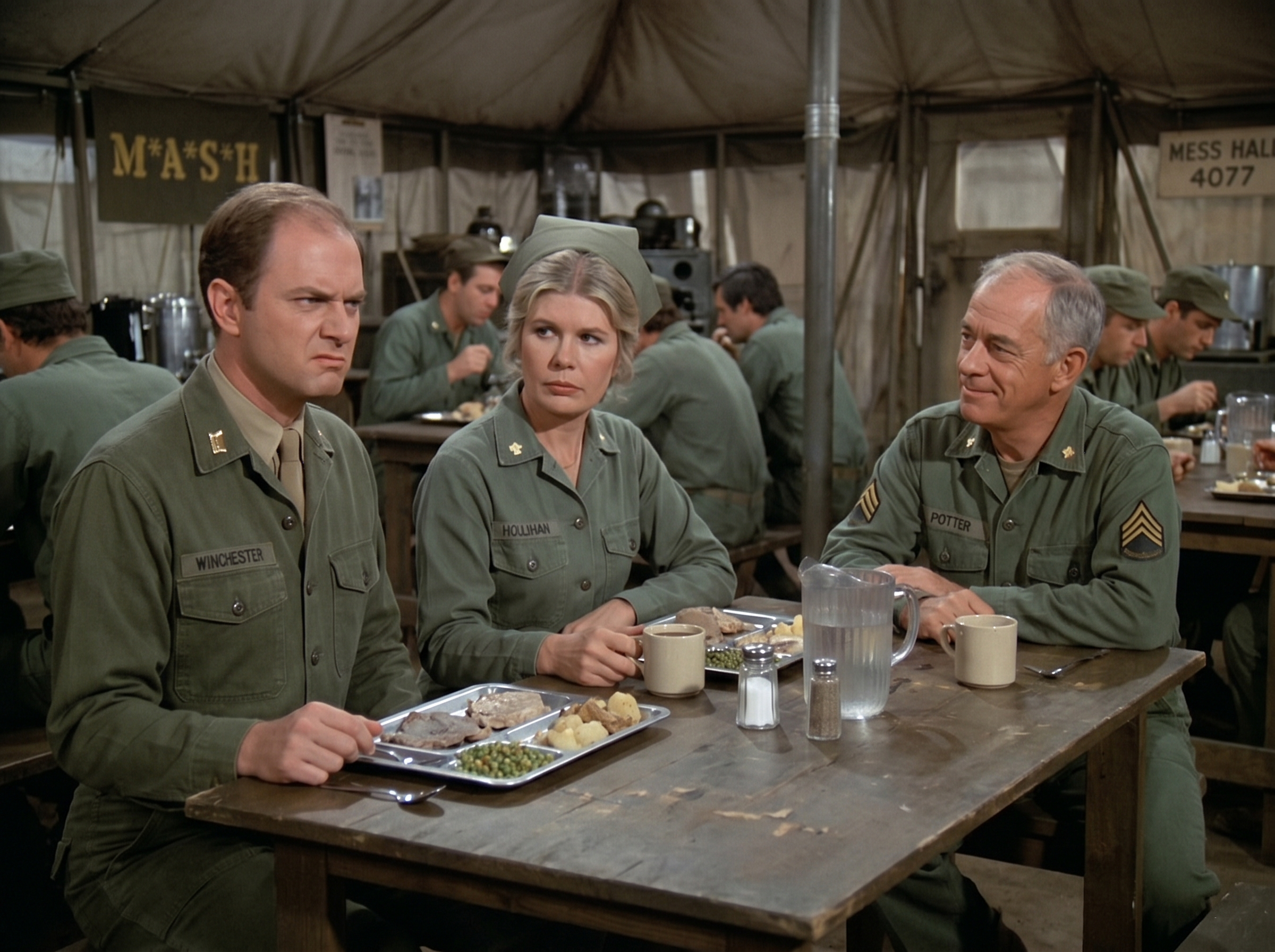
There were days at the 4077th when the endless stream of incoming casualties threatened to break your heart, and then there were days when the mess tent lunch simply tried to break your spirit.
It was a quiet Tuesday afternoon, the kind of quiet that always felt a little suspicious in a war zone. The surgical teams had just finished a grueling eighteen-hour shift in the O.R. The canvas walls of the mess tent flapped gently in a warm, dusty breeze.
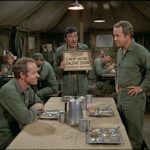
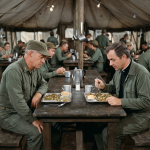
Inside, the air was thick with the scent of boiled coffee, damp canvas, and whatever culinary tragedy Igor had managed to concoct from the morning’s supply drop. The dull, even lighting of the tent cast a soft glow over the long, scratched wooden tables and the dented metal food trays.
At a table near the center of the room, a silent standoff was taking place.
Major Charles Emerson Winchester III sat perfectly upright, his posture as rigid as a marble statue in a Boston museum. His tailored fatigues somehow still looked crisp despite the heat. But his face was a portrait of restrained, horrified indignation.
He was staring down at his metal tray. There, nestled between a scoop of gray, mushy peas and a pile of unidentifiable diced potatoes, sat a slab of mystery meat that defied all logical explanation. It looked back at him with a greasy, defiant sheen.
Beside him, Major Margaret Houlihan sat with forced military composure. Her hands were wrapped tightly around a thick ceramic coffee mug, holding onto it as if it were a life preserver in a sea of exhaustion.
Margaret’s back was straight, her chin held high, but the tight line of her jaw betrayed her. She was fighting a silent war of her own against the sheer, overwhelming fatigue that was threatening to drag her under. She refused to let the terrible food be the thing that finally made her snap.
Across the table, Colonel Sherman Potter leaned forward slightly. His forearms rested comfortably on the worn beige wood.
Unlike the two majors, Potter didn’t look angry. He looked profoundly amused. His eyes, framed by the familiar lines of a man who had seen too many wars, held a gentle, dry spark. He was watching Winchester with the patient, weary affection of a grandfather watching a toddler figure out a difficult puzzle.
The silence at the table was heavy. It was the kind of silence that precedes a storm.
Charles raised his right hand with agonizing slowness. He did not pick up his fork. Instead, he simply pointed a trembling, manicured finger at the slab of meat on his tray. His eyes narrowed. His nostrils flared.
He drew in a long, deep breath, his chest expanding as he prepared to unleash a symphony of aristocratic outrage that would surely echo all the way to Seoul. The entire mess tent seemed to hold its collective breath, waiting for the aristocratic volcano to erupt.
Before Charles could release the devastating monologue he was clearly crafting, Colonel Potter let out a soft, gravelly chuckle.
“I wouldn’t stare at it too long, Major,” Potter said, his voice calm and entirely devoid of sympathy. “If you look it directly in the eye, it might challenge you to a duel.”
The spell was broken. Charles froze, the air slowly leaking out of his lungs. He blinked, the fiery indignation in his eyes giving way to a profound, tragic sadness.
He slowly lowered his hand. “Colonel,” Charles whispered, his voice trembling with genuine despair. “I am a man of medicine. I have seen the horrors of the human body laid bare. I have held beating hearts in my hands. But this…” He gestured weakly at the tray. “This is an affront to the very concept of carbon-based life.”
Margaret let out a sudden, sharp exhale that might have been a laugh if she hadn’t been so tired. Her rigid posture finally collapsed just a fraction. Her shoulders slumped, and she took a slow, deliberate sip from her coffee mug.
She grimaced instantly. “And the coffee tastes like it was brewed in a jeep radiator,” she muttered, staring into the dark, oily liquid. “I think there’s actually a spark plug at the bottom.”
Potter smiled warmly, the crinkles around his eyes deepening. He reached out and tapped his own metal tray with a spoon. “Now, now. Let’s look on the bright side, people. It’s hot, it’s not currently moving, and it didn’t come out of a tin can marked ‘1942’.”
“I would gladly trade this,” Charles said, picking up his fork and poking the meat with the extreme caution of a bomb squad technician, “for a tin can from 1942. I would trade it for a handful of dry dirt from a Boston alleyway. I would trade it for a swift kick in the shins.”
“Careful, Charles,” Margaret said, a faint, tired smile finally breaking through her professional mask. “Igor might take you up on that offer.”
The anger that had been bubbling inside Charles slowly evaporated, replaced by the heavy, familiar blanket of exhaustion that they all shared. He dropped the fork. It clattered loudly against the tin tray.
He leaned back, rubbing the bridge of his nose with his thumb and forefinger. The aristocratic bluster melted away, leaving only a very tired doctor thousands of miles from home.
“Do you know what I was supposed to be eating tonight?” Charles asked quietly, his eyes focused on something far away. “Oysters Rockefeller. At my club. Followed by a prime rib so tender it would weep at the touch of a knife. And a bottle of Bordeaux that costs more than this entire encampment.”
Margaret rested her cheek against her hand. “My father used to take me to a steakhouse in Washington when he was on leave,” she said softly, her voice losing its usual sharp edge. “Thick cuts. Baked potatoes loaded with butter. Real butter. Not this yellow grease they give us.”
Potter nodded slowly, his eyes gentle. “Mildred makes a pot roast,” he said, his voice full of quiet reverence. “Cooks it all day Sunday. Carrots, onions, potatoes. The whole house smells like heaven by two in the afternoon.”
They sat in silence for a moment, letting the ghosts of those wonderful, distant meals hover over their table. The sounds of the mess tent—the clatter of plates, the low murmur of other exhausted doctors and nurses, the hiss of the coffee urn—faded into the background.
In that brief, quiet moment, they weren’t ranking officers. They weren’t an elite surgeon, a head nurse, and a commanding officer. They were just three incredibly tired people, far from the lives they knew, trying to find a tiny shred of comfort in an uncomfortable place.
Charles looked down at his tray one last time. He sighed, a long, weary sound that carried the weight of the entire war.
“Well,” Charles said softly, picking up his knife and fork with a renewed, albeit tragic, sense of purpose. “I suppose one must maintain one’s strength. Even if the fuel provided is barely fit for a stray dog.”
Margaret gave a soft, genuine laugh. She raised her terrible coffee mug slightly in his direction. “To prime rib, Charles.”
“To Mildred’s pot roast,” Charles countered, giving a polite, seated bow toward Potter.
Potter smiled, a deep, contented smile that reached his eyes. He picked up his own fork. “To surviving another day,” the Colonel said gently. “Now eat your mystery meat, kids. Before it eats you.”
They began to eat, the terrible food somehow made just a little bit more palatable by the warmth of the company, sitting together in the quiet sanctuary of the canvas tent.
The food was always terrible, but the company is what kept them alive.