The Communion of Mashed Potatoes
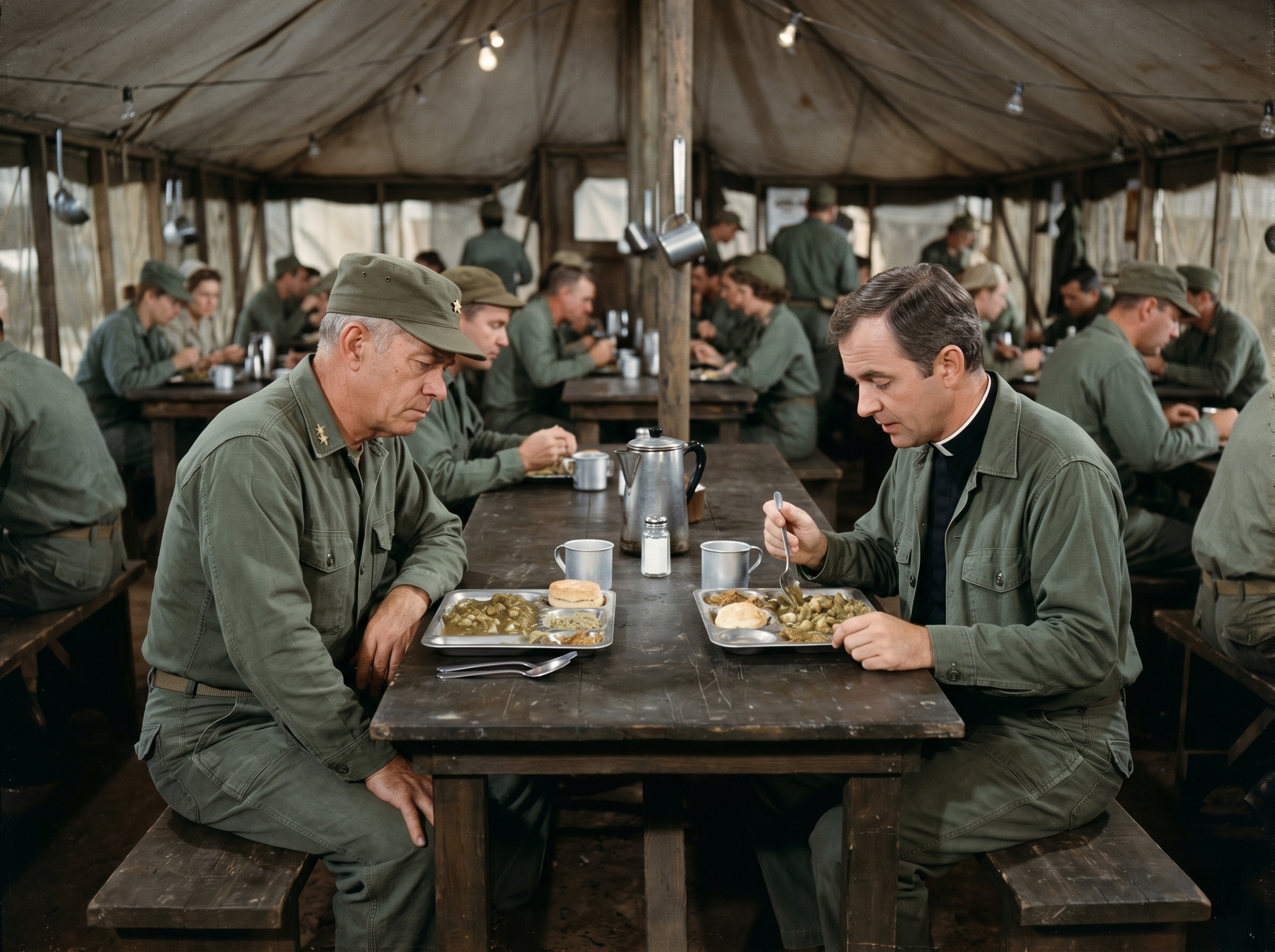
The mess tent was a symphony of clattering tin, the low hum of tired voices, and the distinct, ever-present scent of stewed mystery that defied both culinary logic and the Geneva Convention.
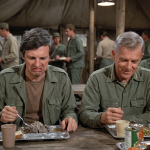
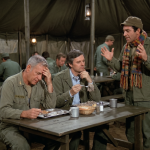
Colonel Sherman Potter sat at the end of the long, rough-hewn table, his shoulders slumped in a way that spoke of a day spent battling bureaucracy and geography. Beside him sat Father Mulcahy, his face illuminated by the harsh, dangling bulbs that swung gently in the drafty tent.
They were staring down their metal trays with the kind of intense scrutiny usually reserved for complex surgical procedures.
“Father,” the Colonel murmured, not looking up from a particularly grey-looking dollop of beans, “I’ve seen a lot of things in my time. I’ve seen the plains of Kansas, the battlefields of Europe, and even, God help me, a parade in downtown Chicago. But I have never seen a biscuit this committed to remaining a rock.”
Father Mulcahy offered a weary, gentle smile, his fork hovering tentatively over his tray. He adjusted his collar, the small white tab looking almost comically clean against the olive drab of his uniform.
“It’s a test of faith, Colonel,” the Father replied, his voice soft but laced with that dry, hidden humor he’d picked up from years of living among the finest sarcastic minds in the army. “Though I suspect the cook is testing my vows of non-violence, too.”
The tent was bustling around them, a blur of motion and sound, but at that small table, a strange, quiet bubble of stillness had formed. It was that rare, fragile moment of the day where the war felt like a distant rumor, overshadowed only by the pressing, universal human need to be fed and understood.
Potter sighed, a long, rattling sound that seemed to pull all the tension out of his spine. He looked at the Father, his expression shifting from battlefield command to something much more vulnerable and searching.
“You know, Father,” Potter started, his voice dropping an octave, “I find myself wondering if we’re actually getting anywhere. We patch them up, we send them back, and the machinery just keeps churning. Sometimes I think the only thing keeping us from losing our minds entirely is the fact that we’re all sitting here, eating this sludge together.”
Mulcahy paused, his fork stopping mid-air. He looked at the Colonel, seeing the weight of every casualty, every decision, and every sleepless night etched into the map of those weary lines around the older man’s eyes.
“We aren’t just patching them up, Colonel,” Mulcahy whispered, his tone suddenly devoid of humor. “We’re witnessing their humanity. We’re holding the line, not just against the enemy, but against the darkness. And sometimes, sir, the most important thing we do isn’t in the OR. It’s sitting right here, in the quiet, proving that we’re still people who share a meal.”
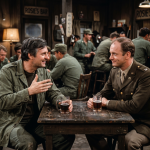
Potter looked at him, startled by the intensity of the sentiment. He opened his mouth to reply, but before he could speak, a sudden, sharp tremor shook the tent—not from the war, but from the arrival of Hawkeye and Trapper at the next table over, their loud, raucous laughter shattering the heavy, contemplative silence like a glass bottle dropped on concrete.
The spell was broken, and the sudden noise seemed to push the Colonel right to the edge of his patience, his hand clenching his fork until his knuckles turned white.
The sudden eruption of noise from the neighboring table acted like a lightning rod, grounding the heavy, spiritual energy that had been humming between the two men. Potter’s face tightened, a familiar, bristling irritation flickering in his eyes as Hawkeye began a loudly performed monologue about the anatomical impossibility of the local meat supply.
“I’m going to kill them,” Potter muttered, though there was no heat in it, only the practiced, rhythmic exhaustion of a father with unruly children. “I’m going to kill them, and then I’m going to court-martial myself for feeling relieved that they’re still loud enough to make jokes.”
Father Mulcahy laughed, a quiet, genuine sound that seemed to weave through the chaos of the mess tent. He reached out, not to touch the Colonel’s arm, but simply to gesture to the tray in front of them.
“Let them be, Colonel. If they stop making noise, that’s when we should start to worry. As long as Hawkeye can complain about the food, it means he still expects the world to taste like something better.”
Potter looked at the Father, his expression softening again, the tension leaking out of his posture. He picked up his fork and poked at the biscuit, which remained stubbornly defiant. He broke off a piece, chewed it with a grimace of mock-courage, and finally chuckled.
“You’re a good man, Francis. Too good for this outfit, frankly.”
“Oh, I don’t know,” Mulcahy replied, picking up his own tray and scooting a little closer to the center of the table. “I think I’m exactly where I’m needed. Besides, where else would I get this kind of perspective on the human condition?”
For the next ten minutes, they didn’t talk about the war. They didn’t talk about the wounded, the weather, or the orders coming down from Seoul. They talked about the taste of fresh-picked blackberries back home, about the way the light hit the hills of the Korean countryside at dusk, and about the strange, enduring comfort of a shared routine.
Around them, the 4077th continued its peculiar dance. Klinger was spotted in the corner, suspiciously eyeing a piece of corrugated tin as if he were trying to measure it for a new hat. Margaret Houlihan walked past with a tray of her own, pausing for a split second to exchange a weary, respectful nod with the Colonel—a silent acknowledgment that they were all still here, all still doing their jobs.
There was a profound, quiet beauty in it. It wasn’t the heroism of the history books; it was the heroism of endurance. It was the way they leaned on each other without ever really asking, the way they built a family out of the scraps of their individual lives, and the way they found reasons to smile in a place that seemed designed to strip the smile right off your face.
As the meal finally came to a close, Potter stood up, his knees popping—a sound almost as loud as the distant artillery. He looked down at Father Mulcahy, who was tidying his own tray with characteristic care.
“Same time tomorrow, Father?” Potter asked, his voice steady and warm.
Mulcahy looked up, his eyes bright with a quiet, resilient kindness. “I wouldn’t miss it, Colonel. I have a feeling the biscuits will be even more challenging tomorrow.”
Potter let out a soft, huffing laugh and began to walk toward the exit, the flap of the tent billowing behind him. He stepped out into the crisp, cooling air of the evening, feeling, for the first time in weeks, that the weight on his shoulders was just a little bit lighter.
Inside the tent, the noise continued, the laughter of the surgeons blended with the clatter of pans, and the hum of a hundred different lives trying to navigate the madness. But the memory of that quiet table, of a Colonel and a chaplain sharing a silent, weary communion over a terrible meal, lingered in the air like the promise of a sunrise.
They were a long way from home, and the world was a long way from peace, but for one more night, they had managed to hold onto each other.
In the heart of the madness, the only thing that really keeps you going is the person sitting across the table.