The Anatomy of a Mess Tent Morning
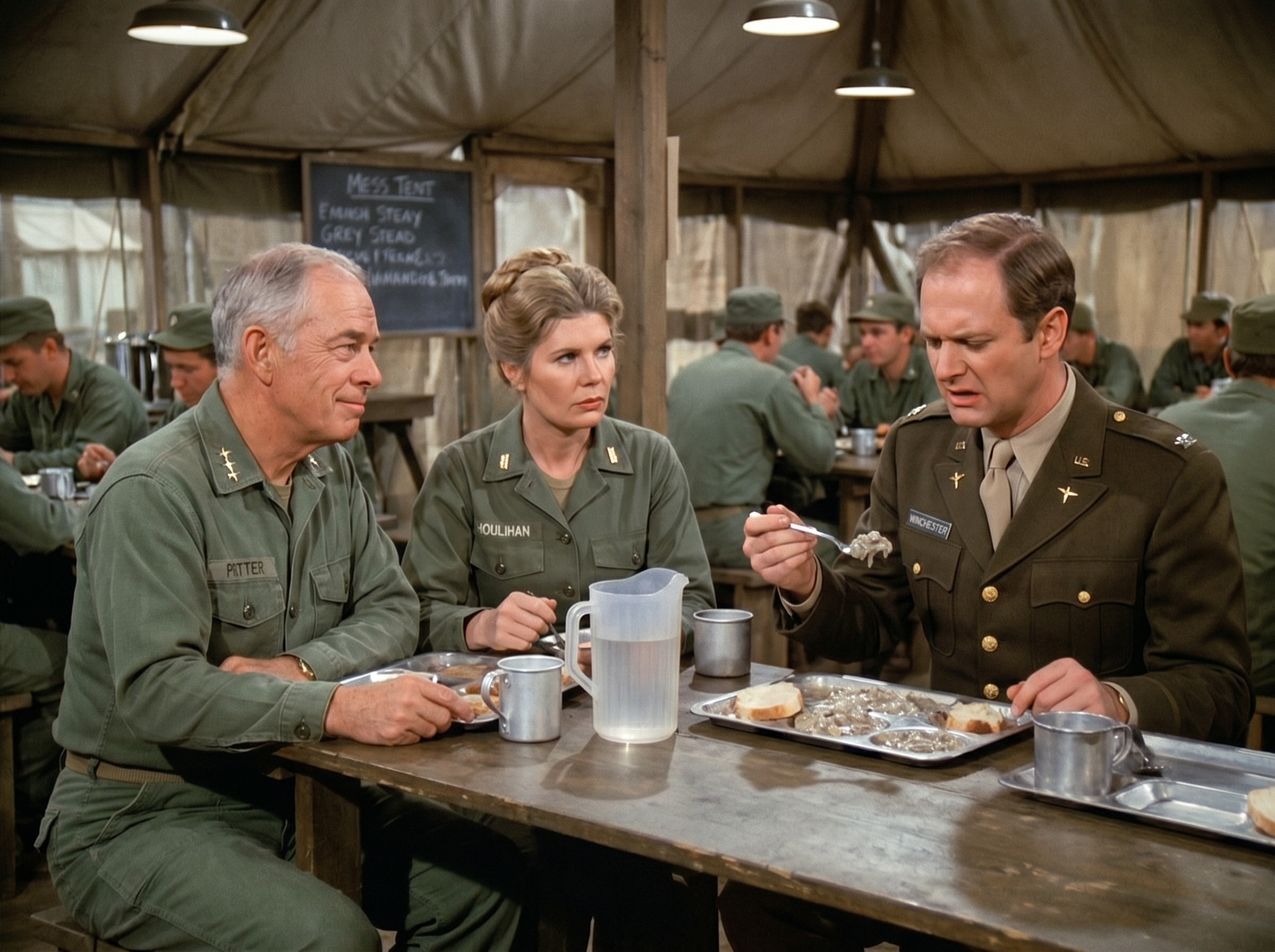
The mess tent of the 4077th Mobile Army Surgical Hospital was never a place of high culinary standards. But on a damp Tuesday morning, following a grueling eighteen-hour surgical marathon, it felt less like a dining facility and more like a cruel and unusual punishment.
The heavy canvas walls held in the damp chill of the morning air. It blended unpleasantly with the lingering smell of antiseptic and the unmistakable, burnt-rubber aroma of whatever Corporal Igor was passing off as breakfast.
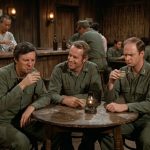
At a long, scarred wooden table near the center of the tent, three officers sat in a tableau of exhausted, quiet endurance.
Colonel Sherman T. Potter sat leaning slightly forward, his face lined with decades of military service and the immediate, heavy strain of the overnight shift. His hands rested lightly near his metal tray, his posture relaxed but grounded.
Beside him sat Major Margaret Houlihan. Even after standing on her feet over a bloody operating table since sunset, her posture was rigidly perfect.
Her green fatigues were neat, her hair carefully pinned, but her eyes betrayed a bone-deep weariness and a sharp, defensive skepticism.
But neither Potter nor Margaret were looking at their own sad metal plates.
Their attention was entirely, quietly captivated by the man sitting adjacent to them, Major Charles Emerson Winchester III.
Charles sat stiffly in his neatly pressed uniform, wearing his collar with the stubborn pride of a man desperately clinging to civilization. He was the very picture of Boston nobility completely misplaced in a muddy Korean valley.
In his right hand, he held a standard-issue metal fork, suspended halfway between his metal tray and his mouth.
Upon the tines of that fork rested a grey, gelatinous, lumpy mass of unidentifiable camp food. It was a substance that defied all known laws of nature, nutrition, and human decency.
Charles stared at the morsel with an expression of profound, offended disbelief. His eyes were narrowed, his brow furrowed, and his lips were pressed into a tight, pale line of restrained, aristocratic irritation.
He looked as though he had been personally, deeply insulted by the United States Army, the mess tent cook, and the very concept of sustenance itself.
Potter watched him with a quiet, dry half-smile. It was the kind of fatherly, knowing amusement that only comes from watching a very proud man confront an immovable, completely inedible object.
Margaret’s expression was sharper. She looked at Charles with a mix of sheer disbelief and impatient exasperation, waiting for the inevitable, pompous eruption that usually accompanied Winchester’s encounters with military rations.
The silence at their corner of the table stretched tight, taut as a snare drum.
Charles did not blink. He did not lower the fork. The grey lump wobbled ominously in the muted morning light.
Around them, the dull clatter of tin cups and exhausted murmurs of the mess tent seemed to fade away, leaving only the quiet standoff between a surgeon and his breakfast.
Charles took a slow, trembling breath through his nose, his knuckles turning white around the handle of the fork.
He slowly rotated his wrist, bringing the offensive substance closer to his face, and then turned his furious, wounded gaze directly toward the Colonel, preparing to deliver a devastating verdict that would surely shatter the quiet morning of the entire compound.
“Colonel,” Charles began. His voice was not the booming roar they expected, but a low, trembling whisper of terrifying, polite restraint.
“I am a man of science,” Winchester continued, his eyes locked on Potter. “I have studied anatomy, pathology, and advanced biology. Yet, I find myself utterly incapable of classifying the phylum of the specimen currently resting upon my utensil.”
Colonel Potter did not miss a beat, nor did he shift in his seat.
Potter merely took a slow, deliberate sip from his battered tin mug, the dry amusement never leaving his eyes. “I believe the United States Army classifies it as ‘Hash, Creamed, Type C,’ Major. But at this hour, it’s mostly just hot and sitting still. I call that a victory.”
Margaret let out a short, scoffing sigh, her patience finally snapping. She uncrossed her arms and leaned over her tray.
“Oh, for heaven’s sake, Winchester, just eat it,” she snapped, though her voice carried more exhaustion than real venom. “You’ve been on your feet in the O.R. for eighteen straight hours. Your body needs fuel, even if it offends your delicate Boston sensibilities.”
Charles slowly turned his head to direct his wounded pride toward the Head Nurse.
“Fuel, Major Houlihan?” Charles replied, his tone dripping with aristocratic disdain. “A tractor requires fuel. A Sherman tank requires fuel. A civilized human being requires nourishment. What I hold before me is an act of hostility disguised as a morning meal.”
He held the fork a moment longer, as if waiting for the food to apologize for its existence. But then, very suddenly, the fight seemed to completely drain out of him.
Charles lowered the fork, letting it clatter softly against the metal tray. The grey lump settled sadly back into its puddle.
His broad shoulders, usually thrown back in proud defiance of his surroundings, slumped a fraction of an inch. He suddenly looked much older, and terribly far from home.
The pompous mask of Major Winchester slipped away, revealing the utterly exhausted, heartbroken surgeon underneath. He rubbed a weary hand across his brow, his eyes falling closed.
The shift in his demeanor was subtle, but in the tight-knit world of the 4077th, it was as loud as an incoming siren.
Colonel Potter’s dry smile faded immediately. The sharp lines around his eyes softened into an expression of quiet, fatherly concern.
“Rough one in there today, Charles?” Potter asked. His voice was gentle, entirely stripped of his commanding officer tone.
Charles kept his eyes focused on the table. “A boy from Ohio,” he murmured, his voice stripped of its usual theatrical projection. “Barely twenty years old. Shrapnel tore through the superior vena cava.”
Charles paused, staring at his empty, trembling hands. “I worked for three hours. I utilized every surgical technique, every ounce of skill I possess. And it simply… wasn’t enough. He was gone before the sun came up.”
The atmosphere at the table changed instantly. The lighthearted irritation of the morning vanished, replaced by the heavy, familiar blanket of shared grief.
Margaret’s rigid posture melted away. The skeptical hardness left her eyes entirely, replaced by the deep, unspoken understanding of a fellow healer who knew the exact, crushing weight of that failure.
She looked at Charles, her heart aching for the arrogant, brilliant man who cared so much more than he ever let anyone see.
Quietly, entirely without fanfare, Margaret reached out. She picked up a slightly burned, dry piece of toast from her own tray and gently placed it onto the edge of Winchester’s plate.
It was a tiny, almost insignificant gesture. But in the barren, brutal reality of the Korean War, it was a massive, tender olive branch.
“Take the toast, Charles,” Margaret said quietly. Her voice was remarkably soft, completely devoid of its usual military authority. “It’s burnt. But it’s not grey. And you need to eat.”
Charles opened his eyes and looked down at the piece of toast. He stared at it for a long moment, as if it were the most precious object he had seen in months.
He looked up at Margaret, genuinely surprised by the sudden, quiet tenderness from a woman he bickered with daily. Then he looked at Colonel Potter, who gave a slow, reassuring nod.
“We do what we can, Major,” Potter said, his voice acting as a steady, grounding anchor in the chaotic world of the camp. “You gave that boy a fighting chance. You did your job. Now, do me a favor and do your job for yourself.”
Charles reached out and picked up the dry toast. His hand was finally steady.
He broke off a small corner. He didn’t offer a grandiose speech of gratitude, and he didn’t need to. The quiet understanding between the three of them spoke louder than words ever could.
As he took a small bite of the burnt bread, the crushing weight of the morning seemed to lift just a little bit.
He was exhausted, he was heartbroken, and he was eating terrible food in a miserable canvas tent halfway across the world.
But as he sat between Potter and Margaret, Charles Emerson Winchester III knew, with bittersweet certainty, that he was exactly where he needed to be. He was surrounded by his people.
In a war zone, survival isn’t just about medicine; sometimes, it’s simply about sharing a piece of burnt toast with the only family you have left.