The Weight of the Quiet
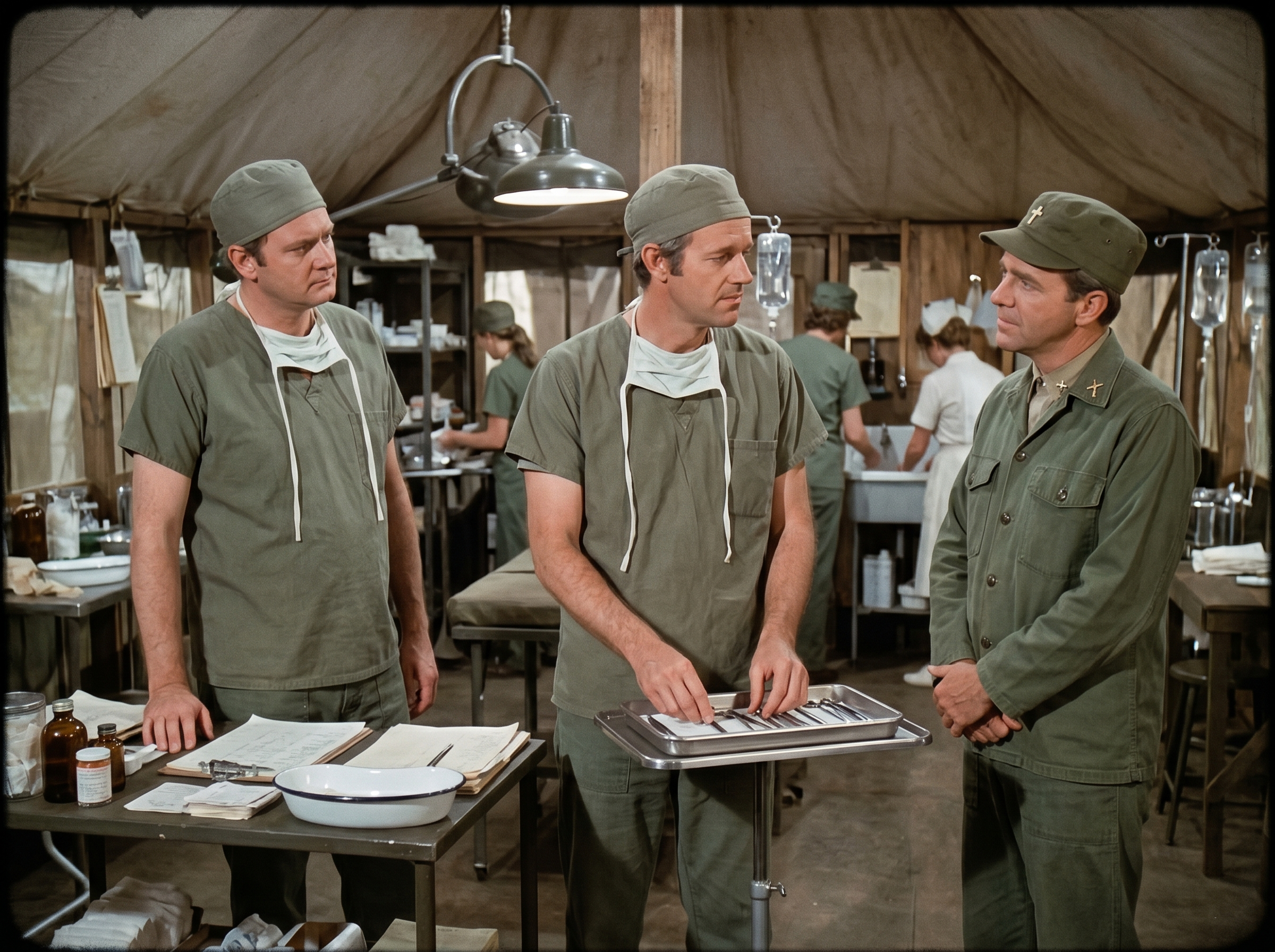
The silence in the 4077th Operating Room was always significantly heavier than the noise.
During a grueling session, the canvas tent was a chaotic symphony of barked orders, clattering metal, and the steady, exhausting hiss of the suction machine. But when the last stitch was tied and the final wounded boy was wheeled away to post-op, the quiet that rushed into the room was thick enough to choke on.
It was hour nineteen of a seemingly endless marathon of meatball surgery.
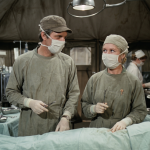
The harsh, blinding glare of the overhead surgical lamps had finally been dialed back. The O.R. was now bathed in the muted, hazy light of a late Korean afternoon, illuminating the pale greens, olive drabs, and faded beige tones of the sterile space.
Captain B.J. Hunnicutt stood by a simple surgical stand, his posture radiating a bone-deep exhaustion.
His green scrubs were wrinkled and worn, carrying the visible toll of the day’s desperate work. His surgical mask was pulled down loosely around his neck, framing a face that looked ten years older than it had when the sun came up.
B.J. was quietly fiddling with a stainless-steel tray of medical instruments.
He wasn’t really organizing them; he was just keeping his hands moving. He nudged a pair of hemostats into line, then shifted a scalpel handle, leaning in with a calm but tightly wound thoughtful concern.
Standing slightly to the right, hands clasped loosely in front of him, was Father John Mulcahy.
The chaplain’s olive-drab cap, adorned with its simple silver cross, sat properly on his head. He looked deeply tired, yet his presence radiated a quiet sadness and an unshakable, hopeful warmth. He was looking directly at the California doctor, his eyes full of earnest attention.
“The nurses tell me the young corporal is resting comfortably, Captain,” Father Mulcahy said softly.
His gentle voice barely rose above the distant, rhythmic thumping of the camp’s generators. “You performed a minor miracle in there. I thought for certain we had lost him.”
B.J. didn’t stop shifting the instruments on the tray.
He kept his eyes focused somewhere between his hands and the chaplain, his expression weary. “It wasn’t a miracle, Father. It was just blind, stupid luck. The shrapnel missed his artery by a millimeter. I didn’t save him; the universe just decided to look the other way for a second.”
A few feet away to the left, Major Charles Emerson Winchester III stood near a prep area, observing the exchange.
His own mask was pulled down, revealing a face completely stripped of its usual haughty Bostonian arrogance. Charles rested his arms near a stack of medical charts, his posture showing nothing but weary dignity and a quiet, reluctant compassion. He was too tired to complain about the mud, the food, or the drafty tent.
He just watched his colleague meticulously arrange the tray, recognizing the silent signs of a surgeon trying to maintain his grip on reality.
“Luck is a terrible surgical assistant, Father,” B.J. continued, his voice tightening with a sudden edge of unspent adrenaline. “You can’t rely on it. You can’t chart it. You just stand there and hope it shows up.”
B.J. picked up a pair of surgical scissors, his grip noticeably tight.
He went to place them down, but his fingers betrayed him with a sudden, violent tremor. The metal scissors slipped from his grasp and clattered loudly onto the stainless-steel tray.
The sharp noise cracked through the quiet tent like a rifle shot, freezing all three men in place.
The metallic echo faded instantly into the heavy canvas walls, leaving a suffocating stillness in its wake.
B.J. stood perfectly frozen, his hand still hovering over the simple medical tray. He stared down at the dropped instrument as if it had personally betrayed him, his shoulders slumping under an invisible, crushing weight.
For a long moment, no one in the room moved.
The muted hospital tones of the O.R. seemed to press inward, isolating the three men in their shared bubble of exhaustion. The war outside the compound felt a million miles away, yet completely suffocating all at once.
Father Mulcahy took a small half-step forward, his hands tightening together as he projected his quiet support.
He opened his mouth to speak, to offer a piece of scripture or a gentle word of grounding comfort, but a voice from the prep area beat him to it.
“Leave the instruments be, Hunnicutt.”
The voice belonged to Charles, but it was remarkably devoid of its usual biting sarcasm.
It wasn’t cloaked in his typical layer of defensive superiority or intellectual mockery. It was simply tired, grounded, and surprisingly gentle.
B.J. slowly turned his head, his posture still leaning over the tray, and looked toward the Major.
Charles didn’t move from his spot. He kept his controlled, dignified stance, his eyes meeting B.J.’s with steady, unspoken understanding. “The tools have surrendered for the day, Captain. Reorganizing them by geometric precision will not retroactively change the terrifying nature of the procedure.”
“I just wanted to make sure the tray was set right,” B.J. said quietly, his voice carrying the rough, hollow edge of fatigue. “Just trying to put things back where they belong.”
“The tray is perfectly adequate,” Charles replied softly.
He offered a slow, deliberate blink, his face a portrait of measured restraint. “And you, Captain, are operating on fumes and a dangerous excess of adrenaline. It is a state I find deeply unbecoming, not to mention entirely useless to the 4077th.”
B.J. let out a short, completely humorless breath that was half-sigh and half-laugh.
He finally stood up straight, letting his hands fall away from the sterile metal surfaces. “You always know exactly what to say to warm a freezing room, Charles.”
“I am not here to warm your room, Hunnicutt,” Charles sniffed gently, though the haughtiness in his voice was a paper-thin veil over his actual concern. “I am simply pointing out that your compulsive tinkering is giving me a headache. And my head is already protesting the vile, motor-oil substitute they dare to call coffee in the mess tent.”
Father Mulcahy smiled warmly, recognizing the Bostonian’s unique, backwards method of offering comfort.
It was the camp’s own strange language of care—insults wrapped in velvet, deflecting the trauma of the day.
“Major Winchester is right, B.J.,” Mulcahy said, stepping slightly closer to the center of the room. “The boy is alive. You did everything you could, and by the grace of whatever you choose to call it, it was enough for today.”
B.J. looked down at his own hands for a moment.
They were steady again. The nervous tremor had passed, leaving behind nothing but a profound, hollow weariness that settled deep into his bones.
“He looked just like a kid who used to deliver papers on my street back home,” B.J. murmured, almost speaking entirely to himself. “Same messy hair. Same terrified look in his eyes when he realized how much trouble he was in.”
A heavy, poignant silence fell over the three men.
It was the unspoken ghost that haunted every corner of the mobile hospital—the constant, crushing reminder of how breathtakingly young the wounded boys on their tables truly were.
Charles looked down at his charts, his face softening for a fleeting second before he expertly reassembled his stoic mask.
“They all look like someone we know, Hunnicutt,” Charles said softly, his voice losing its aristocratic edge completely. “That is the particular, unending cruelty of this miserable place.”
B.J. nodded slowly, acknowledging the rare moment of total, unguarded honesty from the Major.
It was an olive branch, offered in the quiet aftermath of the blood and chaos, reminding him that he wasn’t carrying the madness alone.
“Well,” B.J. sighed, wiping a tired hand across his face. “I suppose I should go check on him in post-op. Just to make absolutely sure the universe is still looking the other way.”
“I will accompany you,” Charles announced, pushing himself away from the prep table with a quiet groan of exertion. “I have a sudden, inexplicable urge to verify that the nursing staff hasn’t entirely botched my post-operative instructions.”
B.J. managed a small, genuine, and exhausted smile. “Whatever you say, Charles.”
Father Mulcahy watched the two men turn together toward the canvas doors of the O.R.
His heart swelled with a quiet, profound affection for these brilliant, broken, beautiful people. They carried the weight of the entire world on their shoulders every single day, yet they always somehow found the strength to carry each other.
“Gentlemen,” Mulcahy called out softly before they could leave.
They both paused and looked back at him, the pale light catching the deep lines on their faces.
“You did remarkably good work today,” the chaplain said, his voice thick with genuine emotion and gratitude. “Both of you. Truly.”
B.J. offered a tired, appreciative nod of thanks.
Charles simply bowed his head in a silent, dignified acknowledgment of the praise before they both pushed open the heavy canvas doors, stepping back out into the reality of the war.
Father Mulcahy remained in the O.R. for a moment longer.
He looked at the perfectly organized tray of instruments left behind, the quiet hum of the surgical lamps above, and felt the lingering sense of deep humanity that simply refused to be extinguished by the surrounding darkness. He folded his hands together once more, closing his eyes in the muted light.
The war raged on outside the gates, but inside the canvas walls, they would always hold back the dark together.