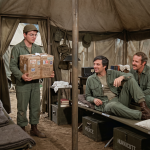
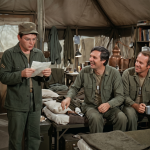
The Music Box in the Mud
Sometimes, the best medicine didn’t come in a vial or a roll of gauze. Sometimes, it arrived in a green metal case.
It was another one of those long, slow-motion afternoons in Korea, where the heat was like a physical weight. The Swamp was sticky and smelled of old coffee, stale tobacco, and the copper tang of antiseptic.
Hawkeye Pierce had found something in a box of personal effects, salvaged from a truck that didn’t make its destination. Not *his* things, of course. Things that belonged to nobody now.
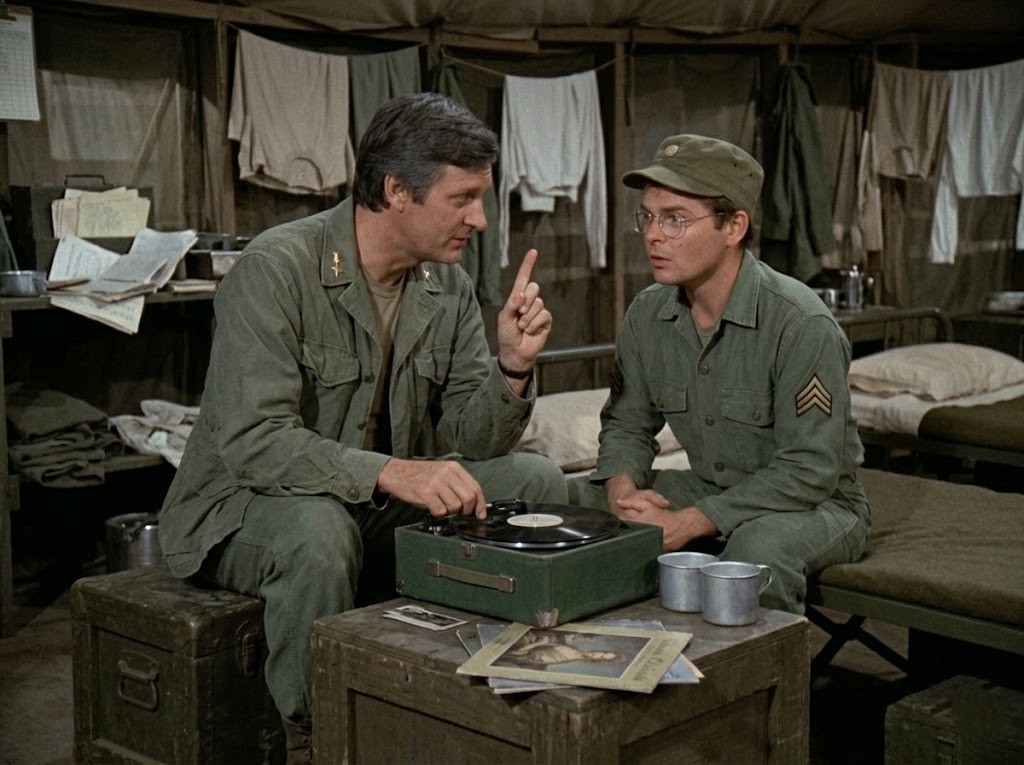
But he saw a small, green metal box. It looked less like official equipment and more like something personal. An old wind-up record player.
He’d wiped off the dried mud, set it on a footlocker, and found a few shellac records. The one he picked was scratched, a single, deep gouge marring the label. “Stardust,” it said, in faded gold ink.
He set the needle down, and the familiar, warm crackle filled the tent. Then, a trumpet rose above the noise, lonely and perfect.
“Would you look at that,” B.J. said, coming in. He’d seen plenty of weird things, but Hawkeye, seated on a footlocker with the intensity of a child discovering fire, was new. “A phonograph.”
“A phonograph, Hunnicutt! The sound of the future. Well, the past. Our past,” Hawkeye replied, not taking his eyes off the spinning black disc.
“Whose is it?” B.J. asked, sitting on his bunk, taking a look at a picture that was part of the small collection next to the player.
“Nobody’s,” Hawkeye said, his voice dropping an octave. “Just… some GI who had good taste.”
They sat and listened. The trumpet gave way to a lush violin section. It was the sound of a country that felt impossibly far away. It was dance halls and dates and air that didn’t smell like burning waste.
The tent flap opened, and a nervous Radar O’Reilly peered in, clutching a fistful of clipboards. “Captain Pierce, the Colonel is asking for the supply re-reqs, and he’s not very, um… he’s in a mood.”
Radar stopped mid-sentence. He heard the music.
“Is that… is that *music*?” Radar asked, his large glasses reflecting the dim tent light.
Hawkeye didn’t answer directly. He held up a single, long index finger, silencing the young corporal.
The music had hit a familiar refrain, the main melody, when the needle reached the deep scratch. It stuck.
*”My star-… my star-… my star-…”* the voice crooned, repeating the word perfectly, endlessly.
Radar blinked. B.J. looked up from his footlocker, a small smile fading. Hawkeye’s index finger remained raised, but his expression had changed. The needle jumped.
“Damn it,” Hawkeye whispered, the playful look vanishing completely, replaced by something much sharper. He stared at the repeating groove, the sound cutting through the tent with annoying precision.
He was Hawkeye Pierce; he was supposed to make everything better, with a joke or a suture. And now, the one thing that had brought a moment of peace was broken, stuck on a perfect, heartbreaking loop. He looked at the player, then at the other men, a desperate tension tightening his jaw.
The needle was still stuck, a mechanical gasp that seemed louder than any artillery.
Radar flinched. The repetition was almost physically painful. B.J. didn’t move, but the photo he held had gone limp in his hands. He was thinking of Peg, and how the music had felt like a message, until it became this stuck record.
Hawkeye continued to stare. He should just lift the arm. It was a single, easy motion. But his hand felt heavy. To lift it was to acknowledge that this moment, too, was broken. It was admitting defeat to a scratch.
“It’s just dust, Hawk,” B.J. said quietly. “Just dust in the groove.”
“Is that all it is, Beej?” Hawkeye shot back, his voice thick with a dry, bitter humor that B.J. recognized instantly. It was his defensive posture. “A little dust. A tiny obstruction. If only everything in this mud puddle was that simple.”
He was picturing the kid the player came from. A little dust, a little piece of metal, a tiny obstruction that stops everything forever.
“I can… I can try to fix it, maybe?” Radar offered, his voice barely a squeak. “I’m pretty good with, you know… things.”
Hawkeye looked at the innocent corporal. Radar saw the machine, not the tragedy. The kid was offering a simple solution to a complex grief.
Hawkeye let out a long, slow sigh. The tension didn’t disappear, but it shifted, dissolving from anger into exhaustion.
“No, Radar. I think we need a specialist for this one,” Hawkeye said, his voice softer, human again.
He slowly lowered his raised index finger. He sat for another minute, listening to the record scratch repeating, *my star-… my star-…*, as if the music itself was stuck in a memory.
With a motion that was both tired and profoundly gentle, Hawkeye reached out and gently nudged the tonearm.
The needle jumped the scratch with a sickening pop, but the music immediately continued. The singer’s voice, *”And now the purple dusk of twilight time…”*, was full again.
It was imperfect. The melody was slightly warped, and the crackling was louder than before. But the song was playing. It was moving forward.
“See?” B.J. said, a genuine smile returning. “Just dust.”
“Good work, Captain,” Radar said, and then he added, “Um, the Colonel still needs those re-reqs.”
Hawkeye took the clipboards from Radar without looking at them. He stood up, but instead of walking away, he picked up the record player, taking the stylus off the disc. He placed it carefully back in its green case.
“Radar,” Hawkeye said, as he moved towards his own bunk to set the case down. “This music box. It stays in The Swamp.”
“Yes, sir,” Radar nodded.
The music was off, and the silence that rushed in was heavy again. But it was a different silence than before.
“I think I need another drink before I can face Potter’s supply-re-req mood,” Hawkeye said, retrieving a mug from a lower footlocker. “Radar, you look like a man who could use a grape soda.”
He had moved on. The record was fixed, the supplies were real, and the next surgery was waiting. They had survived the stuck record.
They would survive the war, too. One scratch, one nudge, one broken moment at a time. The sound of a trumpet, even a imperfect one, was still music in the mud.
*The greatest sound in the world isn’t a flawless symphony; it’s the needle pushing past the scratch.*