The Clipboard Confession
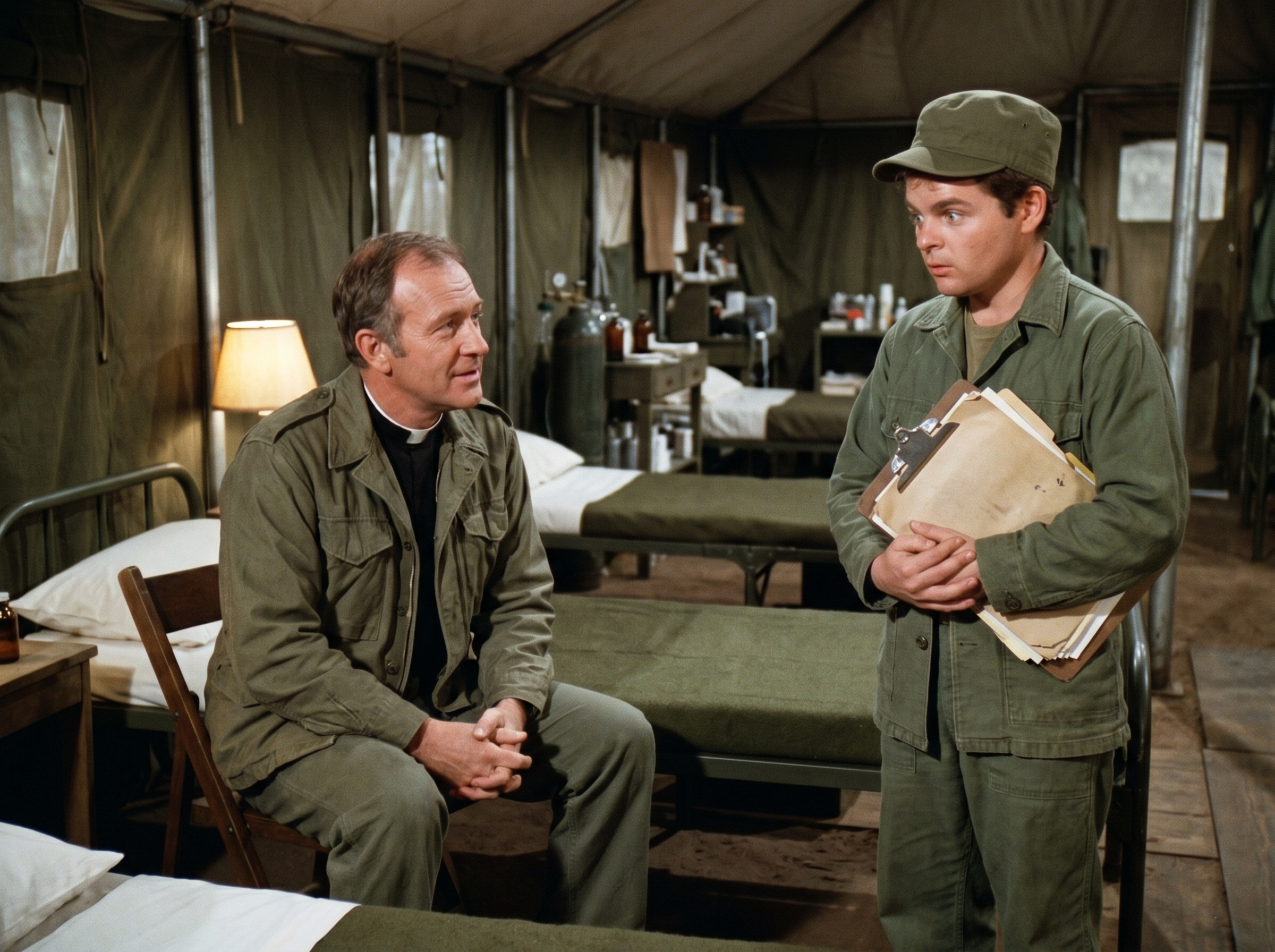
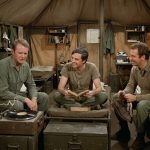
The Post-Op tent in image_0.png is finally quiet, or as quiet as this canvas home ever gets. A soft lamp glow on Father Mulcahy’s makeshift nightstand is the only light, making the empty cots look vast and peaceful. Father Mulcahy is sitting on a small folding chair, his black clerical collar showing beneath his olive uniform, his eyes distant, almost looking inward.
He has been visiting a soldier named Private Davies, whose cot is now empty and perfectly made, like all the others. Mulcahy knows that simple fact is a victory, that the boy was stable enough to move to evacuation hospital. But Davies had been agitated, repeating one thought before the sedative took hold, a confession not about war, but home.
The tent flap swings open, and a stream of cool evening air rushes in, bringing with it the distant rattle of jeep engines and the familiar nervous silhouette of Corporal Walter “Radar” O’Reilly. Radar is always moving, vibrating almost, but tonight his arms are locked around his most constant companion: that overflowing clipboard, which he clutches like a life preserver.
His eyes are wide, and even under his cap, he looks smaller than usual, overwhelmed by the silence he has just broken. He stops a few feet away from the Father, the paper stack on his clipboard rustling slightly in the stillness. He doesn’t say anything at first, just holds the Padre’s gaze, his expression a mix of urgency and deep distress.
Mulcahy notices Radar’s grip. Those young hands, usually busy sorting mail, stamping requisitions, or finding Colonel Potter’s reading glasses, are almost white-knuckled on the wood and paper. Radar takes a step, then another, the tension from him almost visible, like heat off the ground.
Finally, Radar speaks, his voice just a breathless, cracked whisper in the enormous quiet. “Father, I… I need to show you something. I think I found it.” He extends the clipboard, the top paper a chaotic mess of notes and red ink.
Mulcahy takes the clipboard gently, sensing the unusual weight of emotion behind the gesture. He looks down at the topmost sheet. It’s not a standard request or a casualty manifest.
It’s a tangled maze of handwritten lines, arrows, crossed-out names, and lists of units, numbers, and dates. It looks less like official army paperwork and more like a fever dream or a diagram of an impossible hope.
“What am I looking at, Radar?” Father Mulcahy asks, his voice soft, matching the sacred hush of the empty Post-Op.
Radar takes a deep, ragged breath, his cap dipping slightly as he speaks. “It’s for Davies, Father. You know how he was talking… about the farm. About his younger brother. About how they never got to say… goodbye properly. He was so worried his brother wouldn’t… that he’d think…”
The young corporal trails off, fighting back tears. In this quiet place, surrounded by the ghosts of recent pain, his simple, rural innocence is both a source of warmth and a source of profound sadness. Davies had confessed this burden to Mulcahy, but clearly, he had also shared it with the compassionate boy from Ottumwa.
Radar continues, his finger pointing to a chaotic sequence of arrows and unit designations. “I’ve been on the radio. Hours. Talking to clerks I don’t even know, Father. I tracked Davies’ brother through three units. He was transferred to a motor pool, then an engineering battalion, then he was wounded. He’s *there*.”
Radar points emphatically to a line ending at a 121st Evac Hospital unit designation. “He’s there, Father. He’s safe. And I got authorization for a Red Cross communication link. They can get a letter to him *tomorrow* morning before they move Davies again. Davies’ brother is *alive*.”
Father Mulcahy stares at the chaotic clipboard, processing the simple miracle Radar has just performed. While surgeons fought with scalpels, and he fought with prayers, this quiet boy had fought an entire war machine using only a radio, a pen, and a clipboard, searching through the endless paperwork for one vital spark of connection.
It wasn’t a requisition; it was a map. A map to peace for a wounded soldier and his brother.
A smile, slow and warm, spreads across Mulcahy’s tired face. He looks back at Radar, whose eyes are shimmering, a look of desperate hope replacing the initial nervousness.
“Radar,” Father Mulcahy says, his voice thick with emotion, “I believe that clipboard contains one of the finest documents of human compassion I have ever seen.” He rests his hand on Radar’s shoulder. “I will write that letter with you right now, and you will make sure that radio message is sent. Davies needs this, and you, Walter… you are an agent of grace.”
Radar’s shoulders finally relax, and he lets out a quiet sob of relief. The two stand together in the Post-Op tent, surrounded by the empty cots that have held so much suffering, united by the beautiful, human act of paperwork. They sit at the bedside table, the lamp providing enough light for the Father to begin writing. The warm, quiet intimacy of the scene is a reminder that even in a place of war and immense loss, a simple gesture of friendship, love, and tireless commitment can sometimes heal a wound that surgery cannot touch.
In the 4077th, miracles often came disguised as bureaucratic forms and clerical miracles of the heart.