The Ghosts of Christmas Past, Arriving in July
In the 4077th, time wasn’t measured by calendars or clocks.
It was measured by the rhythmic, terrifying chop of incoming Huey helicopters. It was measured by the dwindling stacks of sterile gauze in the supply tent.
And sometimes, it was measured by the sheer, staggering incompetence of the United States Army mail system.
It was the middle of a sweltering, dust-choked afternoon in July. The Korean summer heat was radiating through the heavy canvas roof of the Supply Area tent, baking the air until it smelled like warm wool, iodine, and dried pine.
The camp had just come off a grueling thirty-two-hour surgical marathon. The kind of shift that left everyone hollowed out, moving like ghosts through the compound.
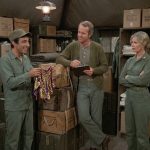
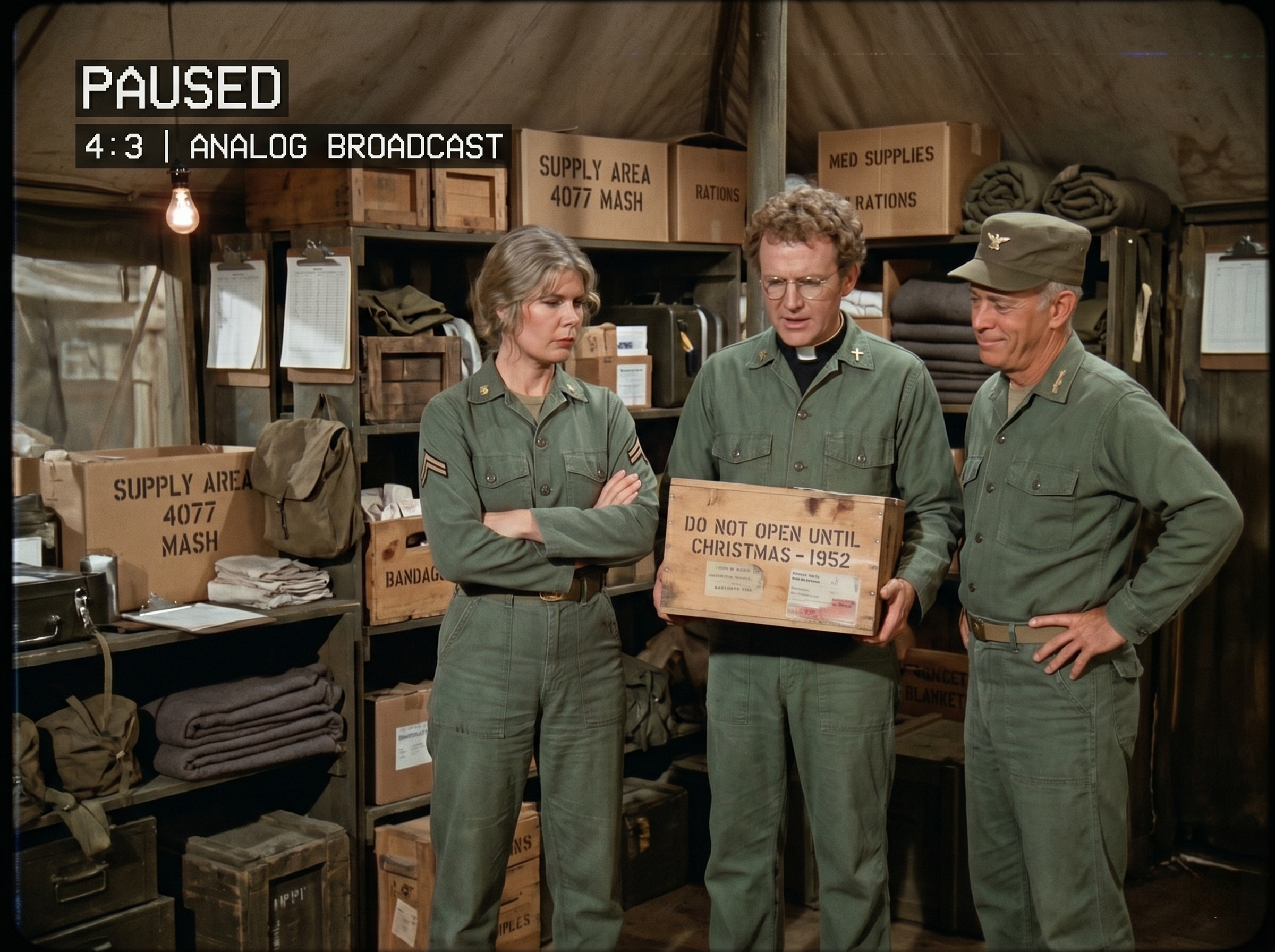
Major Margaret Houlihan stood in the center of the cramped supply tent, her posture as rigid as ever. Her arms were folded tightly across her chest.
Even exhausted, Margaret demanded order. She was currently glaring at a stack of incoming crates, her eyes narrowed in skeptical frustration. She had come looking for fresh surgical soap and decent blankets, but the Army, in its infinite wisdom, had sent something else entirely.
“I just don’t understand it,” Margaret said, her voice tight with that familiar, demanding edge. “We requisition critical medical supplies. We need plasma. We need penicillin. And what does I Corps send us?”
Beside her, Father Mulcahy offered a mild, profoundly confused expression.
The gentle priest was holding a medium-sized wooden crate. He held it carefully, almost reverently, his fingers resting on the rough, splintering pine.
“Well, Margaret,” Mulcahy said softly, tilting the box to examine the faded stencil on the side. “I don’t believe this is penicillin at all.”
Stamped across the raw wood, in bold, undeniable black ink, were the words: DO NOT OPEN UNTIL CHRISTMAS – 1952.
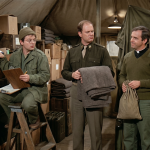
Colonel Sherman T. Potter stood just a few feet away, framed by stacks of olive-drab rations and canvas bags.
He had his hands planted firmly on his hips, his green fatigue shirt damp with the afternoon heat. His face was a map of deep, weary lines, but his eyes held a warm, unmistakable twinkle of dry amusement.
“Sufferin’ saddlebags,” Potter muttered, shaking his head slowly. “Only the military could manage to lose a box of Christmas cheer for eight solid months, only to drop it in our laps during the hottest week of the summer.”
Margaret didn’t find it funny. She stepped closer, her eyes scanning the faded paper labels stuck to the wood.
“Colonel, this is completely unacceptable,” she insisted, her voice rising just a fraction. “If they can lose a crate for eight months, they could lose our medical shipments just as easily. For all we know, this is a box of surgical instruments that someone mislabeled in Tokyo, and it’s been sitting on a dock gathering rust!”
Mulcahy looked down at the crate, his brow furrowing with gentle concern.
“Oh dear. Do you really think so, Major?” he asked. “It feels rather… light for surgical tools. And if you listen closely…”
The priest gave the wooden box a very gentle shake.
From deep inside the crate, there was a soft, muffled rustling sound. It didn’t sound like metal. It sounded like paper. Like something fragile and forgotten.
Potter sighed, a long, tired sound that seemed to carry the weight of three different wars. He dropped his hands from his hips and stepped forward, reaching into his pocket.
“Well, folks,” Potter said, pulling out a sturdy metal pocket knife. “There’s only one way to find out if we’re dealing with rusty clamps or delayed holiday cheer.”
Margaret uncrossed her arms, her skepticism suddenly warring with a very human, very silent spark of curiosity.
Mulcahy set the crate down gently on a stack of folded army blankets. The dust motes danced in the shaft of sunlight above them.
Potter snapped the blade of his knife open. He wedged it under the edge of the wooden lid, right beneath the faded 1952 stamp.
The three of them leaned in close. The war outside the tent—the distant roar of jeep engines, the shouting of orderlies—seemed to fade away entirely.
Potter pushed down on the handle. The old wood gave a loud, agonizing crack, echoing sharply in the quiet tent.
The wooden lid popped loose with a final screech of rusty nails.
Immediately, a distinct, incredibly out-of-place scent filled the sweltering canvas tent. It wasn’t the smell of rust or surgical steel.
It was the smell of cinnamon.
It was the faint, unmistakable aroma of dried pine needles, stale peppermint, and old, sweet paper.
Potter carefully lifted the wooden lid and set it aside. He looked down into the crate, his eyes softening instantly.
“Well, I’ll be,” Potter whispered, the dry humor leaving his voice, replaced by something deeply reverent.
Margaret leaned over his shoulder, her strict military bearing melting away in a matter of seconds.
The crate was packed to the brim with crumpled newspaper from a small town in Ohio. Nestled within the faded headlines were dozens of hand-wrapped packages.
They were wrapped in bright red and green paper, the colors slightly faded from months of transit. Tucked among the packages were stacks of handmade cards, cut from cheap construction paper and covered in the clumsy, earnest crayon scribbles of young children.
Mulcahy reached into the box, his hands trembling just a little. He pulled out one of the paper cards.
“To the brave doctors and nurses,” Mulcahy read aloud, his voice thick with sudden emotion. “Thank you for fixing the soldiers. From Mrs. Gable’s third-grade Sunday school class.”
Margaret stared at the crayon drawing. It was a crude picture of a nurse with a giant red cross on her hat, standing under a massive, brightly colored sun.
“Oh,” Margaret breathed. It was just one syllable, but it carried a universe of exhaustion, homesickness, and sudden, heartbreaking tenderness.
She reached into the crate and carefully lifted out a heavy, lumpy package. The green wrapping paper fell away to reveal a hand-knitted woolen scarf.
It was a garish shade of bright orange, the stitches uneven and dropping in places. It was the kind of scarf only a mother—or a very determined ten-year-old—could love.
Margaret held the thick wool in her hands. In the ninety-degree July heat, it was the most useless object in the entire camp.
Yet, she pulled it slowly to her chest, holding it tight against her olive-drab fatigues. Her eyes were suddenly shining with unshed tears.
“It’s beautiful,” she whispered fiercely, daring anyone to contradict her.
Potter reached in and pulled out a small, crushed cardboard box. He pried it open. Inside was a batch of what used to be chocolate Santa Clauses.
After eight months of sitting in ship holds, truck beds, and sunny loading docks, they had completely melted and re-solidified into one giant, unrecognizable block of sweet, chalky chocolate.
Potter held up the brown block, a fond, wistful smile spreading across his face.
“Looks like Saint Nick had a rough time over the Pacific,” Potter said gently. “But I imagine it tastes just as sweet.”
Mulcahy was smiling now, a radiant, peaceful expression that made the dusty supply tent feel briefly like a cathedral.
“You know,” the Father said, looking at the two of them. “It may be the middle of summer. And the calendar may say 1953. But I believe the spirit of the season has finally found its way to the 4077th.”
Margaret wiped a quick, stealthy hand across her cheek, turning her face slightly so the others wouldn’t see. She carefully folded the orange scarf and draped it over her arm, treating it with more care than she gave a general’s uniform.
“We should distribute these,” Margaret said, her voice back to its usual authoritative clip, though the tremor of emotion was still there. “The patients in post-op. A handmade card from home might do them more good than another dose of morphine today.”
Potter nodded slowly. He looked at the melted chocolate, the crayon drawings, and the useless, beautiful winter scarves.
“I think that’s a fine order, Major,” Potter said softly. “A damn fine order.”
For a few minutes longer, the three of them just stood there in the stifling heat of the supply tent. They didn’t move to leave.
They simply stood together around the open wooden crate, surrounded by the smell of stale cinnamon and the ghostly echoes of a Christmas they had all missed.
They were thousands of miles from home. They were exhausted, filthy, and entirely worn down by the endless grind of the war.
But in that quiet, cluttered space among the canvas bags and clipboards, they weren’t just officers in a mobile army surgical hospital. They were a family, sharing a delayed miracle from a world they were fighting to get back to.
Potter finally clapped his hands together, breaking the spell but keeping the warmth.
“Alright, Padre,” Potter said, picking up the block of melted chocolate. “Grab those letters. Let’s go spread a little July joy before this chocolate melts on us again.”
Mulcahy gathered the crayon cards to his chest. Margaret held the orange scarf tight.
As they walked out of the dim tent and back into the blinding Korean sun, the war was still waiting for them.
But somehow, the burden felt just a little bit lighter to carry.
In a place where tomorrow was never promised, sometimes a little love from yesterday was exactly what you needed to survive today.