A Cup of Something Resembling Coffee
There were days at the 4077th when the war was terrifyingly loud, and then there were days when the silence was deafening.
On those quiet days, the mess tent became the true battlefield. It wasn’t enemy artillery you had to brace yourself for, it was whatever culinary disaster was being served out of a battered metal tin.
On this particular gray afternoon, the scent of boiled canvas, damp earth, and scorched powdered milk hung heavily in the air. The O.R. had been mercifully empty since the early hours of dawn, leaving the camp with nothing to do but dread the call to lunch.
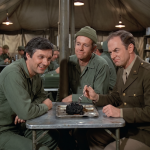
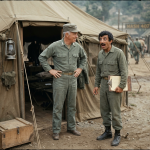
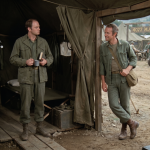
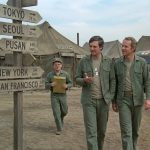
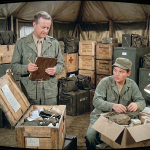
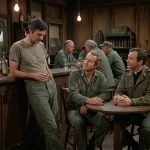
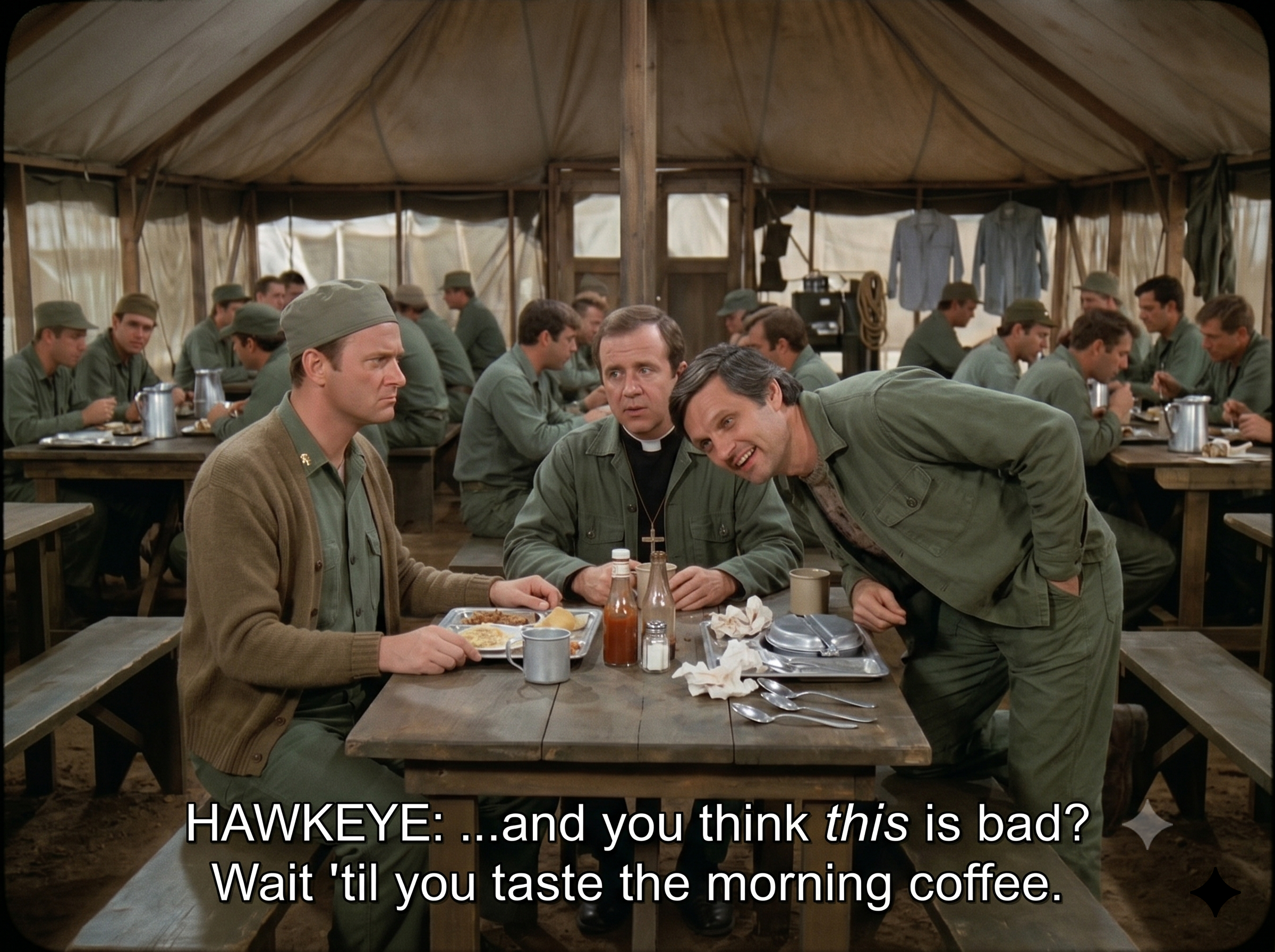
The mess tent was filled with the ordinary, lived-in clutter of a mobile army hospital. Long, splintering wooden tables stretched across the dirt floor, packed with exhausted doctors, nurses, and enlisted men in wrinkled olive drab.
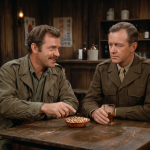
Sitting rigidly upright at one of these tables was Major Charles Emerson Winchester III.
He wore his thick brown cardigan like a layer of armor, though it offered absolutely no protection against the indignities of the United States Army. Charles stared down at his dull metal tray. His face was a perfect portrait of restrained irritation and dry, aristocratic superiority.
On his tray sat a beige, unidentifiable lump of something that had clearly given up on life long before it reached his plate. Charles hadn’t touched a single bite. He looked as though he were waiting for the food to introduce itself and apologize.
Sitting directly across the table from him was Father Mulcahy.
The gentle priest wore his green fatigue jacket over his clerical collar, his hands gently wrapped around a thick ceramic mug. Mulcahy was holding the mug as if trying to absorb whatever meager warmth it had left.
His expression was a picture of mild, innocent confusion, mixed with a soft, genuine concern for the major’s silent suffering.
“It’s… well, it certainly looks hearty today, Major,” Mulcahy offered softly, his voice a soothing balm against the clatter of the tent. “Perhaps if you close your eyes and imagine it as a rustic Bostonian stew?”
Charles slowly raised his eyes from the tray to meet the padre’s. “Father, if I close my eyes, my imagination immediately conjures up the sanitary conditions of the enlisted men’s kitchen. I assure you, it does absolutely nothing to improve the bouquet.”
Before Mulcahy could offer another comforting platitude, a familiar shadow fell across the wooden tabletop.
Hawkeye Pierce stood at the end of the bench. He was slouching heavily, his hands buried deep in the pockets of his worn green fatigues. He looked exactly like a man who had slept for three hours in the last three days.
Despite the deep rings of exhaustion lining his eyes, Hawkeye wore an irreverent, playful smile. He had spotted Charles’s culinary crisis from across the tent, and like a moth drawn to a spectacularly arrogant flame, he couldn’t resist.
Charles picked up his fork, holding it aloft like a tiny, futile weapon against the beige lump. His jaw tightened. He was one bad joke away from marching back to the Swamp and declaring a personal hunger strike.
Hawkeye leaned in closer, his casual grin widening. He knew exactly how close Charles was to snapping, and he was more than happy to give the final push.
“Don’t look at it directly, Charles,” Hawkeye warned, his voice dropping into a dry, theatrical whisper. “It senses fear. If you show weakness now, it’ll crawl right up your spoon and take your wallet.”
Charles didn’t even blink. He kept his gaze fixed straight ahead, exhaling a long, incredibly weary sigh through his nose.
“Pierce,” Charles enunciated perfectly, his Boston accent cutting through the dull roar of the mess tent. “I have endured the mud, the freezing cold, and your incessant, juvenile prattle. But this… this gelatinous insult to the culinary arts is where I draw the line.”
He pushed the metal tray exactly one inch away from him. It scraped harshly against the rough wood, sounding entirely too loud.
Hawkeye chuckled, shifting his weight. He looked down at the offending tray, then back up at Charles’s deeply offended expression.
“And you think this is bad?” Hawkeye delivered his punchline with a perfectly timed, deadpan smirk. “Wait ’til you taste the morning coffee.”
Father Mulcahy blinked at the joke, looking down at the dark, sludgy liquid currently resting in his hands. He took a tiny, hesitant sip.
The priest’s face instinctively scrunched up. He swallowed hard, tapping his chest twice as if to help the liquid find its way down his throat.
“Oh, my,” Mulcahy whispered, his eyes watering slightly. “It does have a rather… robust finish today, doesn’t it? It leaves a distinct feeling of… regret.”
Charles finally broke his stoic posture, letting out a sharp, genuine bark of laughter. He quickly stifled it, clearing his throat and adjusting the collar of his cardigan to regain his composure.
That brief flash of amusement was all Hawkeye needed. The rigid tension in Charles’s shoulders dropped just a fraction of an inch, the heavy burden of the day lifting slightly.
Hawkeye pulled his hands from his pockets and swung his leg over the bench, dropping down into the seat next to Charles. He didn’t have a tray of his own; he was just there for the company.
“You know, Winchester,” Hawkeye said, his voice suddenly losing its sarcastic edge. “Back in Crabapple Cove, my dad used to make a meatloaf that could double as a doorstop. But even he wouldn’t claim whatever it is you’re staring at.”
Charles looked at Hawkeye, an eyebrow raised in mild suspicion. “Are you attempting to commiserate with me, Pierce? Because if so, your bedside manner is as dreadful as this meal.”
“I’m just saying,” Hawkeye replied softly, reaching out to steal a piece of dry, crumbly bread from Charles’s tray. “We’re all in the same leaky boat. And right now, the boat is serving mystery meat.”
He took a bite of the stolen bread and immediately grimaced, chewing with exaggerated difficulty.
Father Mulcahy smiled gently at the two surgeons. It was a familiar, comforting dance. The sharp insults, the endless complaints, the dry humor—it was exactly how they survived the endless hours when the choppers weren’t flying.
The mess tent was loud around them, filled with clattering trays, tired laughter, and the low hum of a hundred displaced people trying to pretend they were anywhere but a war zone.
“Father,” Charles said, his voice surprisingly soft. He reached out and gently pushed his own untouched mug of coffee across the table toward the priest. “If you intend to survive this ordeal, you may need a second cup to kill the taste of the first.”
Mulcahy’s smile widened, bringing a warm light to his tired eyes. “Thank you, Major. A true act of Christian charity.”
Hawkeye swallowed the dry bread with a wince and leaned his elbows heavily on the beige tabletop. He looked at Charles, then at Mulcahy, the playful spark returning to his exhausted eyes.
“Well, if we’re in a sharing mood,” Hawkeye said, “who wants to split my powdered eggs? I think they’re finally starting to hatch.”
Charles groaned, rolling his eyes upward toward the canvas ceiling, while Mulcahy let out a soft, melodic laugh that carried over the noise of the room.
They sat there together at the simple wooden table, surrounded by the practical, worn clutter of the 4077th. The food was undeniably terrible, the coffee was practically toxic, and the brutal reality of the war was waiting just outside the canvas flaps.
But in that small, quiet moment over a bad meal, the heavy weight of Korea felt a little lighter.
They were just three tired men, sharing the misery of a terrible lunch, finding a fleeting moment of grace and humor in the worst place on earth.
Sometimes the worst coffee in the world is exactly what you need, as long as you’re drinking it with the best of friends.