The Amber Light at Rosie’s
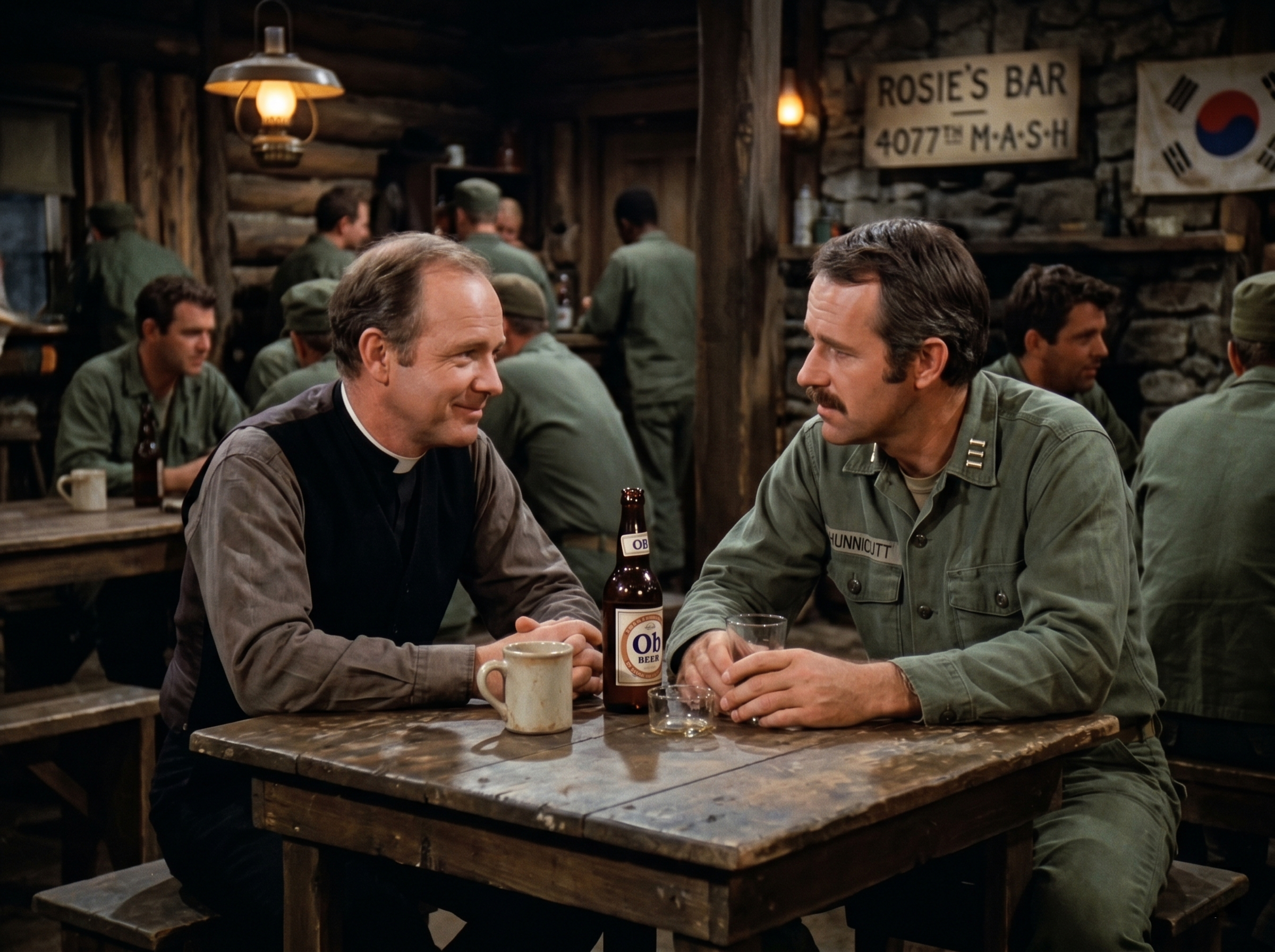
The war usually stopped at the rickety wooden door of Rosie’s Bar.
It was a small, rustic sanctuary, smelling faintly of stale beer, cooked pork, and damp wood. The walls were worn and tired, patched together with scavenged lumber and stubborn survival.
Inside, the warm amber glow of practical table lamps cast soft shadows across the room. It was a gentle, forgiving light. It was the kind of light that hid the dark circles under a surgeon’s eyes and softened the harsh realities of the 4077th.
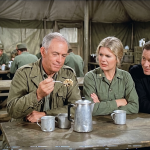
Captain B.J. Hunnicutt sat at a small corner table, hunched forward over a chipped ceramic cup.
He was out of his scrubs, dressed in his worn, lived-in olive drab fatigues. His arms rested loosely on the table, his posture completely relaxed, letting the heavy exhaustion of a thirty-six-hour shift drain into the scuffed floorboards.
Sitting directly across from him was Father Francis Mulcahy.
The priest wore his standard, modest fatigues, his collar a small patch of stark white in the dim, brown-toned room. Mulcahy was nursing a lukewarm cup of tea, perfectly content to simply share the quiet space.
For a long time, neither man spoke. The hum of a distant generator and the faint murmur of other patrons at the bar provided a soothing, steady backdrop.
B.J. stared down into his cup, tracing the rim with his thumb. His dark eyes were warm, but they held a deep, quiet ache. It was the specific, heavy kind of homesickness that only struck when the operating room was finally empty.
“Mail call was early today, Father,” B.J. finally said, his voice low and soft.
Mulcahy leaned in just a fraction, his posture radiating a sincere, compassionate warmth. “Oh? Good news from home, I hope, Captain?”
B.J. offered a small, bittersweet smile. He reached into his chest pocket and pulled out a letter. The envelope was already soft and creased, having been read half a dozen times between triage sessions.
“A letter from Peg,” B.J. murmured, tapping the paper gently against the wooden table. “And a photograph.”
He didn’t show the picture to the priest. Instead, he just held it in his hand, looking at the worn table as if projecting the image onto the wood.
“Erin is walking, Father. Really walking. Not just holding onto the coffee table, but crossing the living room all by herself.”
Mulcahy’s face broke into a gentle, genuine smile. “That is wonderful news, B.J. A true milestone. You must be incredibly proud.”
“I am,” B.J. said quietly. “I am so proud I could burst.”
But the smile didn’t quite reach B.J.’s eyes. The warm amber light seemed to catch the sudden, shimmering moisture gathering along his lower lashes. He leaned closer to the table, his broad shoulders curving inward.
“She was wearing a little yellow sundress,” B.J. continued, his voice barely above a whisper. “Standing right there on our front porch in Mill Valley. The sun was shining. The grass was green.”
He stopped, taking a slow, shaky breath. The contrast was too much. The beautiful, vibrant reality of California felt like a million miles away from the mud, the canvas, and the blood of Korea.
“I missed it, Father,” B.J. said, the weight of the war finally pressing down on his chest. “I missed her first steps. I missed her first word. I’m missing the best parts of my own life.”
Mulcahy remained silent, his soft eyes locked on B.J., offering a steady anchor in the sea of the captain’s grief.
B.J. looked up, his eyes meeting the priest’s. The easygoing, quietly funny doctor was gone for a moment, replaced by a terrified father.
“What happens when this is all over, Father?” B.J. asked, his voice cracking with an unresolved tension. “What if I step off that train, and I walk up to that porch, and I’m just… a stranger? What if this place takes so much out of me that I don’t know how to be the man they need anymore?”
Father Mulcahy did not rush to fill the silence.
He understood the profound weight of the doctor’s fear. In a place that demanded so much blood and sweat, it was easy for a man to feel like his soul was slowly being drained away, drop by drop.
The priest folded his hands modestly on the table. He leaned forward compassionately, his expression softening into a look of absolute, unwavering kindness.
“B.J.,” Mulcahy began, his voice a gentle, steady murmur that seemed to perfectly match the warm lighting of Rosie’s. “I think you are looking at this through the wrong end of the telescope.”
B.J. blinked, a silent question in his exhausted eyes. He let the letter rest flat against the wood.
“You worry that this place is turning you into a stranger,” Mulcahy said gently. “You worry that the war is erasing the man who lived in Mill Valley. But I sit across from you, and I look at you, and I see something entirely different.”
Mulcahy reached out, lightly tapping the creased envelope with his index finger.
“Do you know what happens to men who truly lose themselves in a place like this, Captain? They stop hurting.”
B.J. frowned slightly, absorbing the words.
“They stop feeling the distance,” Mulcahy continued, his soft smile holding a profound, fatherly wisdom. “They build walls. They become cynical. They stop carrying the photographs in their pockets because the pain of looking at them becomes too much to bear.”
The priest paused, letting the ambient noise of the rustic bar settle around them. The faint clinking of glasses. The quiet murmur of conversation.
“But you, B.J.,” Mulcahy said warmly. “You carry that ache with you every single day. You hold onto it. You let it hurt.”
B.J. let out a long, heavy breath, leaning his head resting on his hand. “It hurts like hell, Father.”
“I know it does,” Mulcahy said, his eyes radiating a deep moral comfort. “But that pain is your shield. That homesickness you feel? That is the very thing that is keeping you human.”
The amber light flickered slightly, casting a warm glow over the simple wooden table.
“When you are standing in the operating room for thirty hours,” Mulcahy said softly, “fighting to save the life of an eighteen-year-old boy you’ve never met… you aren’t doing it because you are a soldier. You are doing it because you are a father.”
B.J. looked down at the letter again. The heavy, suffocating fear that had gripped his chest slowly began to loosen.
“You see every boy on that table as someone’s son,” Mulcahy said. “Because you know exactly how much a parent loves their child. That love for your family hasn’t been replaced by the war, B.J. It is the very thing guiding your hands.”
The profound empathy of the priest’s words settled over the table like a warm blanket.
B.J. picked up the ceramic cup, running his thumb over the chipped edge once more. The tension in his broad shoulders finally melted away. He looked back up at Father Mulcahy, the deep homesickness in his eyes now mixed with a profound, quiet gratitude.
“So,” B.J. said, a faint hint of his dry, familiar humor returning to his voice. “You’re saying I’m stuck being me?”
Mulcahy’s smile widened into a delighted grin. “I am afraid so, Captain. For better or for worse, the man who eventually steps off that train in California will be the exact same loving father who left.”
“I don’t know, Father,” B.J. mused, leaning back in his chair with a soft sigh. “I think I might be a little worse for wear. I’ve developed a highly questionable tolerance for whatever it is Rosie puts in these cups.”
Mulcahy chuckled, a gentle, familiar sound that felt like home.
“Well,” the priest conceded, his eyes twinkling in the dim light. “I am sure Peg will forgive you for that minor transgression. Though I would strongly advise against trying to recreate Rosie’s recipes in your own kitchen.”
“I think the Mill Valley fire department would agree with you,” B.J. smiled.
He carefully picked up the letter and the photograph, sliding them back into his chest pocket. He patted the pocket gently, right over his heart. The pain of missing them was still there, a constant companion in the Korean dirt, but it no longer felt like a burden. It felt like a tether.
They sat together in the quiet corner of the bar, two friends sharing a moment of peace before the war demanded their return.
The amber lamps glowed warmly against the worn walls, holding the darkness at bay for just a little while longer.
Some wounds don’t need a surgeon to heal; they just need a quiet corner, a warm light, and a friend who knows exactly how to listen.