The Wrong Kind of Brass
Sometimes, the loudest moments at the 4077th didn’t come from the OR.
They came from the office. Usually involving a misplaced file, a missing radio part, or, and this was our bread and butter, Corporal Klinger.
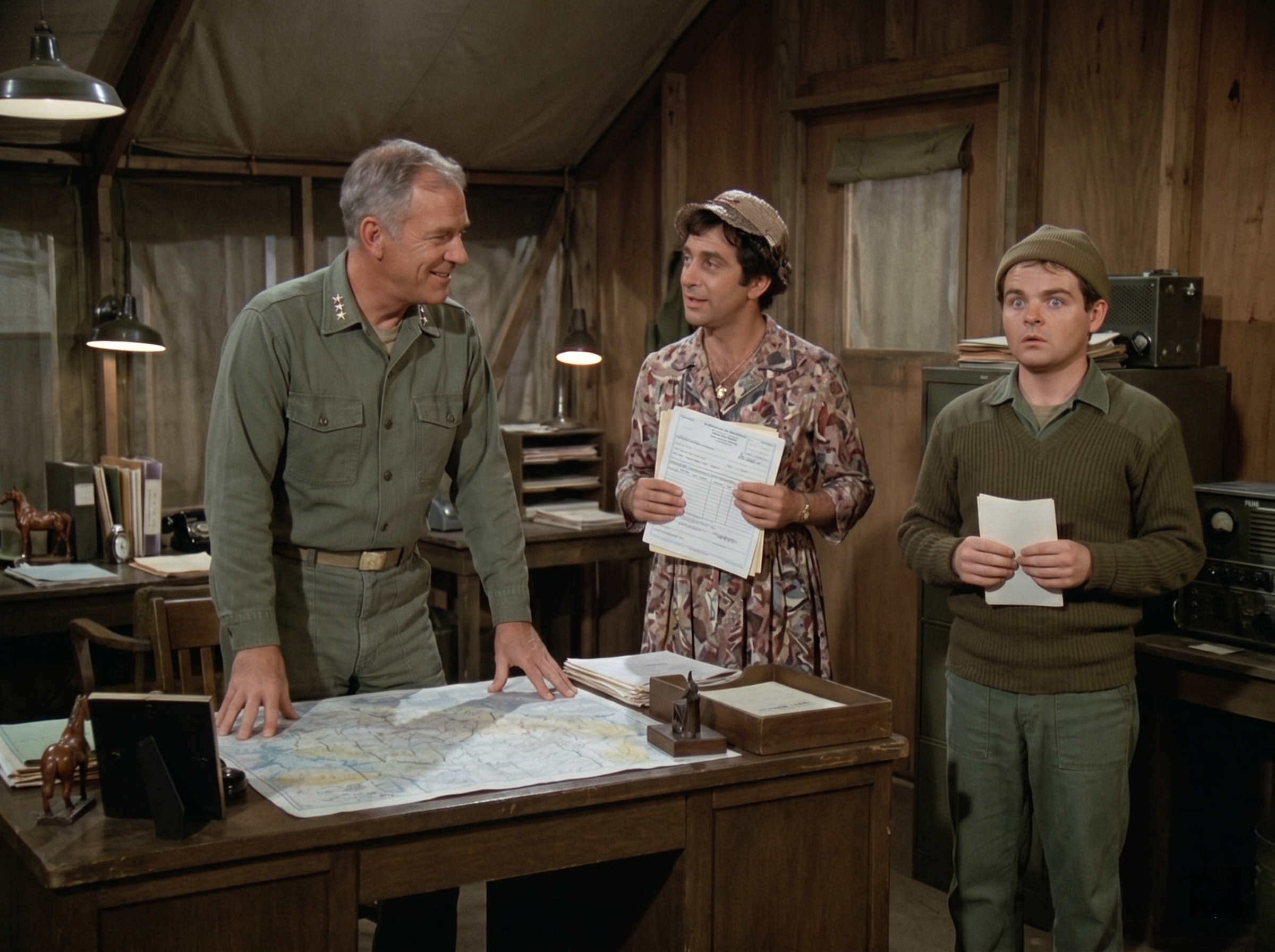
In the late afternoon haze, the usual organized chaos of the camp seemed to settle. Radar was buzzing around the paperwork. Colonel Potter was at his desk. And Max Klinger was trying, yet again, to navigate the complex geography of a psychiatric discharge.
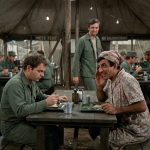
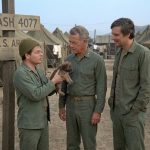
His outfit that day was a particularly bold choice: a patterned housedress in muted earthy tones, complete with a straw sun hat. It didn’t look comfortable, and it definitely didn’t look Regulation. Klinger was holding a thick stack of papers, his expression a mix of desperate rehearsal and genuine hope.
Radar, as always, was his cautious sidekick. Clutching a small set of index cards—probably important, almost certainly forgotten by someone else—he was radiating his usual nervous energy. He’d seen Klinger try this before, but today felt different. There was a weird vibration in the air, a tension beneath the familiar dynamic.
“Klinger,” Radar whispered, eyes darting from his cards to the Colonel’s broad back. “Are you sure? This one looks… complicated.”
“My final appeal, Radar!” Klinger hissed back, adjusting the floral brim of his hat. “This is the big one. It’s got character, nuance, and 12 supporting affidavits.”
Radar looked at the desk. At the neat stacks. At the small brass horse figurine. It felt less like an office and more like a high-stakes poker game, only the chips were Sanity Points and the dealer was a very weary, very experienced Colonel.
Colonel Potter didn’t turn around immediately. He was leaning over a large map of the entire peninsula, his hands braced flat against the wood. We all knew that posture. That was the look of a man carrying the weight of the whole world, and whose horse-sense was currently being tested.
When he finally straightened up, he didn’t look at Klinger. He looked right *through* him, focusing on something distant outside the window. A half-smile played on his lips, but it was the kind of smile that made your stomach drop. It was the smile of a man accepting a very bad, very permanent, hand of cards.
Radar stopped breathing. He’d seen the Colonel tired. He’d seen him angry. He’d seen him sad. But he had never seen him look *lost* quite like this. It was an quiet, powerful absence.
“Colonel?” Radar prompted, his voice cracking slightly, holding the small index cards like a lifeline. He wasn’t sure what he was asking for. Just… for Potter to be Potter again.
Colonel Potter blinked. He took a slow breath, then turned his focus back to the man standing before him in the floral housedress. He studied Klinger. It wasn’t the look of frustration. It was the careful, appraising look a doctor might give a complicated patient. He took in the patterned fabric, the straw hat, the sheaf of papers. And that small, heartbreakingly distant smile remained.
He seemed to be seeing Klinger differently, as if through a new, much softer lens. It was as if all the theatricality and the desperate absurdity had just been stripped away, leaving only the raw, shared fatigue of two men wearing different uniforms of distress.
Potter looked up from Klinger’s papers and met the man’s eyes directly. His own gaze was soft, completely devoid of sarcasm. It was filled with a warm, unspoken understanding that Klinger had never encountered from a superior officer in his entire, creative life.
A profound, quiet stillness settled in the room. Even the radio static seemed to fade. Radar held his breath, watching the silent communication pass between the two men. It felt like they were the only people in the world who truly got it.
“Max,” Colonel Potter said, his voice quiet but clear. It wasn’t the commanding tone of the Colonel. It was the voice of the wise, weary father.
Klinger froze. The dramatic protestation he’d spent hours rehearsing just melted away. He let the papers dangle slightly, the fight simply draining out of him. He realized in that instant that his entire act had just been rendered obsolete by something much more powerful: a simple, unconditional acknowledgment.
He saw the lines of care etched into the Colonel’s face. He saw the same bone-deep exhaustion reflecting back at him. This wasn’t about a discharge anymore. This was about being *seen*. Really seen. Not as a joke, not as a lunatic, but as a fellow human being struggling through a nightmare, in the only way he knew how.
Klinger didn’t argue. He didn’t plead. He simply closed his mouth. A slow, tentative smile began to mirror the Colonel’s own, breaking through the absurdity of the straw hat. Radar breathed again, a quiet sigh of relief. The world felt okay, for a moment.
Potter patted the stack of papers on his desk, his touch surprisingly gentle. The small brass horse caught a glint of the setting sun, a familiar sentinel in the shared storm.
Sometimes the most important thing wasn’t winning, but being recognized as a comrade-in-arms, even in floral chintz.