The Quiet Echo of a Thousand Letters
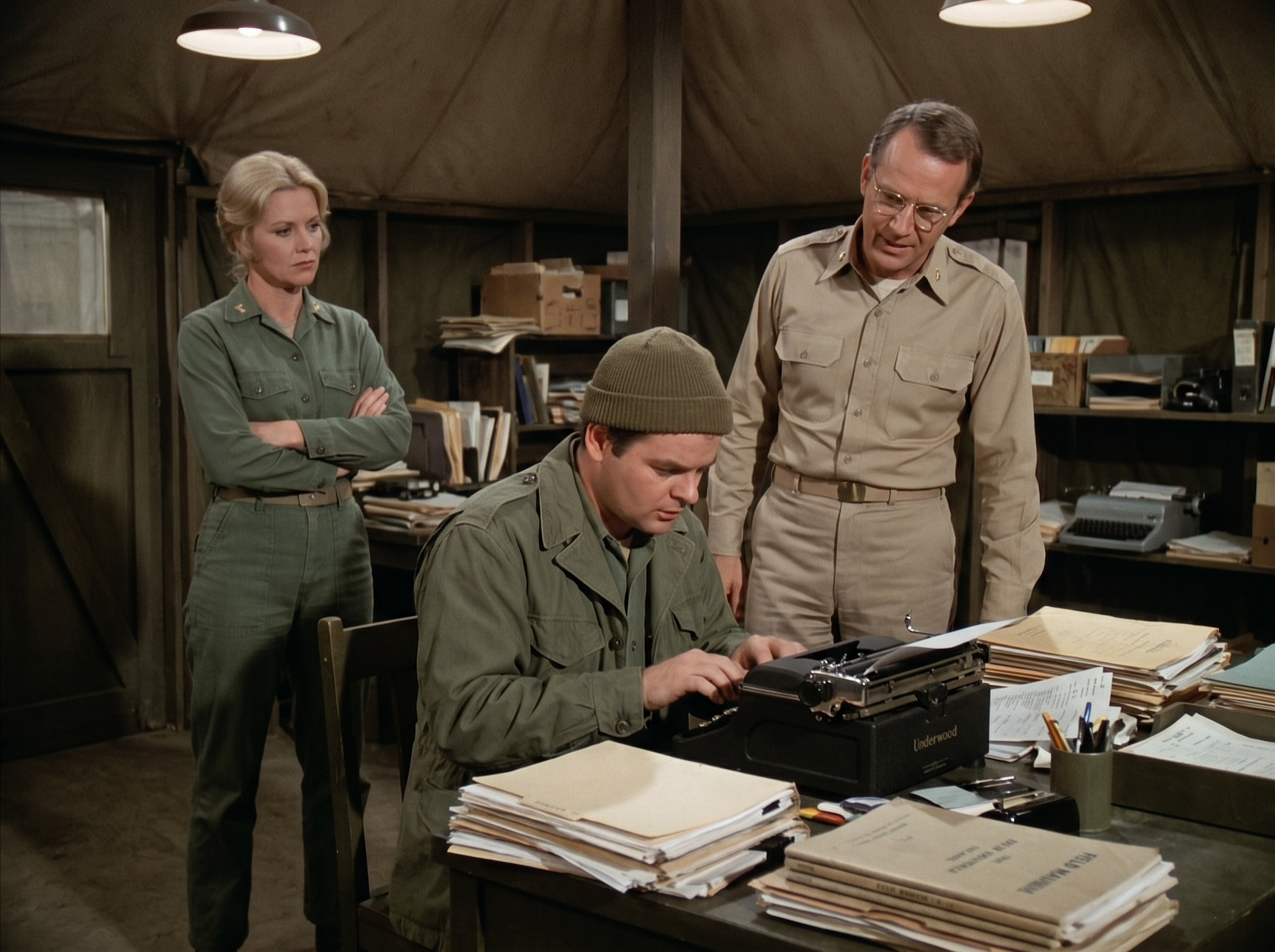
The air in the 4077th administrative tent always tasted of dust, stale coffee, and the frantic, rhythmic clacking of a typewriter that never seemed to get enough rest. Outside, the war was a distant rumble, a reminder of the world’s madness, but inside, it was just the three of them, caught in the strange, suspended animation of a long afternoon.
Radar sat hunched over the Underwood, his brow furrowed beneath that ever-present knit cap as if he were trying to translate the very heartbeat of the camp into official correspondence. He was typing with a focused, desperate intensity, his fingers dancing across the keys while Margaret stood just a few feet away, her arms tightly crossed over her chest. She wasn’t shouting orders today; she was simply watching, her face a carefully constructed mask of professional rigidity, yet there was a softness around her eyes that betrayed a deep, weary concern.
Colonel Potter loomed behind them, hands on his hips, his gaze fixed on the paper sliding through the carriage. He looked tired, the kind of exhaustion that settled deep into the bones, but he stood tall, a steady anchor in a sea of shifting circumstances. The tension in the room was thick enough to cut with a scalpel—a palpable, heavy silence that hadn’t been broken for nearly ten minutes.
Suddenly, Radar stopped. He froze, his fingers hovering over the keys, and the abrupt absence of sound felt like a physical blow. He slowly pulled the sheet of paper from the machine, his hands trembling just enough to be noticed, and looked up at the Colonel.
“I can’t do it, sir,” Radar whispered, his voice cracking with a vulnerability that turned the air in the tent cold. “I’ve tried to phrase it three different ways, but every time I read it back, it just… it doesn’t sound like him at all.”
Colonel Potter didn’t reach for the paper. Instead, he let out a long, slow breath, the sound whistling through his teeth as he looked at the younger man with a look of profound, fatherly empathy. Margaret unfolded her arms, her posture shifting from that of a rigid officer to a woman who had seen too many boys grow up too fast. She took a step closer, her heels clicking softly against the dirt floor, and leaned over to look at the letter.
“Radar,” she said, her voice unusually gentle, stripped of its usual sharp, military edge. “You’re trying to summarize a man’s life into three paragraphs of standard army boilerplate. It’s an impossible task, and quite frankly, it’s a disservice to the memory you’re trying to preserve.”
Radar looked down at his lap, his shoulders slumping. “I just don’t want his folks to think he was just another name on a manifest, Major. He was the guy who could find a working toaster in a scrap heap, and he always saved his ration of peaches for the new guys who couldn’t stomach the powdered eggs.”
The Colonel stepped forward, resting a heavy, reassuring hand on Radar’s shoulder. The weight of it seemed to hold the young man together. “Son, that’s exactly what you put in there. Forget the regulations. Forget the ‘heroic sacrifice’ rhetoric. You tell them about the peaches. You tell them about the toaster. You tell them that he was a human being who was loved by the people who stood beside him.”
A small, sad smile tugged at the corner of Radar’s mouth. He looked up at Margaret, who nodded firmly, her eyes glistening just a fraction. It wasn’t the kind of professional distance she usually maintained; it was the shared, silent acknowledgement of the price they all paid just for being here. In that moment, the hierarchy of the 4077th dissolved. There was no Major, no Corporal, and no Colonel—just three people huddled in a tent, trying to find a way to honor a friend who was no longer there to hold his own pen.
Radar turned back to the typewriter, took a deep breath, and began to type again. The rhythm was slower this time, more deliberate, and every click felt like a heartbeat. The Colonel and Margaret stayed where they were, watching over him in the dim, amber light of the tent, keeping their own private, solemn vigil.
They didn’t speak. There was nothing left to say that hadn’t been felt in the marrow of their bones. The war would continue, and the wounded would arrive, and the machinery of their lives would keep turning, but for this one, quiet moment, they were doing something important. They were keeping a memory safe, cradling it in the middle of a war zone, proving that even in the most broken of places, kindness was the one thing that never really went out of commission.
In the end, it isn’t the battles we remember, but the people who helped us carry the weight of them.