The Infinite Scroll of Home
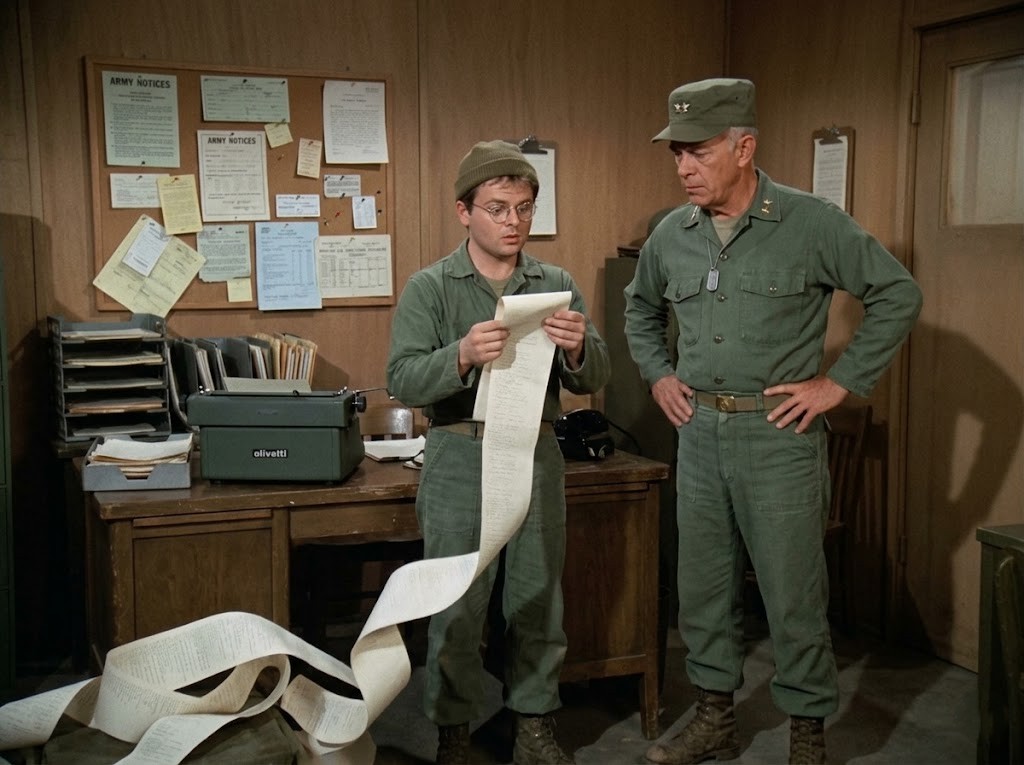
The mud outside was deep enough to swallow a jeep, but inside the Colonel’s office, the air felt heavier. It was that specific kind of swampy, Korean-summer thickness that made even breathing feel like a chore.
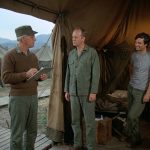
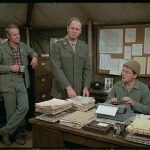
Radar stood in the center of the room, his small frame looking almost fragile against the backdrop of the dusty plywood walls. In his hands, he clutched a sheet of paper—or rather, a ribbon of paper—that seemed to have a life of its own.
It cascaded down from his trembling hands, pooling on the floor like a wayward waterfall of teletype messages.
Colonel Potter stood a few feet away, his hands planted firmly on his hips. He was staring at the paper with the kind of bewildered skepticism usually reserved for Hawkeye’s latest breakfast concoction.
“Radar,” the Colonel sighed, his voice raspy from a long day of briefings. “Tell me that isn’t the requisition order for more tongue depressors.”
Radar adjusted his glasses, his eyes wide and blinking rapidly behind the lenses. “No, sir. It’s… well, it’s everything, sir. It’s the backlog. The supply sergeant in Seoul said the lines were crossed, the codes were scrambled, and then the machine just sort of… kept going.”
He looked down at the scroll, then back up at the Colonel, his face etched with genuine distress.
“Sir, I think it’s a list. A list of every single item requested by every unit in this sector since 1951. And it’s not just office supplies. It’s… it’s requests for things that haven’t been made in a decade.”
Potter stepped closer, leaning in to squint at the tiny, frantic typing.
“Every item?” Potter muttered. “Radar, if that machine is right, that means we’re technically in the queue for a shipment of horse saddles and a crate of typewriters that probably belong in a museum.”
Radar took a shaky breath, his fingers tightening on the paper.
“Sir, there’s something else. Way down at the bottom. It’s not a requisition. It’s a message. It’s addressed to the 4077th, but it doesn’t look like an Army code.”
The Colonel froze, his expression hardening as he reached out to take the end of the scroll. His fingers brushed against Radar’s, and for a moment, the room went completely still.
“What does it say, son?” Potter whispered, his voice uncharacteristically soft.
Radar pulled the paper back just an inch, his voice barely a tremor in the quiet office. “It’s a personal message, Colonel. It’s from… home.”
The Colonel didn’t take the paper. Instead, he pulled his hand back as if the words were written in fire. He looked at the window, where the relentless rain had begun to tap a frantic rhythm against the glass.
“From home?” Potter repeated. “Radar, you know the lines don’t work like that. The wires don’t go back to Iowa or Missouri. They only go to hell and back.”
“I know, sir,” Radar whispered, his eyes filling with that earnest, devastating clarity that always seemed to cut right through the chaos of the camp. “But read the first line. Just the first line.”
He held the paper out, letting the sheer weight of it drag across the floor. Potter leaned in, his eyes scanning the blurred ink.
*To the boys in the mud, who keep the lights on when the world goes dark.*
The Colonel stood there for a long moment, the silence of the room punctuated only by the distant, rhythmic thud of a chopper landing in the mud. The fatigue that usually slumped his shoulders seemed to vanish, replaced by a sudden, sharp clarity.
“It’s not a requisition,” Potter breathed, his voice thickening. “It’s a letter. A collective letter. Someone—some clerk, some operator, some tired soul back at the base—decided that for once, they weren’t going to send a supply list. They were going to send a thank you.”
He reached out and gently took the paper, guiding it away from the floor. He began to read aloud, his voice dropping into that gentle, grandfatherly rasp that had steered the 4077th through a hundred storms.
The list wasn’t an itemized inventory of supplies. It was a list of small, human miracles.
*One box of clean bandages. Two jokes told in a surgery tent at 3:00 AM. A handful of dry socks. The sound of a guitar played by a fence. A shared look between friends that meant ‘I’m still here if you are.’*
As the Colonel read, the office didn’t feel like a command post anymore. The typewriter on the desk, the army notices pinned to the board, the mundane clutter of the war—it all seemed to drift into the background.
Radar slumped slightly, the tension leaving his body. He let out a long, shaky breath, and a small, crooked smile finally touched his lips.
“They heard us, Colonel,” Radar said softly. “Even all the way out here. They know we’re still here.”
Potter folded the long, winding scroll with careful, practiced hands, treating it with more reverence than he would a medal of honor. He looked at his young clerk, seeing the boy he had protected and pushed and mentored for so long.
He didn’t need to issue an order. He didn’t need to report to the brass. He just needed to hold that connection to the world beyond the perimeter fence, if only for an hour.
“Well, Radar,” Potter said, patting the younger man on the shoulder. “I suppose this means we’re officially over-budget on heart.”
Radar chuckled, a small, genuine sound that cut through the gloom of the late afternoon. The rain outside kept falling, and the war kept grinding on just a few miles away, but for that moment, the 4077th felt like it was exactly where it belonged.
They weren’t just soldiers in a tent. They were a family, held together by the quiet recognition of a stranger on the other end of a wire.
The Colonel sat down at his desk and set the paper aside, looking out into the twilight.
“Keep that safe, son,” he said. “It’s the most important piece of paper we’ve ever received.”
Sometimes the most vital supplies aren’t found in a crate, but in the simple reminder that we aren’t forgotten.