The Quiet Watch in Post-Op
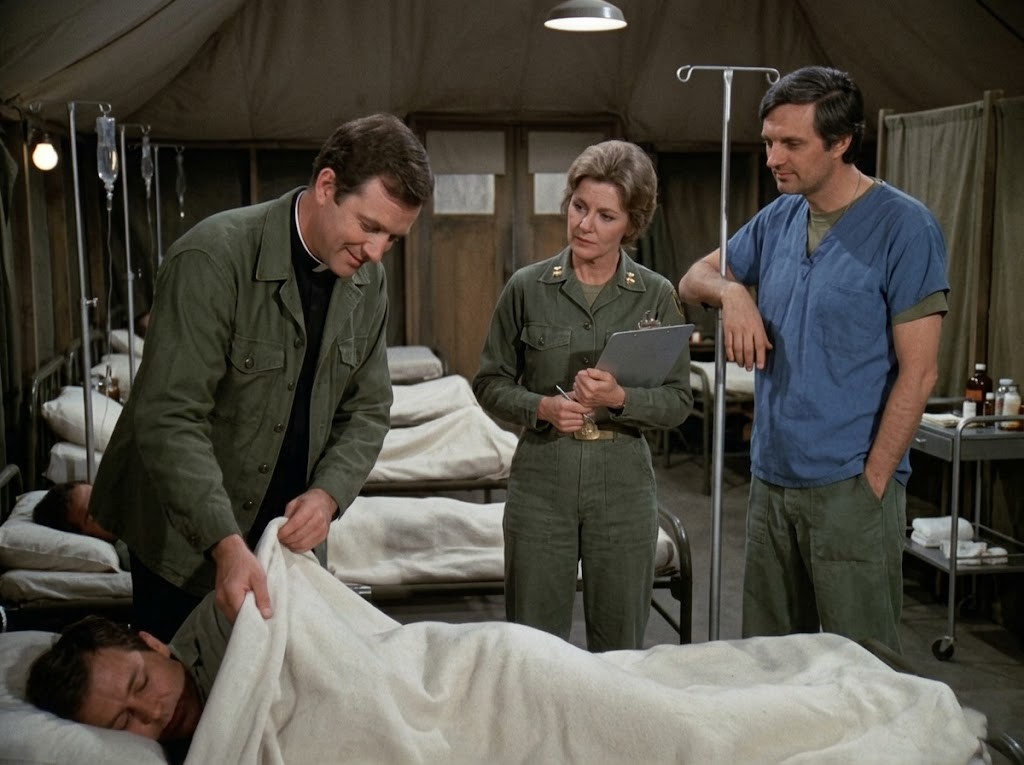
The 4077th had a very specific kind of silence.
It wasn’t the true, deep quiet of a peaceful night back home in Maine, or the hushed reverence of a cathedral.
It was the heavy, breathless pause that came only after the helicopters had finally stopped flying.
They had just finished a grueling thirty-two-hour session in the O.R.
The kind of shift where the days blurred into nights, and coffee became the only thing keeping the medical staff tethered to the earth.
Now, the harsh glaring lights of the operating room were off, replaced by the dim, yellow glow of the hanging bulbs in the Post-Op ward.
Hawkeye Pierce hadn’t even bothered to change out of his blue surgical scrubs.
He was dead on his feet, his shoulders aching with that familiar, deep-bone exhaustion.
He knew a perfectly terrible martini was waiting for him in the Swamp.
He knew his cot was calling his name.
But somehow, his feet had carried him here, into the canvas-walled ward, just to make sure the patchwork they’d done was holding together.
He leaned casually against the metal frame of an empty bed, his hands shoved deep into his scrub pockets.
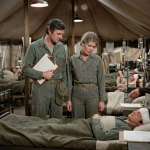
He was watching Major Margaret Houlihan.
Margaret was supposed to be off duty, too.
Her green fatigues were wrinkled, and her hair was losing its strict military shape, but her posture remained stubbornly upright.
She held her trusty clipboard like a shield, moving slowly down the aisle between the cots.
She wouldn’t rest until every single chart was checked, every IV drip calculated, and every dressing inspected.
“You know, Major,” Hawkeye said softly, his voice a dry, raspy whisper. “If you stare at that chart any harder, the ink is going to surrender.”
Margaret didn’t snap at him.
She was too tired for their usual banter.
She just offered a small, weary sigh, her eyes fixed on the young soldier sleeping in the cot before her.
“His fever is down,” she whispered back, her voice carrying a maternal softness that she usually kept strictly hidden behind her captain’s bars. “But his pulse is still racing. He’s restless.”
Just then, the canvas flaps of the ward parted, letting in a brief gust of the chilly Korean night air.
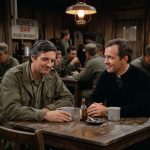
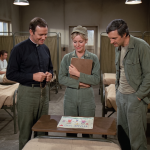
Father Mulcahy stepped inside.
He was still wearing his olive-drab fatigue jacket over his clerical collar.
The chaplain moved with a quiet, unassuming grace, making his own final rounds to offer comfort where medicine had reached its limits.
He walked over to where Hawkeye and Margaret were standing.
He offered them both a gentle, knowing smile before turning his attention to the young boy in the bed.
The kid couldn’t have been more than nineteen.
His face was pale, his breathing shallow.
Suddenly, the boy’s head began to toss violently from side to side on the thin pillow.
A low, panicked whimper escaped his lips.
His hands, bruised and scraped, flew up from under the blankets, grabbing frantically at the empty air.
“Incoming…” the boy gasped in his sleep, his voice tight with absolute terror. “Get down… Tommy, get down!”
The boy’s eyes snapped open, but he wasn’t seeing the dim lights of the Post-Op ward.
He was still out there, trapped somewhere in the muddy, terrifying dark of the front lines.
With sudden, desperate strength, the young soldier lunged upward, his hands locking onto Father Mulcahy’s jacket with a bruising grip, pulling the chaplain down as he let out a choked, terrified cry that threatened to wake the entire ward.
For a split second, the air in the ward froze.
Hawkeye pushed off the bedframe, his exhaustion vanishing as his surgeon’s instincts instantly kicked in.
Margaret dropped her clipboard to her side, her free hand immediately reaching out to check the boy’s vital signs, her eyes wide with sudden concern.
But Father Mulcahy didn’t pull away.
He didn’t call for a sedative, and he didn’t try to break the young soldier’s frantic grip.
Instead, he simply leaned closer, allowing the boy to hold onto him.
“It’s all right, son,” Mulcahy said.
His voice was a soft, steady murmur, cutting through the shadows of the tent like a warm light.
“You’re safe now. The noise is gone. You’re safe.”
The boy was breathing hard, his terrified eyes darting wildly between Mulcahy, Margaret, and Hawkeye.
“Tommy?” the boy choked out, his voice cracking. “Did Tommy make it?”
Margaret looked down at the boy’s chart, her expression softening into something deeply vulnerable.
She recognized the name from the intake tags.
She looked up, meeting Hawkeye’s eyes.
Hawkeye gave a slow, barely perceptible nod.
“He made it, soldier,” Hawkeye said quietly, his usual sharp wit entirely absent, replaced by a quiet, steadying honesty. “He’s in the ward right next door. He’s sleeping, just like you should be.”
The boy stared at Hawkeye, searching the tired surgeon’s face for any sign of a lie.
Finding none, the tension began to drain out of his young, battered body.
His desperate grip on the chaplain’s jacket slowly loosened.
“He made it,” the boy whispered, the words sounding like a prayer.
“He certainly did,” Mulcahy added gently. “And so did you. Your work is done for now. It’s time to rest.”
Margaret reached out, her hand brushing lightly, almost imperceptibly, against the boy’s forehead.
It was a deeply human gesture, stripped of all military protocol.
“Your fever has broken, Private,” she said softly, her voice carrying the reassuring tone of a mother smoothing away a bad dream. “You’re going to be just fine. But you need to close your eyes.”
The boy looked up at the three of them.
He saw a tired surgeon in blue scrubs, a strict nurse who was looking at him with gentle eyes, and a kindly priest who hadn’t pulled away when he was afraid.
He took a deep, shaky breath, and finally, his heavy eyelids fluttered shut.
Within seconds, the deep, healing rhythm of sleep reclaimed him.
The crisis had passed as quickly as it had arrived.
The heavy, peaceful silence of the ward settled back over them.
Father Mulcahy reached down, his face breaking into a warm, deeply affectionate smile.
With quiet reverence, he took the edge of the rough military blanket and gently pulled it up, tucking it securely around the sleeping boy’s shoulders.
It was such a simple, ordinary gesture.
But in the middle of a war zone, surrounded by the scent of iodine and damp canvas, it felt incredibly profound.
Margaret stood nearby, clutching her clipboard once again, but the rigid tension had completely left her shoulders.
She watched the chaplain tuck the boy in, a look of quiet, exhausted respect resting on her features.
Hawkeye leaned back against the bedframe, crossing his arms loosely over his chest.
He watched the priest and the head nurse, a fond, slightly sad smile touching the corners of his mouth.
He was a man who used jokes and sarcasm to keep the horrors of the war at bay.
But in moments like this, he didn’t need a punchline.
He just needed to be here, standing in the quiet dimness with the people who understood it all.
They were thousands of miles away from home, standing in the middle of a senseless conflict, held together by coffee, sheer willpower, and each other.
They weren’t just an army medical unit.
They were a family.
Mulcahy patted the blanket one last time and stood up straight, offering a quiet nod to Hawkeye and Margaret.
“He’ll sleep until morning now,” the Father whispered.
Hawkeye nodded slowly, his eyes never leaving the sleeping patient.
“Yeah,” Hawkeye murmured softly. “We all should.”
None of them moved toward the door right away.
They just stood there together for a little while longer, standing guard over the quiet breathing in the dark, finding a brief, beautiful moment of peace before the helicopters came back again.
Some of the greatest healing at the 4077th didn’t happen on the operating table, but in the quiet, tender moments of the night shift.