The Weight of the Ladle
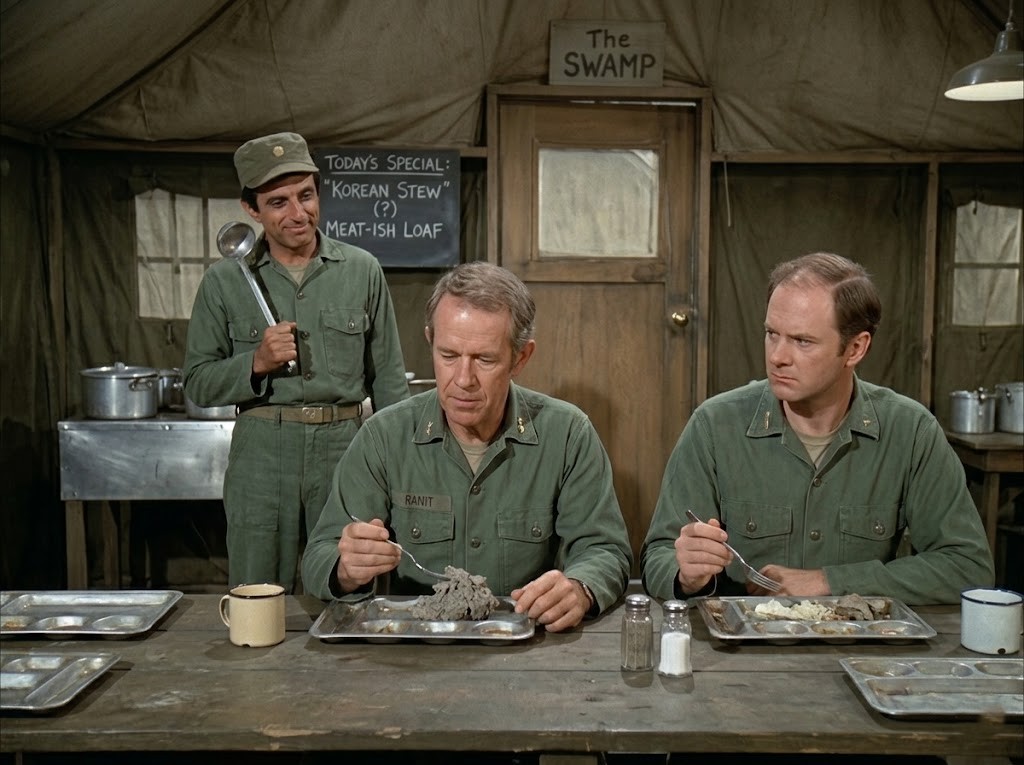
The sign behind Klinger’s shoulder said it all, chalked in a hurried, desperate hand: *Today’s Special: “Korean Stew” (?) or Meat-ish Loaf*.
In the mess tent of the 4077th, punctuation marks were often the only honest thing on the menu.
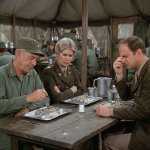
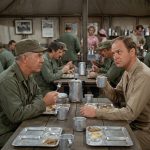
Colonel Potter sat staring down at his metal tray, his fork poised like a shovel over a grey, unidentifiable mound that seemed to defy the laws of gravity and culinary science. Next to him, Charles Emerson Winchester III stared at his own portion with a look of profound, aristocratic betrayal, his jaw set in a hard line as if he were preparing to court-martial the entire kitchen staff.
Behind them stood Max Klinger, holding a massive metal ladle like a scepter, a faint, weary smirk playing on his lips. He wasn’t wearing a dress today—just the standard olive drabs—but the theatricality remained, a silent acknowledgment that they were all playing parts in a grand, absurd comedy just to keep from crying.
It had been a brutal seventy-two-hour shift in Post-Op.
The smell of ether and damp canvas still clung to their fatigues, heavy and suffocating. No one had slept more than two consecutive hours since Tuesday, and the rain outside had turned the compound into a soup of thick, red clay.
“Max,” Colonel Potter said, his voice carrying the dry, raspy gravel of a man who had seen three separate wars and thought he had outlived surprises. “I’ve commanded cavalry units, Sherman tanks, and medical doctors. But I’ll be damned if I can identify the tactical purpose of this… substance.”
“It builds character, Colonel,” Klinger replied smoothly, leaning slightly forward. “And according to Igor, it’s also an excellent adhesive if the tent roof starts leaking again.”
Charles didn’t laugh. He slowly turned his head toward Potter, his eyes burning with a cold, exhausted intensity.
“Sherman,” Charles murmured, his voice dropping to a rare, vulnerable whisper that completely lacked his usual bombastic arrogance. “If I force myself to swallow even a single morsel of this barbaric paste, I fear the last remaining vestige of my humanity will vanish into the mud of this godforsaken peninsula.”
Potter looked up from his tray, his fatherly eyes catching the sudden, genuine tremor in Winchester’s hands.
The silence between the two men stretched tightly across the wooden table, heavy with the realization that Charles wasn’t just complaining about the food anymore—he was finally breaking under the weight of the week.
Potter lowered his fork, letting it clatter softly against the aluminum tray.
He didn’t offer a lecture on military discipline, nor did he pull rank. Instead, he simply reached over and placed a steady, calloused hand briefly over Charles’s trembling fingers.
“Take a breath, Charles,” Potter said softly, his voice dropping into that quiet, steady tone he reserved for the moments when the doctors forgot they were allowed to be human beings. “The line is long, the hours are ugly, and the kitchen is doing the best they can with what the supply sergeants forgot to steal. But we don’t break at the table.”
Charles swallowed hard, looking away from the tray and staring toward the canvas door of the tent.
For all his talk of Boston society and high opera, he was just another tired surgeon stuck in a swamp, miles away from everything he loved, staring down at a cold meal after saving lives until his knees buckled.
Klinger watched them, the smirk fading from his face.
He quietly set the heavy ladle down against the side of the metal pot, the metallic clink echoing softly in the crowded tent. He reached into the deep pocket of his fatigue jacket, his fingers searching past the standard issue gear until they found what he was looking for.
With a sly, cautious glance toward the mess tent entrance to ensure Margaret or the camp inspectors weren’t lurking, Klinger slipped two small, tightly wrapped items onto the table.
They were two small cellophane packages of real, state-side graham crackers—undoubtedly procured through a complicated chain of black-market favors and traded nylon stockings.
“Compliments of the chef, gentlemen,” Klinger whispered, his voice warm and entirely devoid of his usual hustle. “Sourced directly from Toledo. It’s not a French soufflé, Major, but I guarantee it doesn’t look back at you when you poke it.”
Charles looked down at the small crackers, then up at Klinger.
The aristocratic mask slipped for just a second, replaced by a profound, quiet gratitude. He didn’t say a word, but the tension in his shoulders visibly dissipated.
Potter picked up one of the packages, a faint, wry smile touching his mustache.
“Klinger,” the Colonel remarked, tapping the cellophane against the table. “If I find out you traded my good riding boots for these, you’ll be on latrine duty until the next administration.”
“Colonel, I wouldn’t dream of it,” Klinger said, a flash of his old spark returning as he picked his ladle back up. “Your boots only bought the peanut butter I’m saving for Friday.”
A small, genuine chuckle finally broke from Charles’s throat—a dry, exhausted sound that seemed to clear the heavy air around their table. He carefully pocketed the crackers, picked up his fork, and looked back at the grey mound on his tray with a renewed, stubborn resolve.
They were tired, they were dirty, and the war was still waiting for them outside the tent doors.
But as the three of them shared a quiet, understanding look amidst the clattering of trays and the low hum of the mess hall, the swamp felt just a little bit warmer.
Sometimes, the only way to survive the front lines was through the quiet grace of a shared joke and a friend who knew exactly when to lower the ladle.