THE MORNING THE MESS TENT HELD ITS BREATH
The coffee in the 4077th’s mess tent was, according to Hawkeye Pierce, an act of industrial sabotage perpetrated on the United States military. Major Charles Emerson Winchester III, more eloquently, referred to it as “a punitive beverage, intended to degrade the human spirit.”
Yet, morning after morning, they all shuffled in, the same collection of weary faces in wrinkled olive drab. The metal food trays were lukewarm, the powdered eggs had a color found nowhere in nature, and the only constant was the low-level, companionable grumbling.
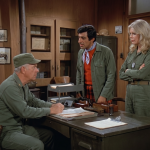
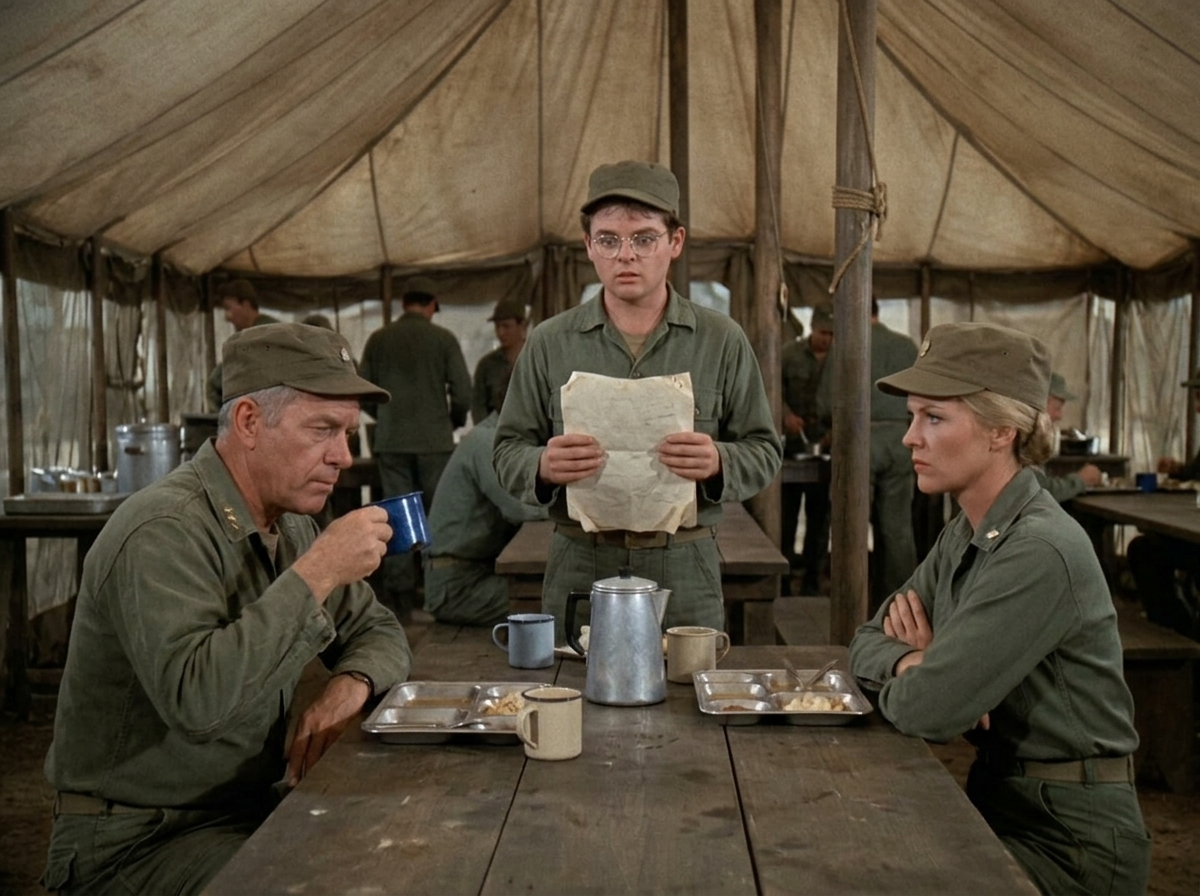
This particular morning started like all the others. Colonel Sherman Potter sat at his usual spot, the gray starting to edge into the temples beneath his cap. He was a rock; consistent and unyielding. Beside him sat Major Margaret Houlihan, her posture as sharp as a finely-honed scalpel, her arms crossed firmly against the chill of the tent and, more likely, against the general incompetence she perceived in the world.
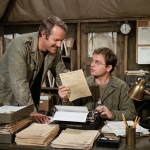
Radar O’Reilly had slipped into his place between them. He was holding something. Not a clip-board, not a stack of requisitions to be signed, not even the morning’s mail. It was a folded piece of paper, already looking fragile and handled, clutched carefully between his hands. He was staring down at it, avoiding all eye contact, his expression a complicated mix of anxiety and something terribly fragile.
Potter had been about to lift his blue enamel mug, but he stopped mid-motion. “Radar, you’ve been nursing that paper since you sat down. Is it a transfer request from General Clayton? Because if it is, tell him he can have Klinger, but I’m keeping the rest of you.” It was a dry, practiced joke, a small inoculation against the inevitable disappointments that came in the mail.
Margaret didn’t even offer a smile. She just sighed, a sound that conveyed volumes of impatience. “For heaven’s sake, Corporal, read it or eat it. You’re giving me a headache just watching you.”
Radar looked up, wide-eyed. “It’s… it’s not a regulation, sir. Ma’am. I know I shouldn’t bring personal stuff to the mess, but… this came from my mother in Ottumwa. Last night.”
He stopped. The mess tent, typically a cacophony of clattering metal and tired banter, was starting to get quieter. Other officers, including the Swampmen, were looking over. Margaret’s brow softened slightly. Even Hawkeye, seated several tables away, paused his monologue on the virtues of real toast to listen. The 4077th lived on mail, on small fragments of the lives they used to have, but news from home was sacred.
“Ottumwa,” Potter said, his voice lowering to that gentle, paternal rumble. “Is everyone alright, son?”
Radar’s lip gave a small, traitorous tremble. “Mom says the storm last Tuesday… it took down the big oak tree by the creek. The one my dad planted when they bought the farm. The house is okay, mostly. Just… a window and some siding. But the tree…” He swallowed hard.
Potter set his mug down, fully this time. He knew what a hundred-year-old oak meant to a man like young Walter O’Reilly. It was a cornerstone. Margaret slowly uncrossed her arms. “The important thing, Corporal, is that your family is safe. Property can be mended.” She said it with her usual professional clip, but the severity in her face had melted away.
“I know, Major. But she also said…” Radar looked at the folded paper again, his small, bespectacled face a mask of concentrated effort to hold it together. “She also said the storm took the old tire swing. The one I used when I was a kid. The one she said they’d keep for when I came home. And then…” his voice cracked, “And then she wrote about my dog, Ranger.”
The silence in the tent had become absolute. Nobody moved. Nobody ate. Everyone simply waited, sensing the weight of the moment. Ranger, they knew from endless stories, was a fixture in the O’Reilly mythology. A very old, very slow, very loyal retriever mix who lived for two things: catching flying discs and waiting for “his boy” to come home.
“She says Ranger won’t go near the back porch anymore,” Radar whispered, the words barely audible. “He just sits by the stump where the oak used to be and whines. He thinks… he thinks I’m under it.”
Radar’s small voice seemed to echo in the canvas tent, hanging heavy and silent. That one sentence—*He thinks I’m under it*—had stripped away everything else. It wasn’t just about a dog, or a tree, or an old tire swing. It was about the terrifying, fragile threads that connected them to a world that was moving on without them, a world where memory was a luxury they couldn’t afford, and where home felt both desperately close and agonizingly far away.
For a long moment, the only sound was the generator’s distant hum and the soft, repetitive scratching of Klinger’s pencil, four tables away, who had stopped filling out a form and was staring, his mouth slightly open.
Potter reached out and put his hand over Radar’s trembling, paper-clutched ones. It was a gesture of immense, simple comfort. “Radar, you listen to me,” he said, his voice clear and resonant in the stillness. “That dog is waiting. And when you get back, you are going to walk right up that path, and you are going to take him for the longest walk of his life. And that tree… you can’t replace a memory like that. But you can honor it. When you return, you and your mother are going to plant a new tree. A strong sapling. And you’ll name it. Perhaps, ‘Captain O’Reilly’s Legacy’?”
Radar looked up at him, a tear finally escaping and tracking down his cheek. He managed a shaky nod. He looked around the silent mess tent, and saw not the hierarchy of rank, but the faces of people who understood.
Margaret reached across the table and took the edge of the blue enamel coffee mug that Potter had left. With surprising gentleness, she guided it towards Radar. “Drink, Corporal,” she said, her voice softer than anyone could remember hearing it in months. “It’s… well, it’s coffee. It’ll help.” Radar took a small, hesitant sip, the bitter taste grounding him.
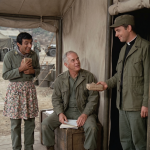
Slowly, the spell in the tent was broken. Klinger cleared his throat, put down his pencil, and silently slid his own lukewarm tray in front of Radar, offering up the most edible part of his meal, a single, sad biscuit. “From a soldier to a soldier,” he said, with more dignity than his chiffon scarf usually allowed.
And further down, from the direction of the Swamp, a voice rang out—dry, witty, and perfectly timed to diffuse the emotion before it became overwhelming. “Listen, son,” Hawkeye called, gesturing with a metal spoon, “all I’m saying is, if your mother is planting trees, I have some recommendations for species that are impervious to army coffee, general orders, and Winchester’s snoring. It’s for the good of the planet.”
A small ripple of laughter started, soft and warm, spreading like a blanket over the tent. Even Radar managed a genuine, if watery, smile. The tension evaporated, leaving only a collective sense of relief.
Potter picked up his mug again, taking a deliberate sip. “Right then,” he announced, his steady, fatherly tone back. “Let’s not waste good food. Even if it is… this.” The low buzz of conversation resumed, the clatter of cutlery, and the shared, familiar complaints about the breakfast menu.
Later that afternoon, a single, hand-written order was tacked to the main bulletin board, signed with a flourish by Colonel Potter. It requested authorization for the requisition of one (1) “High-Quality, Large-Breed Flying Disc” and one (1) “Weather-Resistant Tire Swing Rope” for the eventual, celebratory return of Corporal Walter O’Reilly. No officer questioned the logistics.
That morning, for five minutes, the entire 4077th had held its breath, suspended in a shared moment of memory and loss. But when they finally exhaled, they did it together, as a family. In the middle of the chaos and the exhaustion, they had found a way to share the burden. The coffee was still terrible, the powdered eggs still an offense against nature, but the company, as always, was indispensable.
Because sometimes, in the silence of a canvas tent, the smallest heartbeat from home is the loudest sound in the world.