The Weight of the Silence
The heaviest sound in the 4077th wasn’t the rhythmic, thumping dread of incoming choppers. It was the absolute, crushing silence that filled the camp after the choppers flew away empty.
It was a silence that sank into your bones, settling somewhere deep between your shoulder blades and your heart.
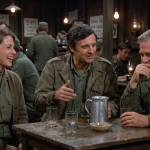
Inside the Officers’ Club, the air was thick with the smell of stale beer, damp canvas, and the cheap pine of the floorboards. The overhead lamps cast a dim, sickly yellow glow over the mostly empty room. It was 0300 hours. The generator hummed its endless, rattling tune outside, a mechanical heartbeat for a camp that had just barely survived another thirty-six-hour marathon in the OR.
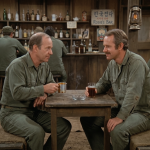
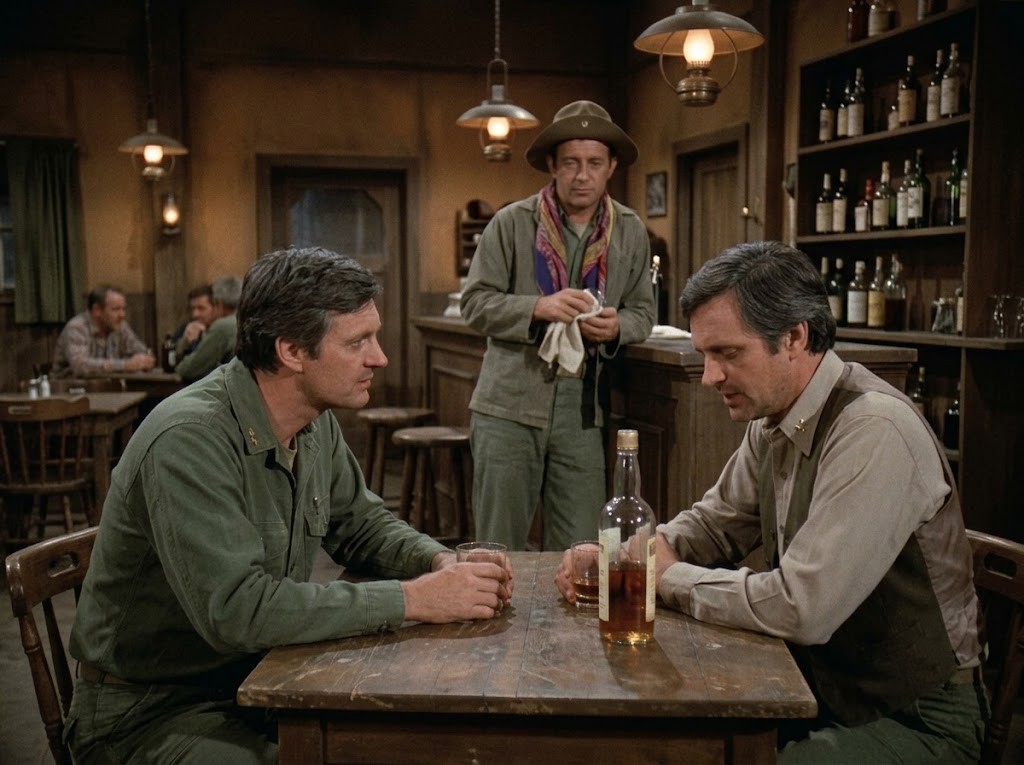
At a scarred wooden table in the center of the room, Captains Benjamin Franklin Pierce and B.J. Hunnicutt sat trapped in their own private gravity.
Between them sat a half-empty bottle of amber rye and two mismatched glasses. They had poured the drinks twenty minutes ago. Neither man had taken a sip.
Hawkeye sat on the left, still wearing his rumpled green fatigue shirt. He was leaning forward, his elbows planted firmly on the table. Usually, Hawkeye’s face was a theater of expressions—eyebrows dancing, mouth twisted in a wry smirk, eyes sparkling with some impending punchline. But tonight, he was perfectly, unnervingly still.
His eyes were locked onto B.J. with an intensity that bordered on physical. He was watching his friend the way a doctor watches a fading pulse.
Across the table, B.J. seemed entirely hollowed out. He wore his familiar tan vest over a long-sleeved shirt, but the usual warmth that radiated from the Californian was completely gone. His broad shoulders were slumped. His gaze was dropped, staring blankly down at the golden liquid in his glass as if trying to read a fortune he already knew was bad.
Behind them, standing quietly near the bar, was an older enlisted man. He wore a rumpled slouch hat and a garish, colorful silk scarf draped loosely around his neck. He was slowly wiping a rag across his hands, his eyes flicking sympathetically toward the two surgeons. He knew better than to offer a joke or another bottle. In a war like this, you learned to respect the sacred space of a broken spirit.
“You’re going to burn a hole in that glass, Beej,” Hawkeye said finally. His voice was low, stripped of its usual theatrical cadence.
B.J. didn’t blink. He didn’t shift his weight. He just kept staring at the table.
“I can hear you thinking from here,” Hawkeye pressed gently, leaning an inch closer. “It sounds like a rusty tractor going uphill in the mud. Want to open the hood and let me take a look?”
For a long moment, the only answer was the distant hum of the camp generator. Hawkeye watched as B.J.’s jaw tightened, a small muscle feathering near his temple.
“He was wearing a ring, Hawk,” B.J. whispered. His voice was so fragile it sounded like it might shatter before it reached the center of the table.
Hawkeye felt a cold stone drop in his stomach. He didn’t need to ask who B.J. was talking about. It was the young corporal from table three. The one with the chest wound that had stopped bleeding entirely too soon.
“A simple silver band,” B.J. continued, his eyes still fixed downward, his voice trembling on a razor’s edge. “Right hand. Just like mine. I had to take it off to get the IV in.”
B.J. finally raised his head. His eyes were red-rimmed, haunted, and brimming with a sudden, devastating panic that made Hawkeye’s breath catch in his throat.
“I put it in his pocket,” B.J. said, his voice breaking. “Hawk… what if they don’t find it? What if they send him home, and she never gets it back?”
Hawkeye didn’t move. He didn’t reach for a joke to deflect the pain, and he didn’t offer a hollow medical platitude about doing everything they could. He just sat there, absorbing the full weight of his friend’s quiet terror.
He knew exactly what was happening. B.J. wasn’t just talking about a silver ring. He was talking about Peg. He was talking about the terrifying fragility of the tether that connected them to the people they loved back in the real world.
In the background, the man in the slouch hat quietly set his rag down on the bar. He picked up a fresh towel, draped it over his shoulder, and silently turned away, giving the two captains the dignity of an empty room.
“They’ll find it, Beej,” Hawkeye said, his voice steady and low. It was the voice he used when talking a patient down from a nightmare in Post-Op.
“You don’t know that,” B.J. countered softly, a bitter edge creeping into his tone. He reached out and wrapped his large hand around his glass, though he still didn’t lift it. “Things get lost here, Hawk. Whole lives get lost. Dog tags, letters, pictures. People.”
He stared at his knuckles, turning white against the glass. “I held that ring in my palm. It was still warm. I looked at it, and for a second—just for one horrible second—I couldn’t remember what my own wedding ring felt like.”
Hawkeye felt a sudden, sharp ache in his chest. Usually, B.J. was the anchor. B.J. was the guy who kept Hawkeye from floating off into the stratosphere of his own manic despair. But right now, the anchor was untethered, drifting dangerously close to the jagged rocks of this endless, senseless war.
“Look at me, Beej,” Hawkeye said.
B.J. shook his head slowly, refusing to break his gaze from the table.
“Look at me,” Hawkeye repeated, a little firmer this time, injecting just enough captain’s authority to break through the fog.
Slowly, B.J. dragged his eyes up to meet Hawkeye’s. The absolute exhaustion in B.J.’s face was heartbreaking. It was the face of a man who had seen too much blood and not enough sanity.
“You remember what it feels like,” Hawkeye said simply, his dark eyes locked onto B.J.’s. “I know you do. You know how I know?”
B.J. didn’t answer, but the panic in his eyes stilled just a fraction.
“Because if you didn’t remember,” Hawkeye continued, his tone softening into something deeply tender, “it wouldn’t hurt this much. The fact that you’re sitting here, torturing yourself over a piece of silver from a kid you never met, proves that your heart is still exactly where it belongs. It’s still in Mill Valley.”
B.J. let out a shaky breath. His shoulders dropped half an inch.
“The army can take a lot of things from us,” Hawkeye said, gesturing vaguely around the dim, depressing room. “They can take our sleep, our civilian clothes, our digestion, and our youth. They can make us sew up kids until our fingers bleed.”
Hawkeye finally reached out and tapped the rim of B.J.’s glass with his own long fingers.
“But they can’t take Peg,” Hawkeye said fiercely. “And they can’t take Erin. They can’t touch that. Unless you let them.”
The hum of the generator seemed to fade into the background. The stifling air of the Officers’ Club felt a little less heavy. B.J. stared at Hawkeye for a long time, the words slowly sinking into his exhausted mind. The hollow look in his eyes began to retreat, replaced by a profound, bone-deep weariness, but also a sliver of returning warmth.
A small, sad smile touched the corner of B.J.’s mouth. It wasn’t much, but it was enough.
“You’re a pretty good doctor, Pierce,” B.J. murmured, his voice sounding a little more like himself.
“I’m a brilliant doctor,” Hawkeye corrected without missing a beat, leaning back in his chair and letting the tension bleed out of his spine. “I’m also a devastatingly handsome philosopher. It’s a heavy burden, but I manage.”
B.J. let out a quiet, tired chuckle. He finally lifted his glass from the table.
Hawkeye picked up his own glass, holding it up in the dim yellow light. The amber liquid caught the glow of the overhead lamp.
“To the rings we wear,” Hawkeye said softly. “And the ones we send home.”
“To home,” B.J. echoed, his voice thick with emotion, but steady.
They clinked their glasses together. The sharp *clink* of cheap glass rang out in the quiet room, a tiny, defiant sound against the massive backdrop of the war. They drank the cheap rye, letting it burn its way down, anchoring them back to the present, back to the table, back to each other.
They sat in silence for a while longer, but the crushing weight of the room was gone. It was just two tired men, sitting at a wooden table, keeping the dark at bay until the sun came up.
Sometimes, the greatest miracle performed at the 4077th wasn’t saving a life on the operating table, but keeping a soul alive in the quiet hours after.