The Weight of Paper, The Strength of Family
They say the pen is mightier than the sword, but in the middle of a forgotten Korean swamp, it was the paperwork that truly had the power to crush a man’s spirit.
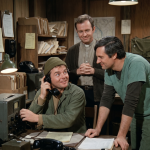
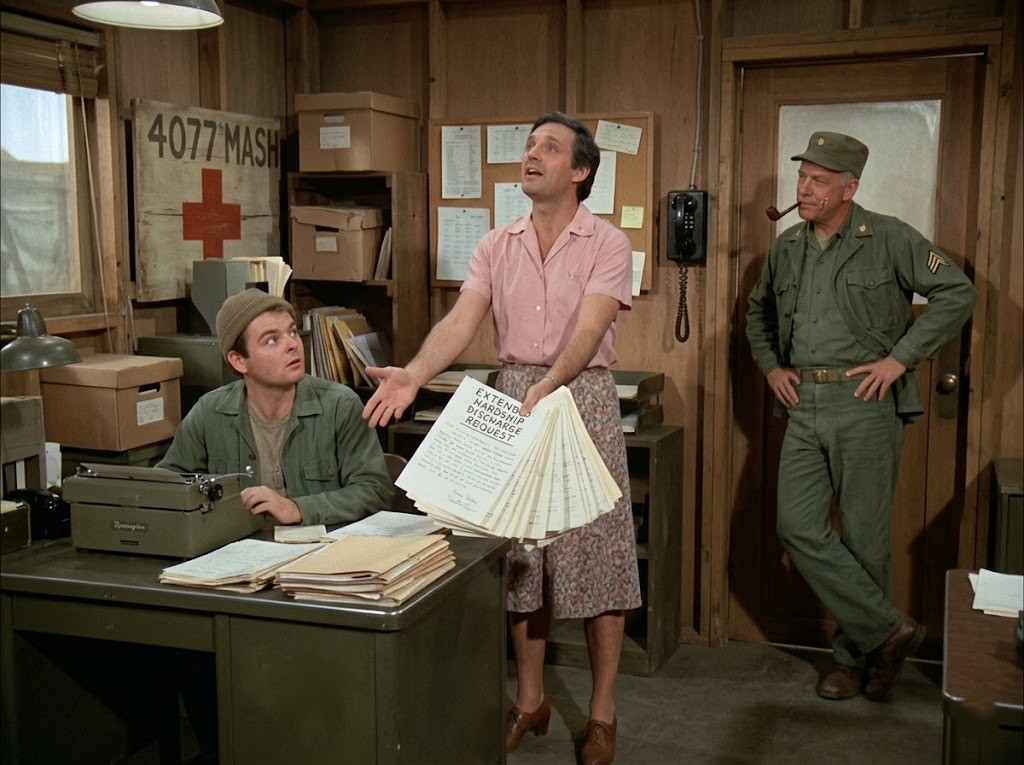
Inside the cluttered office of the 4077th M*A*S*H, the air smelled of stale coffee, damp wool, and the faint, sweet scent of Captain Maxwell Klinger’s favorite lavender perfume.
Corporal Radar O’Reilly sat frozen at his olive-drab desk, his fingers hovering over the keys of his trusty Remington typewriter like a pianist who had suddenly forgotten the notes. His eyes were wide with a mixture of sheer panic and profound confusion as he looked up.
Standing before him was Klinger, looking resplendent in a floral print skirt, a matching pink blouse, and sensible brown heels that clacked rhythmically against the floorboards.
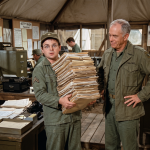
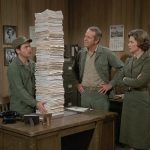
But it wasn’t the outfit that had stopped the room cold; it was the massive, fan-shaped stack of official documents Klinger was brandishing with the dramatic flair of a Shakespearean actor.
The top page, stamped in bold, uncompromising ink, read: *EXTENDED HARDSHIP DISCHARGE REQUEST.*
“Look at it, Radar! Just look at the beautiful, glorious architecture of my freedom!” Klinger cried out, his eyes cast toward the wooden rafters as if appealing directly to the heavens. “It’s all here. Every form, every signature, every single sob story from Toledo carefully documented in triplicate!”
From the doorway, Colonel Sherman Potter leaned heavily against the frame, a seasoned spectator to the daily theater of the 4077th. He puffed slowly on his pipe, the fragrant smoke curling around his faded utility cap, his sharp eyes taking in the spectacle with a mixture of dry amusement and fatherly exhaustion.
“Klinger, if that stack of paper grows any taller, General MacArthur is going to mistake it for a tactical hill and order the Infantry to take it,” Potter barked, though the corner of his mustache twitched with a faint smile. “What in the name of the Great Blue River is the meaning of this?”
“It’s my masterpiece, Colonel,” Klinger said, his voice dropping from theatrical grandeur to something raw and desperate. “This isn’t just another Section Eight stunt. This is the real deal. My mother’s illness, the hardware store closing, the whole roof collapsing back home… I finally got the Red Cross to verify it all.”
Radar looked down at the top sheet, his young face tightening as he read the official seals. For months, Klinger’s discharge requests had been a running joke—a colorful protest against the madness of war.
But as Radar’s eyes scanned the fine print, the joke suddenly vanished. The stamps were real. The signatures from the stateside board were authentic.
The room grew incredibly quiet, save for the low, distant rumble of artillery miles away, a reminder of the world they were all trapped in.
Radar swallowed hard, looking up at his friend with a sinking heart, realizing that this wasn’t an act.
“Colonel…” Radar whispered, his voice cracking slightly as he looked from the papers to Potter. “He’s not kidding this time. The paperwork is perfect. If you sign the top sheet… Klinger actually goes home.”
Colonel Potter took the pipe out of his mouth. The dry, sarcastic air in the room evaporated instantly, replaced by a heavy, suffocating stillness.
Potter pushed himself off the doorframe and walked slowly toward the desk. His boots clicked softly against the floor, a stark contrast to Klinger’s heels. He reached out and took the heavy stack of papers from Klinger’s hands, his eyes scanning the pages with the practiced precision of an old cavalry man.
Klinger stood perfectly still, the theatricality draining from his posture until he just looked like a tired kid from Ohio dressed in a skirt, waiting for a verdict that would change his life.
“Well, I’ll be damned,” Potter muttered softly, setting the stack down next to Radar’s typewriter. “You actually pulled it off, Max.”
Hawkeye Pierce walked in a moment later, a half-eaten piece of toast in his hand and a joke ready on his lips, but he stopped dead when he felt the atmosphere in the room. He looked at Radar’s pale face, at Potter’s solemn expression, and finally at Klinger, who couldn’t even meet his eyes.
“What’s going on?” Hawkeye asked, his usual cynical wit suddenly sounding hollow. “Did the army finally outlaw floral patterns, or is someone just dead?”
“Klinger’s papers went through, Pierce,” Potter said quietly, leaning against the edge of the desk. “He’s got his ticket out of this circus.”
Hawkeye stared at the papers, the smirk completely disappearing from his face. For all the jokes, all the martinis at the Swamp, and all the complaining they did about the heat, the mud, and the endless stream of wounded, they had become a family.
Losing one of their own—even to go home—felt like a sudden, sharp tear in the fabric of their survival.
“Home,” Hawkeye repeated, the word sounding foreign and heavy in his mouth. He looked at Klinger, a soft, genuine smile breaking through his fatigue. “Toledo. Mud hens. Hot dogs with chili. You lucky, beautiful son of a gun.”
“I… I should be thrilled, Captain,” Klinger said, his voice barely a whisper. He looked around the cramped, olive-drab office. He looked at the “4077th MASH” sign on the wall, at Radar’s messy desk, at the old telephone that connected them to so much misery and so much shared courage.
Suddenly, the floral skirt felt foolish. The heels felt heavy.
“I’ve spent every waking moment trying to get out of this uniform, trying to get away from this place,” Klinger said, his shoulders slumping. “But looking at this desk… looking at you guys… I don’t know who is going to make sure the camp has enough penicillin. I don’t know who is going to steal the extra blankets from Supply when the winter hits.”
Radar stood up, walking around the desk to stand next to the tall Toledo native. He reached out and gently touched Klinger’s sleeve. “We’ll manage, Klinger. We always do. You gotta go home to your mom.”
Colonel Potter picked up a pen from Radar’s desk. He uncapped it slowly, holding it over the signature line. The power to send a man back to peace was entirely in his fingers.
“You’ve done your bit, Klinger,” Potter said, his voice thick with a father’s quiet pride. “You’ve worn the dresses, you’ve taken the flak, and you’ve saved a hell of a lot of lives by keeping this camp running when everything else was falling apart. Nobody here will ever begrudge you your freedom.”
Potter pressed the pen to the paper.
“Wait,” Klinger said suddenly, his hand reaching out to gently stop the Colonel’s arm.
Potter paused, looking up through his eyebrows. Hawkeye watched silently, a profound respect in his eyes.
“Don’t sign it yet, sir,” Klinger said, a sad but fierce smile touching his lips. “The morning shift of wounded is coming in from the frontline in twenty minutes. The OR is going to be a madhouse. You need every hand on deck, even the ones in heels.”
Klinger picked up the massive stack of papers himself, carefully tapping them against the desk to straighten the edges, and tucked them neatly into an administrative drawer.
“The paperwork can wait until tonight,” Klinger said softly, turning toward the door with a renewed sense of dignity. “Right now, the 4077th needs its clerk.”
Hawkeye patted Klinger firmly on the shoulder as he passed, a silent communication of gratitude that bypassed all words. Potter slowly capped his pen, a deep warmth in his tired eyes as he watched the Toledo kid walk out to face the incoming choppers.
They were all prisoners of a war they didn’t ask for, but in that quiet office, they knew they would never truly be alone as long as they had each other.
In a place where everything was temporary, the love they had for one another was the only thing that remained permanent.