The Calm Beneath the Monsoon
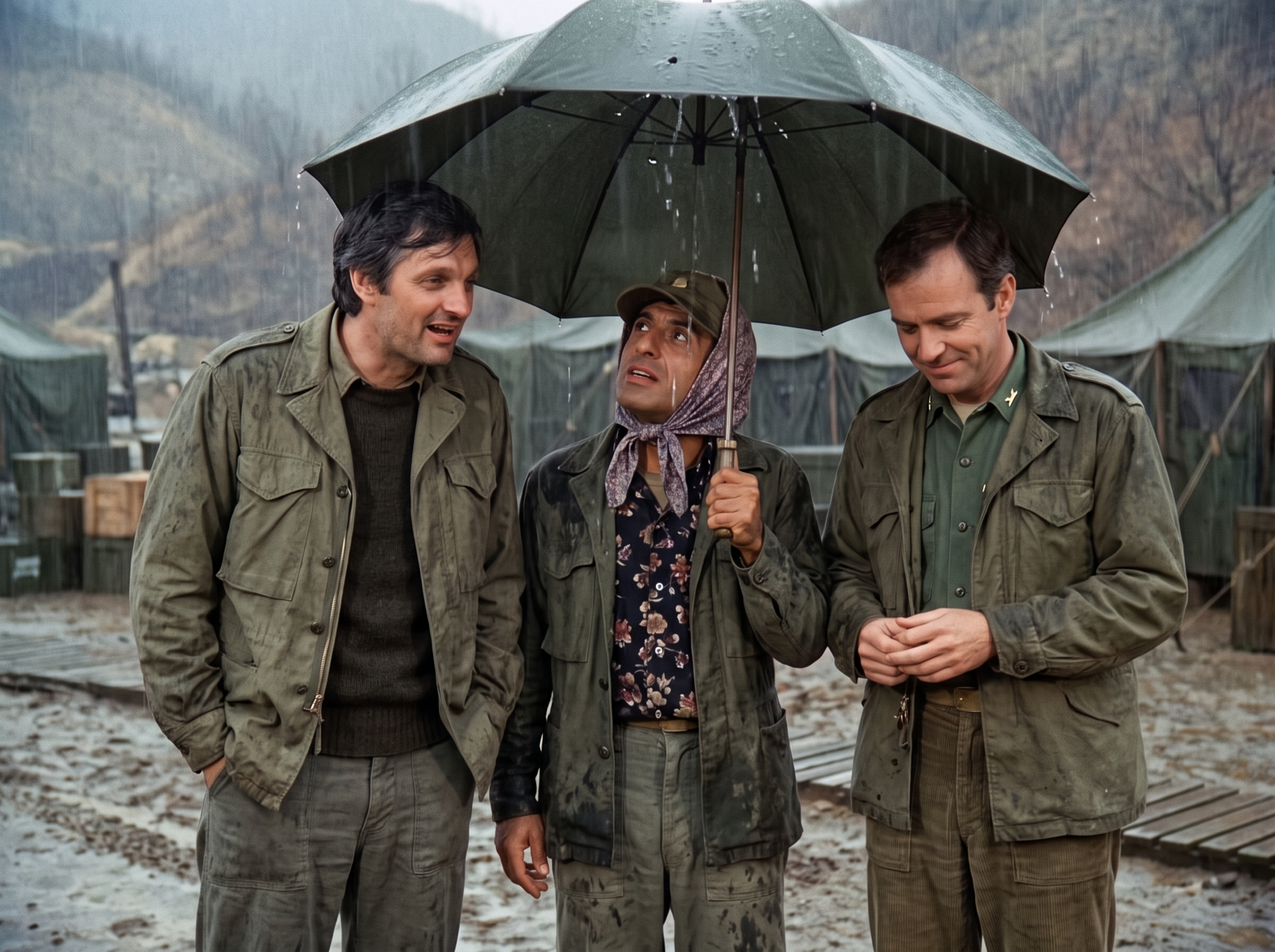
The rain in Korea didn’t just fall; it owned the place. It was a relentless, grey curtain that turned the 4077th from a hospital into an island of shivering, mud-caked souls.
Hawkeye stood near the edge of the compound, his shoulders hunched against the damp chill, eyes tracing the muddy tracks leading toward the mess tent. Beside him, Winchester stood with the stiff, practiced posture of a man who refused to let the weather compromise his dignity, though his usually impeccable hair was beginning to rebel against the humidity.
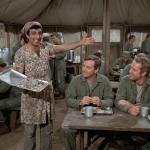
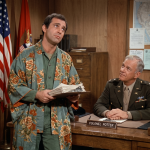
Between them stood Klinger. He wasn’t wearing his usual outlandish getup, but he had improvised with a floral-print shirt that looked like it had been salvaged from a lost luggage bin in 1948, topped off with a babushka tied snugly under his chin. He held a giant, utilitarian olive-drab umbrella, acting as the reluctant sentry for his two drier—if not happier—colleagues.
“Klinger,” Hawkeye sighed, his voice echoing the weary rhythm of the downpour. “You look like a very confused grandmother waiting for a bus that stopped running three years ago.”
“I’m exercising my right to stay dry, Captain,” Klinger replied, shifting the umbrella to shield Hawkeye’s shoulder as a particularly heavy gust threatened to soak them. “And if this is how I have to dress to keep the pneumonia away, then call me Nana.”
Winchester let out a sharp, aristocratic huff, adjusting his own jacket. “Your fashion choices are not merely ‘confused,’ corporal. They are an affront to the very concept of military decorum, even in this dismal purgatory.”
“I’m keeping you dry, aren’t I, Major?” Klinger pointed upward, his eyes wide and innocent, though a grin tugged at the corner of his mouth.
Suddenly, a distant, muffled roar—the sound of a chopper—cut through the steady drone of the rain. It wasn’t the rhythmic thrum of a transport; it was a desperate, stuttering sound, like a bird with a broken wing. The three men froze. The lightness of their banter evaporated, replaced instantly by the familiar, heavy knot of dread that lived in the stomach of everyone in camp.
The sound grew louder, then abruptly faltered, trailing off into a sickening silence that hung over the compound like a shroud.
The silence that followed the engine’s death was heavier than the storm.
Hawkeye’s jaw tightened. The playful, cynical glint in his eyes vanished, replaced by the clinical, focused gaze of a surgeon who knew that silence usually meant the worst. He stepped out from under the umbrella, ignoring the rain that instantly plastered his hair to his forehead.
“That wasn’t a routine landing,” he said, his voice low and steady.
Winchester, stripping away his usual mask of superiority, stepped forward, his expression grave. Even Klinger, usually so theatrical, looked genuinely shaken, his hand gripping the umbrella handle so tightly his knuckles turned white.
“They’re coming in short,” Klinger whispered, looking toward the ridgeline where the choppers usually appeared. “Too short.”
“We go,” Hawkeye said, already turning toward the triage tent. He didn’t look back to see if they were following; he knew they would.
But then, the sound returned—a sputtering, struggling mechanical wheeze. It wasn’t a crash. It was a landing, performed by a pilot who had somehow coaxed a dying machine to the ground. Through the grey veil, the silhouette of the chopper appeared, listing heavily to one side, settling into the mud at the edge of the helipad.
The tension broke, replaced by the frantic, galvanized energy of the 4077th. People poured out of tents—nurses, orderlies, surgeons—all moving as one.
As they ran, Hawkeye slowed just for a second, glancing back at Klinger, who was still clutching that ridiculous, precious umbrella. Klinger caught the look, gave a small, solemn nod, and dropped the umbrella, breaking into a run alongside them.
They reached the pad just as the side hatch of the chopper slid open. The scene was chaotic, wet, and miserable, but there was a profound, quiet beauty in how they worked. There was no hesitation, no hierarchy—just a group of people, exhausted and bone-tired, lifting stretchers and shouting instructions over the wind.
Winchester, ignoring the mud that ruined his boots, was already helping a wounded boy off the craft, his hands steady and his voice uncharacteristically soft. Hawkeye was there, too, checking vitals with a precision that betrayed no hint of the fatigue he felt in his very marrow.
Hours later, the rain finally slowed to a drizzle. The triage tent was quiet, the patients stabilized and settled. Hawkeye walked back out into the cool night air, finding Klinger sitting on a crate, his floral shirt stained with grease and mud, the babushka long since abandoned.
Hawkeye sat down next to him. He didn’t say a word, just pulled a battered pack of cigarettes from his pocket and offered one. Klinger took it, his hands shaking just a little.
“Rough one,” Klinger muttered.
“They’re all rough,” Hawkeye replied, staring up at the dark, clearing sky. “But we’re still here. And so are they.”
They sat in the quiet of the Korean night, three very different men bound together by a thousand moments just like this. There was no glory in the mud, and no heroes in the rain—just a family, held together by the simple, stubborn act of staying beside one another until the storm passed.
In the heart of the 4077th, even the longest storm was made bearable by the people standing next to you.