The Aunt Becky Butter Cookie Ceasefire
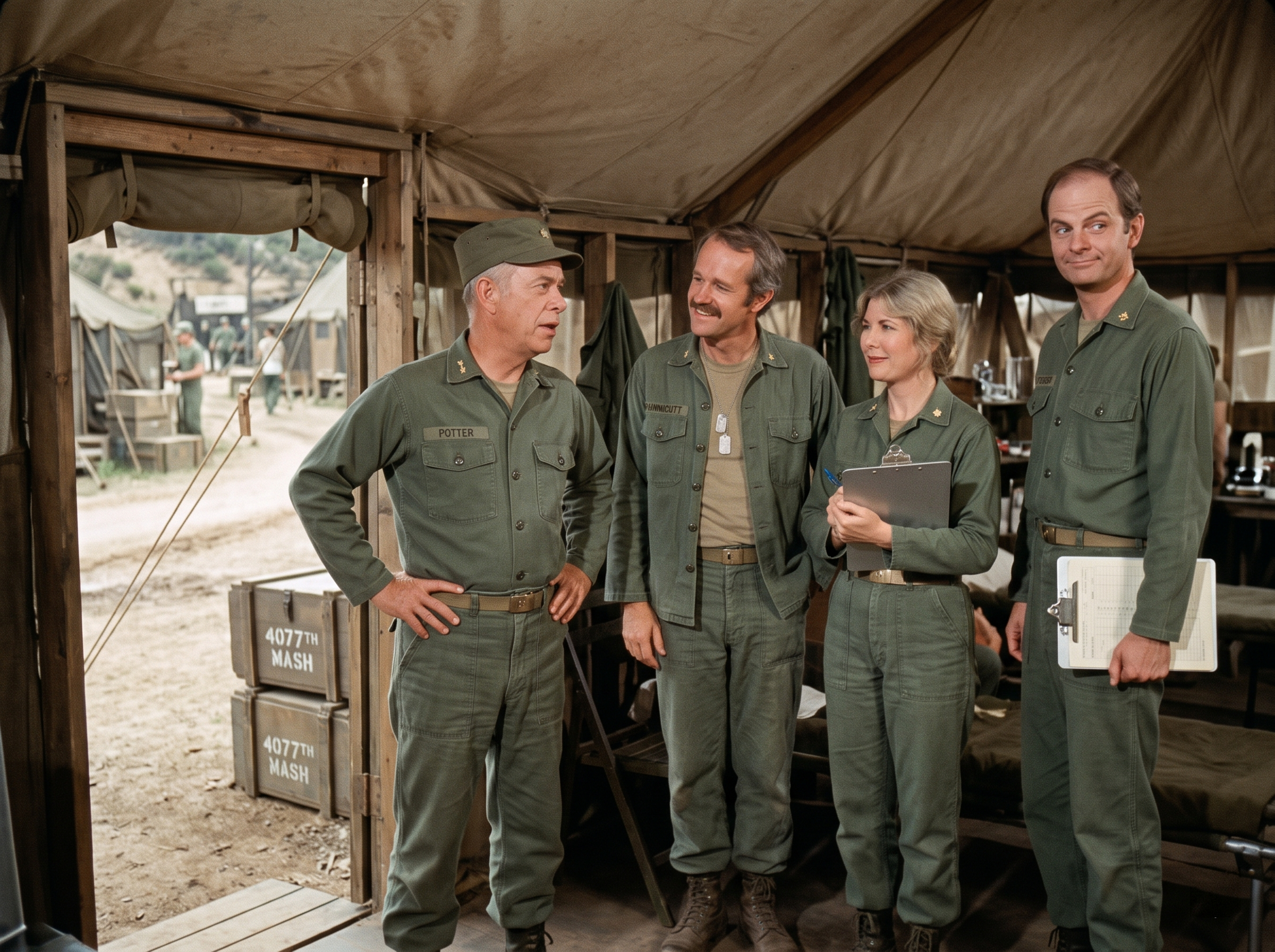
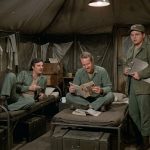
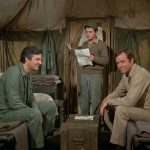
The silence was often heavier than the mortar fire, especially at three in the morning. It was the fatigue, pressing down on pre-op like the heavy canvas of the tent walls themselves. We learned to navigate the lulls, the brief ceasefires of human suffering, but the weariness never quite left the bones of the 4077th. Tonight, inside the main medical tent, a small knot of officers was frozen in an odd, suspended moment.
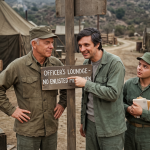
Colonel Sherman Potter, a man whose spine was forged of Missouri oak and dry wit, was leaning against the door frame. He wasn’t speaking, just observing the external compound, but his hands were on his hips, and his posture held that fatherly, exasperated patience. He was waiting. We were all waiting. Radar had just screeched past with the mail, a blurry streak of green fatigues and a mail bag.
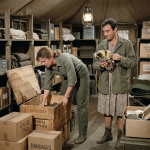
Next to Potter, Captain B.J. Hunnicutt, a man with a heart as big as his mustache, was smiling that quiet, knowing smile. He shifted slightly, the dog tags hidden beneath his shirt making a faint clink, his eyes tracking something outside. Behind him, Major Margaret Houlihan was already back in ‘head nurse’ mode, clipboard in hand, noting down the contents of incoming supply crates. But her usual sharpness was softened by the shared, tired peace of the evening.
Further back, Major Charles Emerson Winchester III, our refined intellectual, was listening. His typical expression of mild disdain was present, but it was tempered by the sheer, human relief of being off the surgical line. They were collectively watching one specific stack of incoming medical supply crates that Radar had dumped by the door. They all knew what it was.
Weeks ago, Potter had mentioned—off-handedly, naturally—how much a simple, buttery taste of home could soothe the soul in this Godforsaken dustbowl. “My Aunt Becky,” he’d said, “used to send cookies in a tin lined with old maps.” And since then, for three long mail calls, the 4077th had been under a silent, shared siege of anticipation. We were all fighting our own battles, but a collective focus on a single, shared comfort made the other battles feel smaller.
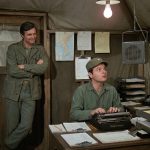
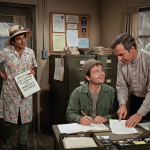
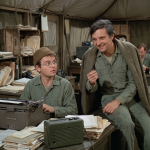
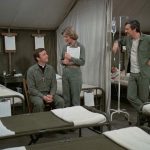
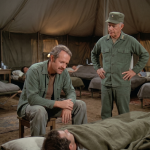
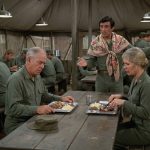
The image shows that second where anticipation is at its peak. Radar’s voice, now fading into the distance toward the swamp, cracked once more, echoing, “Special delivery for Colonel Potter… from Missouri!” And their eyes—Potter’s tired but warm, B.J.’s eager, Margaret’s observing, Charles’s cynical—all locked onto one small, unassuming cardboard box. It was resting right there, on a crate labeled ‘4077TH MASH.’ Just as the tension broke, the old pre-op generator, which had been temperamental all week, gave one final, choked sputter and died.
Total darkness consumed the inside of the tent, leaving only the fading, warm-golden twilight from the external compound. But in that second, right before the darkness won, a collective ‘no’ rippled through the officers. Potter’s face in the image, looking dryly frustrated yet grinning, is that precise emotion. They had the promise of comfort, and the means to enjoy it—the lights—had just failed them.
“Well, naturally,” came Winchester’s voice from the newly acquired darkness, a perfect, refined drawl of acceptance. “Because if the war doesn’t break us, the general breakdown of civilization inside this camp certainly will.” A short, contained bark of laughter from B.J. followed, cutting the tension of the blackout. Potter didn’t move from the doorway; he was now just a darker silhouette against the external twilight.
“B.J., son, you got any of that fancy penicillin hidden in your pockets to fix a generator?” Potter’s voice was dry, the humor tired but present. “Only the kind that grows in Aunt Becky’s butter, Colonel,” B.J. shot back, already moving. Margaret’s voice cut in, professional even in pitch-black: “Major, keep moving. The supply list is essential, generator or no.” “I’m moving, Major,” Winchester sighed from the dark, “I am merely ensuring I don’t move onto a supply crate.“
Outside, the compound was still active with lanterns, and the twilight lingering. Potter finally pushed off the door frame. “Forget the generator for five minutes, Major Houlihan. Radar’s announced it. If we don’t retrieve that box now, I suspect Klinger will magically acquire it for a new bonnet.” He stepped out into the twilight, his boots crunching on the dusty ground. B.J., Margaret, and even Charles, trailing slightly, followed.
The view out the tent, seen from inside in the original image, is what they stepped into. B.J. was already beside the crate pile. “I think this one has Missouri dust on it,” he announced, his hand hovering over the small, battered cardboard box. A faint stencil on the box read ‘TO SH Sherman and Family. Aunt Becky’s Best.’ The juxtaposition of ‘family’ on a standard-issue military box in a MASH unit in Korea was enough to make any heart ache with tenderness.
Margaret, standing with her clipboard now slightly lowered, was the first to speak, her voice surprisingly soft. “It actually says ‘Family,‘ Colonel. Look.” Potter just looked at it. His eyes were moist, reflecting the lantern light from a passing Jeep. He cleared his throat, the dry wit returning as a defense. “Well, of course it does, Margaret. Becky was very thorough. My family in Missouri knows better than to write ‘Special, top secret, Aunt Becky’s cookies’ on the side of a supply shipment.“
“Generations of family secrecy, I presume?” Charles added, stepping up, his sarcasm surprisingly light. “Like a culinary secret service?” Potter smirked. “Something like that, Winchester. Here, B.J., grab the butter. We have to defend this perimeter.” They retrieved the box and retreated—not back into the dark pre-op tent, but just outside the door, near the lanterns. Potter, using B.J.’s Swiss Army knife with an uncharacteristic clumsiness that showed his fatigue, cut the taped seal.
The top flaps were pulled back. The smell… It was instantaneous. Butter, warm, rich, sugary, and entirely not from Korea, flooded the air. And beneath the smell was the sound—the faint rustle of old, crinkled maps. Becky had lined the tin with old maps of the Midwest. It was a detail Potter hadn’t mentioned. It was a secret comfort, just for him, that his aunt had preserved.
A collective sigh of relief, almost like a held breath being released, came from the four. Potter just stared into the box for a full minute, not moving. He wasn’t seeing the cookies. He was seeing a specific kitchen window, a specific table, a life he had left behind, now preserved in a small tin. He cleared his throat again, louder this time. “All right, all right. Aunt Becky didn’t make these for a statue. We all did our share of waiting. Standard rationing rules apply.“
He pulled out the first small, crinkled brown bag, a map segment visible on it, and handed it to Margaret. “Major. A butter cookie ceasefire.” Margaret looked at the bag as if it were fragile porcelain. A genuine tear escaped her eye, glinting in the lantern light. “Thank you, Colonel. Truly.” Her stern facade didn’t break, but the tender humanity beneath shone through entirely.
B.J. was handed the second bag. “B.J., son. Something other than the local brew to wash down the penicillin.” B.J. just grinned, his entire face warm with shared relief. And then Potter turned to Charles. “Winchester… Aunt Becky made these in Missouri. I understand the butter didn’t come from a cow with a degree from Harvard, but it might just pass muster for your refined palate.“
Winchester took the bag with exaggerated delicacy, but his typical disdain was completely gone, replaced by a quiet, genuine smirk of sharing a simple human secret. “I believe, Colonel,” he announced, opening the bag and pulling out a small, perfect cookie, “that I can find a single moment of refined culinary appreciation in this, ah… ‘tribute from the heartland.‘” He took a bite. The dry sarcasm entirely left him. The image from just minutes ago, of Charles observing, was now replaced by a refined appreciation of a simple, shared comfort.
The blackout was forgotten. The war, for one single minute, was forgotten. They all stood in the twilight, outside that dusty tent in the center of the visual source, a four-person perimeter of shared warmth. They ate the cookies in silent, shared tenderness. The taste was home. It was Aunt Becky. It was family. And in that quiet, dusty, tired moment, they were, undeniably, a family of their own.
Sometimes a simple ceasefire, paved with Aunt Becky’s butter cookies and Missouri maps, was the only peace we could find.