A Quiet Moment in the Eye of the Storm
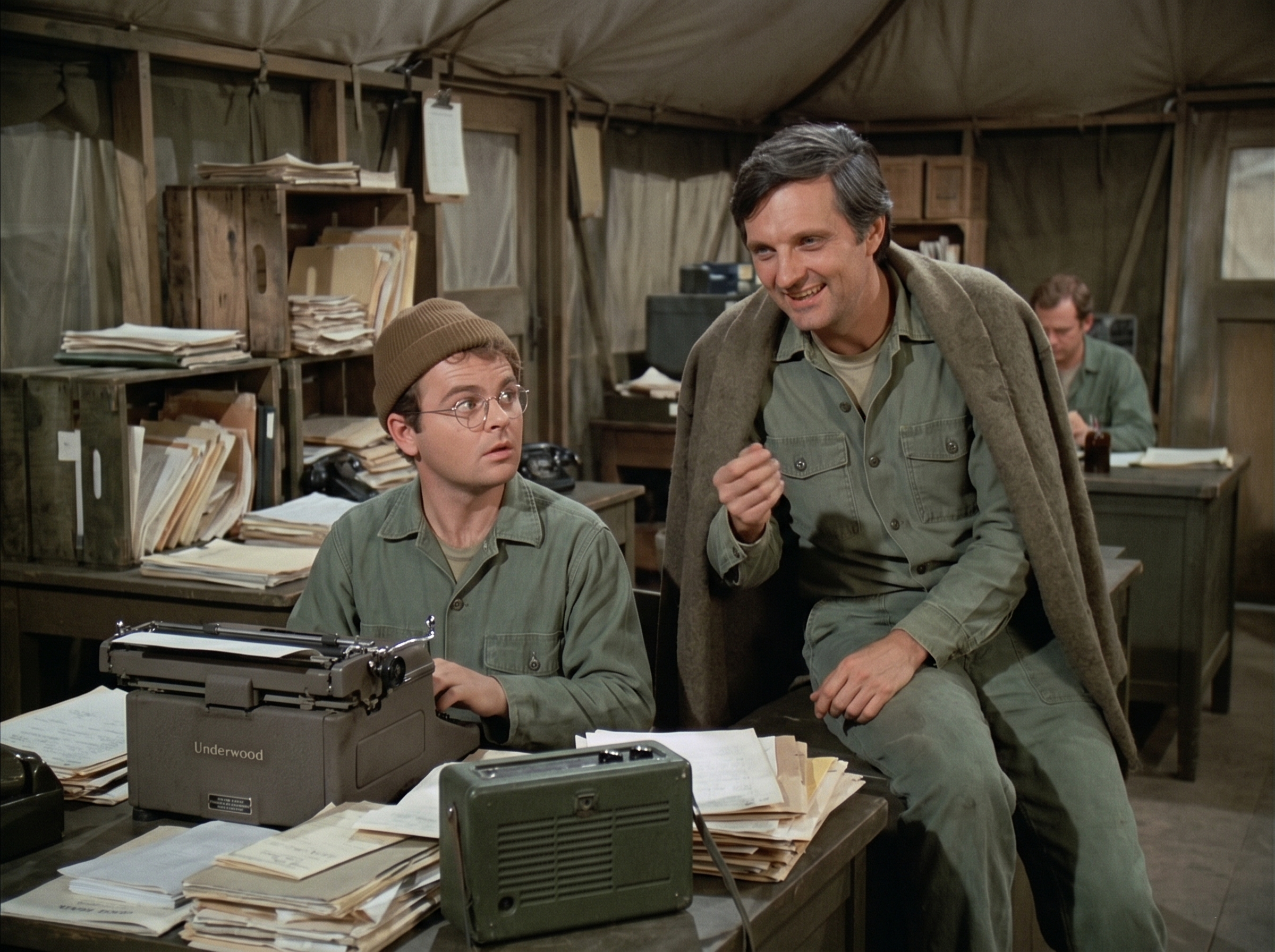
The mud outside Company Clerk Radar O’Reilly’s office was thicker than usual, a stubborn, gray reminder that the war was still very much happening, just a few yards away. Inside, however, the air smelled of stale coffee, old paper, and the peculiar, comforting scent of an Underwood typewriter ribbon that had seen better days.
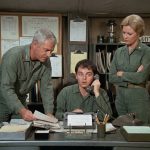
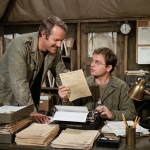
Radar sat hunched over the keys, his brow furrowed in that familiar, studious concentration that made him look a decade younger than he actually was. He was navigating the endless, Kafkaesque bureaucracy of Army supply requisitions, his fingers dancing with a rhythm honed by necessity and an uncanny ability to predict what the brass needed before they knew they needed it.
Suddenly, a weight settled onto the corner of his desk—not the weight of a heavy ledger, but the warm, familiar presence of Hawkeye Pierce.
Hawkeye had draped his olive-drab blanket over his shoulders like a weary king in a makeshift kingdom, his hair slightly disheveled from a long shift in Post-Op. He leaned in close, his face illuminated by the harsh, singular light of the tent, wearing that signature lopsided grin that balanced precariously between exhausted sarcasm and genuine affection.
“Radar,” Hawkeye murmured, his voice low, cutting through the rhythmic clacking of the keys. “I have just returned from the front lines of the mess tent, and I bring tidings of great sorrow. The mystery meat is not only a mystery; it has apparently achieved sentience. It’s currently attempting to organize a labor union near the mashed potatoes.”
Radar didn’t stop typing, but a small, involuntary smile tugged at the corner of his mouth. “That’s nice, Hawk. But if I don’t get these forms for Colonel Potter by 0800, we’re all going to be eating mystery meat for breakfast, lunch, and dinner for the next month.”
Hawkeye sighed, a sound that carried the heavy, lingering fatigue of a man who had seen too much and wanted to laugh to keep from breaking. He reached out, his hand hovering over the carriage return, and whispered something so sudden and startling that Radar’s fingers froze mid-air, the typewriter bell pinging sharply in the silence, leaving the entire office suspended in a moment of sharp, unexpected tension.
The ping of the typewriter bell seemed to echo through the entire 4077th. Radar’s eyes widened, his head snapping up to look at Hawkeye, his innocence meeting the older man’s weary, searching gaze.
“You really mean it?” Radar whispered, his voice barely audible over the distant, rhythmic thrum of a helicopter approaching the pad.
Hawkeye nodded, his grin fading into something much softer, something honest. “I do, kid. It’s just sitting there. Waiting for someone to appreciate it.”
The tension in the room shifted instantly. It wasn’t the stress of a wounded soldier or a shortage of supplies, but the quiet, profound weight of a friendship forged in the most unlikely of places. Radar slowly pushed back his chair, his hands trembling just a little—not from fear, but from the sudden, overwhelming realization that even in a place where nothing ever felt permanent, there were small, beautiful secrets to be kept.
Hawkeye climbed off the desk, the heavy blanket slipping slightly, revealing the tired set of his shoulders. He reached out and gently tapped the top of the Underwood, a gesture of respect for the machine and the man who kept their world spinning.
“Don’t tell Winchester,” Hawkeye added with a wink, the mischief returning to his eyes. “If he finds out, he’ll try to lecture us on the etiquette of secret-keeping in the field. He’ll probably insist that the proper way to handle it involves a monocle and a very firm letter to the War Department.”
Radar let out a soft, genuine laugh, the kind that reached his eyes and stayed there. The fatigue of the long night seemed to lift, if only by an inch or two. He looked down at the pile of paperwork—the requisitions, the manifests, the endless lists of things they needed and things they were losing—and for the first time all day, it didn’t look like a mountain. It looked like a map of their shared lives.
“You’re okay, Hawkeye,” Radar said, his voice quiet and sincere. “You’re really okay.”
“I try, Radar. I try,” Hawkeye replied, turning toward the tent flap. He paused, looking back at the desk, at the radio, and at the small, frantic, wonderful heart of their home. “Finish your work, clerk. We’ve got a long day ahead of us, and I have a feeling the mystery meat is going to need a mediator.”
As Hawkeye stepped out into the bright, harsh Korean light, Radar remained at his desk for a moment, listening to the quiet hum of the radio and the distant sounds of camp life settling into its rhythm. He adjusted his watch, pulled the carriage back, and began to type again, his movements steady and purposeful.
The war wasn’t over, and the future was a blurred, uncertain thing, but in that small, crowded tent, surrounded by the debris of their daily battle, there was a quiet grace. They were tired, they were far from home, and they were often broken, but they were here—together—and for now, that was enough.
In a land defined by loss, the greatest victory was simply finding a reason to smile before the next shift began.