The Weight of the Miles
Silence at the 4077th was a rare and suspicious thing.
It wasn’t a true silence, of course. There was always the distant, rhythmic thumping of the generators, the crunch of boots on the dusty compound paths, and the low murmur of voices from the mess tent. But on a late Tuesday afternoon, the sky empty of choppers and the O.R. scrubbed down and dark, a heavy, waiting quiet settled over the camp.
It was the kind of quiet that gave a man too much time to think.
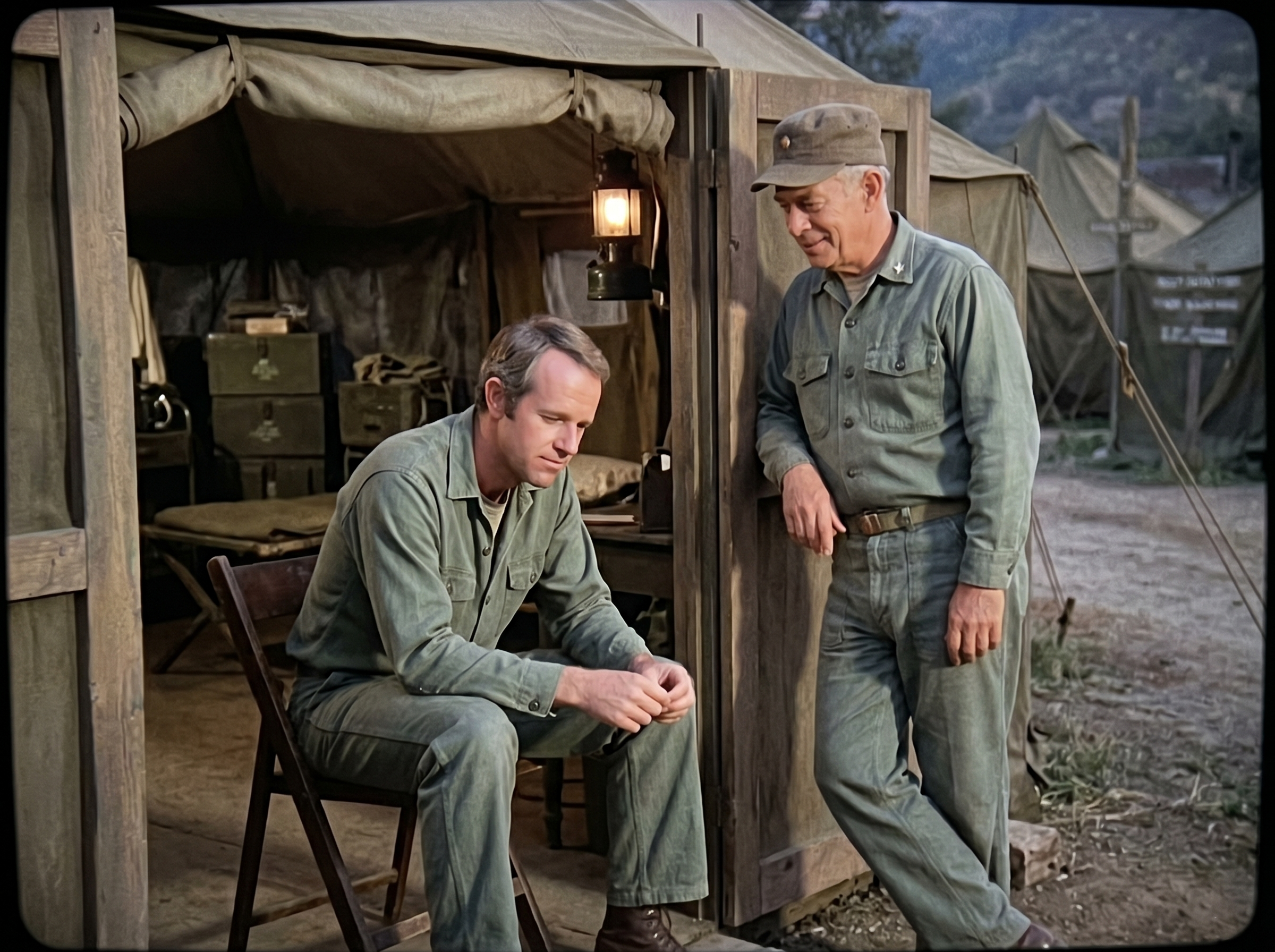
Captain B.J. Hunnicutt sat just inside the open flaps of the Swamp, perched on a rickety wooden folding chair. He was leaning forward, his elbows resting near his knees, his hands loosely clasped together.
To anyone walking past, he simply looked like a tired surgeon taking a breather. But the posture was a lie.
B.J. was thousands of miles away.
His eyes were fixed on a spot of dirt just past the toe of his combat boots, but he wasn’t seeing Korea. He was seeing the sloped driveway of a house in Mill Valley. He was smelling the crisp California air. He was hearing the soft, unmistakable sound of his wife, Peg, humming in the kitchen.
The contrast between that vibrant memory and the faded canvas tan tones of the camp around him felt like a physical weight pressing down on his chest.
“You’re wearing a hole in the floorboards with your eyes, Hunnicutt.”
B.J. blinked, pulled sharply back to reality.
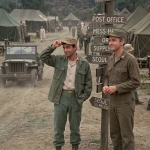
Standing in the doorway, framed by the wooden supports of the tent and the unlit kerosene lantern hanging above, was Colonel Sherman T. Potter.
The Colonel wasn’t standing at attention. He was leaning casually against the doorframe, his hands resting easily, a patient, weary wisdom etched into the lines of his face. The late afternoon sunlight cast soft shadows across his worn green fatigues and the brim of his cap.
B.J. managed a faint, tired smile. “Just taking inventory of the dirt, Colonel. Making sure none of it went AWOL since this morning.”
Potter didn’t laugh. He just smiled, a gentle, fatherly expression that saw right through the younger man’s polite deflection. “It’s a dangerous time of day, Captain. The sun goes down, and the miles start piling up on you.”
B.J. shifted in his chair, unlacing his fingers. He wanted to offer up a witty Hawkeye-style remark to brush it off, to keep the armor up. But the exhaustion in his bones was too deep, and Potter’s steady gaze was too kind.
“It’s her birthday today,” B.J. said, his voice dropping to a quiet rasp. “Erin.”
Potter’s expression softened even further. He didn’t interrupt. He knew better than to rush a man standing on the edge of a memory.
“She’s two,” B.J. continued, staring back down at his hands. “Two years old. When I left, she was barely more than a bundle of blankets. Now she’s walking. Talking. Having a birthday cake.”
He looked up at Potter, and the steady, grounded facade of Captain Hunnicutt finally cracked.
“I missed her first steps, Colonel,” B.J. whispered, his voice tightening with a sudden, sharp fear. “I missed her first words. What if… what if I get back, and she looks at me, and she doesn’t know who I am? What if I’m just a stranger in a green suit who walked into her house?”
The heavy, painful silence hung in the doorway, thicker than the summer heat, as B.J. laid his deepest terror bare in the Korean dirt.
Colonel Potter didn’t answer right away.
He stayed leaning against the wooden frame of the tent, letting the canvas rustle softly in the evening breeze. He looked out across the compound for a long moment, the fatherly warmth in his eyes turning inward to his own distant memories.
Finally, he pushed himself gently off the doorframe and took a half-step into the tent, though he remained standing, keeping that comfortable, grounding distance.
“You know, Hunnicutt,” Potter began, his voice a low, gravelly rumble that felt as solid as an oak tree. “In the winter of ’18, I was over in France. Mud up to my knees, ears ringing from the artillery. I had a picture of Mildred in my breast pocket that I’d stared at so often, the ink was starting to wear off the paper.”
B.J. looked up, listening quietly as the older man spoke.
“We had our first boy while I was over there,” Potter said, a faint, nostalgic smile touching the corners of his mouth. “I didn’t meet him until he was nearly walking himself. And I had the exact same nightmare you’re having right now.”
Potter hooked his thumbs into his pockets, his posture relaxed, practical, and lived-in.
“I was terrified,” Potter admitted, a rare confession that made the air in the Swamp feel suddenly sacred. “I thought I’d walk through that front door in Hannibal, Missouri, and my own flesh and blood would cry and hide behind his mother’s skirts. I thought the war had taken too much of my time, and I’d lost my place in my own family.”
“Did he?” B.J. asked, his voice barely above a whisper. “Did he hide?”
Potter chuckled, a soft, dry sound that carried years of affection. “Hell, no. He looked at me, grabbed my pant leg, and drooled right on my best dress shoes. Ruined the shine entirely.”
B.J. let out a short, breathy laugh, the tension in his shoulders dropping just a fraction.
“The point is, Son,” Potter said, his tone turning earnest and deeply comforting. “Kids don’t care about the calendar. They don’t care about the miles. They care about the love that fills the house. And Peg is filling that house with enough love for the both of you until you get back to carry your share.”
B.J. took a deep breath, the stale air of the tent suddenly feeling a little easier to pull into his lungs.
“You think so?” B.J. asked, seeking the reassurance he usually provided to everyone else.
“I know so,” Potter said firmly. “The heart has a longer memory than the eyes, Hunnicutt. You’re her father. That isn’t a title you lose just because some politicians decided to have a shooting match in a foreign country. When you walk through that door in Mill Valley, she’ll know you. Because Peg will have made sure she knows you.”
Potter reached out and gave the canvas wall of the tent a definitive, affectionate slap.
“Now,” Potter said, his voice returning to its usual dry, commanding cadence, though the twinkle in his eye remained. “I believe the mess tent is attempting to pass off something resembling meatloaf tonight. It’s a crime against culinary decency, but it’s hot.”
B.J. finally sat back in his chair, a true, grateful smile breaking through the weary lines on his face. The deep, agonizing ache of homesickness hadn’t vanished—it never did—but it had transformed back into a bearable, dull throb.
“Meatloaf, huh?” B.J. said, shaking his head. “You really know how to cheer a guy up, Colonel.”
“Command decision, Captain,” Potter smiled, turning back toward the dirt path. “It builds character. Or at least, an iron stomach. Don’t sit in the dark too long, Son.”
“I won’t,” B.J. promised. “And… thank you, Sherman.”
Potter tipped his cap slightly, stepping out into the fading daylight. “Happy birthday to the little girl, B.J.”
B.J. watched the Colonel walk away, the dust settling behind his worn boots. He looked down at his empty hands one last time, no longer seeing a stranger in a green suit, but a father, just taking the long way home.
Some days, the bravest thing a doctor at the 4077th could do was simply carry the weight of the miles and keep walking.