The Frontline Haberdashery and the Morning Wire
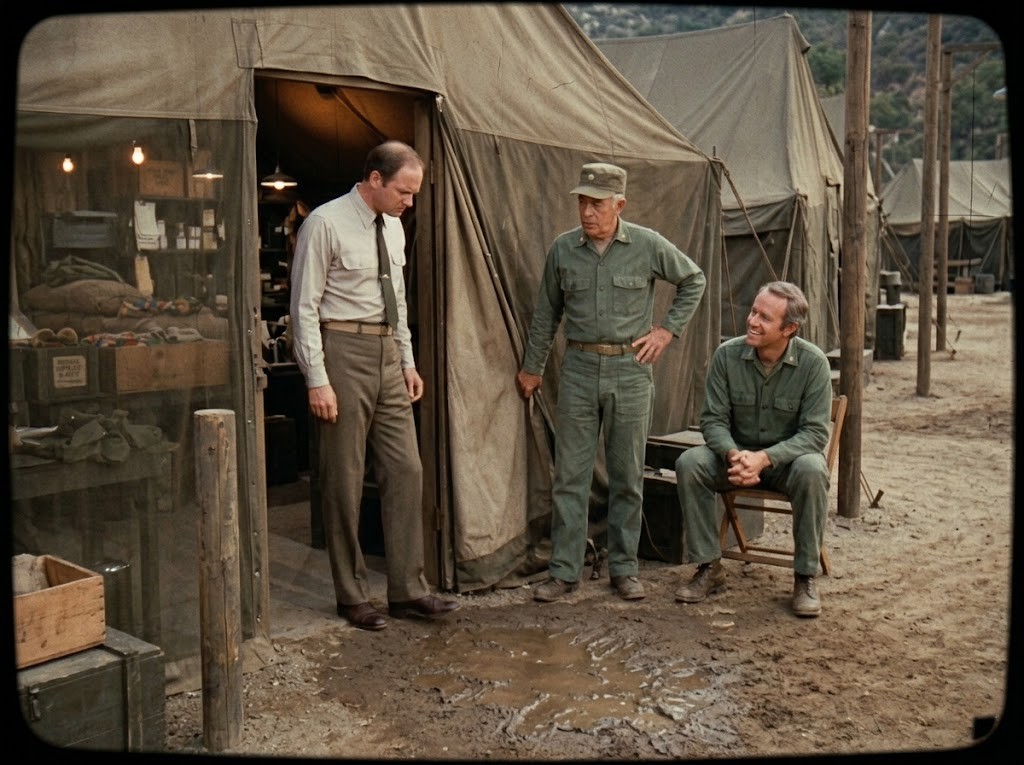
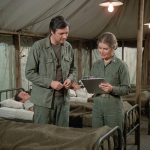
The morning after an eighteen-hour marathon in the Operating Room always brought a very specific, bone-deep cold to the 4077th. It was the kind of chill that seeped under the canvas of the tents, bypassed the skin entirely, and settled directly into the joints of exhausted surgeons.
Inside the clerk’s office, the air smelled faintly of stale coffee, mimeograph ink, and the lingering scent of rubbing alcohol that seemed permanently attached to the doctors. The camp was quiet, save for the distant, low hum of a generator and the relentless Korean wind rattling the tent flaps.
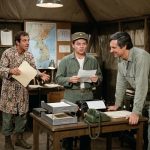
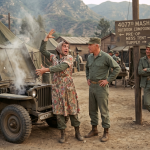
Captain Benjamin Franklin “Hawkeye” Pierce burst through the door, shattering the quiet. He was wearing what could only be described as a visual assault. It was a bathrobe, but not just any bathrobe. It was a loud, swirling, chaotic nightmare of paisley and floral prints that looked like it had been violently ripped from a midwestern living room sofa.
Hawkeye was clutching a manila folder in his left hand, gesturing wildly with his right, his face a mask of theatrical, exhausted indignation.
“I am telling you, Beej, it is a deliberate, psychological attack by the United States Army,” Hawkeye declared, waving the folder at the ceiling as if the generals themselves were hiding in the canvas. “They know they can’t break our bodies with the hours, so they are actively going after our minds.”
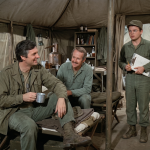
Captain B.J. Hunnicutt was already in the room, leaning casually against the edge of the clerk’s desk. He hadn’t even bothered to change out of his blood-stained green fatigues. He looked utterly drained, his shoulders heavy, yet he wore a quiet, steady smile. B.J. was watching his best friend’s misery with the deep, grounded amusement of a man who found a lifeline in the absurdity of their situation.
“I sent a requisition, explicitly and clearly, for fifty boxes of surgical hemostats and three new sterilizing trays,” Hawkeye continued, his voice rising in that familiar, rhythmic cadence. “And what do I get? This! Three hundred yards of surplus upholstery fabric! I am wearing a couch, Beej! I am wrapped in a parlor room from 1922!”
B.J. chuckled softly, resting his hands on the desk. “I don’t know, Hawk. I think it gives you an air of dignity. Very aristocratic. Like a duke who completely lost his mind.”
“I am not a duke, I am a drafted doctor in a mud puddle!” Hawkeye shot back, turning his attention to the center of the room. “Radar! I want you to get me a direct line to I Corps. I want to speak to whoever is in charge of turning a frontline surgical hospital into a haberdashery.”
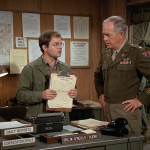
Corporal Walter “Radar” O’Reilly was standing behind his desk, but he wasn’t looking at Hawkeye, and he wasn’t looking at the hideous robe. He was staring intently at a freshly typed sheet of paper he had just pulled from the wire machine.
His eyes were incredibly wide behind his round spectacles. His mouth hung slightly open in a state of absolute, frozen shock. He looked like a boy who had just seen a ghost walk through the olive-drab filing cabinets.
“Uh… Captains?” Radar squeaked, his voice barely cutting through Hawkeye’s rant.
“Not now, Radar, I am building up to a magnificent crescendo of righteous anger,” Hawkeye said, taking a step closer and pointing a finger at the map of Korea on the wall. “I’m going to demand a court-martial. Or at least a matching set of drapes.”
“Sirs!” Radar said, louder this time. His voice cracked, carrying a weight that instantly cut through the comedy in the room. He held the paper up, his hand trembling just a fraction.
Hawkeye stopped mid-sentence. The theatrical anger instantly melted away from his face, replaced by the instinctual, heavy dread that every doctor at the 4077th carried just below the surface.
B.J. stopped smiling entirely. He pushed off the edge of the desk, his posture suddenly rigid, his eyes locking onto the young corporal.
“What is it, Radar?” B.J. asked, his voice dropping an octave, calm but completely serious.
Radar swallowed hard, his Adam’s apple bobbing in his throat. He looked down at the paper, then back up at the two surgeons. “It’s a teletype from Tokyo General. It’s about the evacuation flight… the one with the chest wound from yesterday afternoon.”
Hawkeye went perfectly still. They both knew exactly who Radar meant. Private Thomas Miller. He was a nineteen-year-old kid from Iowa who had talked about his mother’s cherry pie right up until the anesthesia took him under. They had worked on him for six agonizing hours, breaking every medical rule in the book to keep his lungs functioning long enough to get him on the chopper.
They had sent him away hanging by a thread so thin it was practically invisible.
“And?” Hawkeye asked, his voice barely a whisper, the exhaustion suddenly visible in every line on his face.
Radar stared at the paper, his face completely unreadable, the silence in the tent stretching out into eternity.
The silence in the clerk’s office was suddenly deafening. Outside, the distant, rhythmic thumping of an incoming chopper echoed over the hills, but inside the tent, the world had entirely stopped.
Hawkeye slowly lowered his hand. The ridiculous, swirling floral bathrobe suddenly looked incredibly out of place, a foolish costume worn by a man waiting for a firing squad. He braced himself against the side of the filing cabinet, his knuckles turning white.
B.J. took a slow step closer to the desk, his eyes never leaving the young corporal’s face. “Radar,” he prompted gently, his voice carrying the steady warmth of a father trying to comfort a frightened child. “Tell us.”
Radar looked up from the paper. Slowly, a trembling, disbelieving smile broke across his round face. His eyes shone brightly with unshed tears, catching the harsh light of the single bulb hanging above his desk.
“He made it,” Radar breathed out, the words catching in his throat. “The manifest says he touched down in Tokyo alive. They rushed him straight into post-op. He was awake, sirs.”
The physical reaction from the two doctors was immediate and profound. The massive, crushing weight of the adrenaline crash hit them both at the exact same moment.
Hawkeye let out a long, shuddering breath he hadn’t realized he was holding. His shoulders slumped forward, and he leaned his head back against the cold metal of the cabinet. He closed his eyes, and for a fleeting second, he looked incredibly old, and incredibly grateful.
B.J. let out a soft exhale, running a hand over his face. The rigid tension left his body all at once. When he lowered his hand, that steady, warm smile had returned to his face, but this time it was different. It reached all the way to his eyes, shining with a quiet, powerful relief.
Radar cleared his throat, wiping a hand quickly across his cheek. “There’s a note attached from the Chief Surgeon in Tokyo,” he added, looking back down at the wire.
“Let me guess,” Hawkeye said, opening his eyes and pushing himself off the cabinet. His voice was thick with emotion, though he desperately tried to coat it in his usual sarcasm. “He wants to know who left a pair of pliers in the kid’s chest.”
“No, sir,” Radar said, his smile widening. “It says: ‘To the butchers at the 4077th. I do not know what kind of meatball surgery you performed on this boy, but the patchwork held. He is stable. He is going to keep his lungs, and he is going to go home to Iowa. Good work.'”
Hawkeye looked over at B.J., shaking his head slowly. “Meatball surgery. The absolute nerve of that guy.”
B.J. chuckled softly, reaching out and clapping a hand firmly onto Hawkeye’s shoulder. “I’ll take it as a compliment, Hawk. Especially coming from a guy who gets to sleep in a real bed and drink coffee that doesn’t taste like battery acid.”
Hawkeye looked down at his loud, paisley robe. He looked at the manila folder still clutched in his hand—the bureaucratic mix-up, the requisition for clamps that had magically turned into upholstery fabric.
Suddenly, none of it mattered. The army’s infinite stupidity, the freezing cold, the terrible food, the sheer exhaustion—it all faded into the background. It was just white noise compared to the fact that a nineteen-year-old kid from Iowa was going to see his mother again.
“You know, Beej,” Hawkeye said softly, tossing the manila folder carelessly onto Radar’s desk. He adjusted the lapels of the ridiculous robe, a genuine, tired smirk finally returning to his face. “Maybe this chintz isn’t so bad after all. It’s growing on me. I might have a three-piece suit made out of it. Wear it to the officer’s club in Tokyo when this whole miserable thing is over.”
B.J. squeezed his best friend’s shoulder before letting go. “I’ll hold you to that, Hawk. I expect a matching fedora. But right now, I think we’ve earned a drink. Even if it is distilled in an old jeep radiator and tastes like gasoline.”
“Lead the way, Doctor,” Hawkeye replied, turning toward the door.
Radar stood quietly behind his desk, watching the two men walk toward the exit. He felt that deep, familiar surge of affection he always felt for these brilliant, exhausted, crazy surgeons. He knew they hid behind their jokes, their complaints, and their gin. He knew they used the humor as a shield against the endless parade of broken bodies. But in moments like this, Radar saw exactly who they truly were.
“I’ll file this right away, sirs,” Radar said gently. He didn’t put the teletype into the olive-drab army folders. Instead, he carefully placed it into a slightly battered, personal folder he kept tucked away in the bottom drawer. It was the folder where he kept the good news. It wasn’t very thick, but it was the most important thing in the office.
Hawkeye stopped at the tent flap, turning back to look at the young corporal. The witty, sharp-tongued swamp rat was gone for a split second, replaced entirely by a weary, deeply human man who had just won a tiny victory against an impossible war.
“Thanks, Radar,” Hawkeye said softly, the gratitude hanging heavily in the cold air.
“Anytime, Captain,” Radar replied softly.
Hawkeye and B.J. pushed through the canvas flaps, walking out into the freezing Korean morning side by side. The war was still waiting for them out there. The helicopters would inevitably return, bringing more noise, more chaos, and more broken kids. But today, for just a few precious hours, the air felt a little lighter to breathe.
In the middle of a war that made no sense, the only things that truly mattered were the lives they saved, and the friends who helped them carry the weight.