The Best Table in a Bad Town
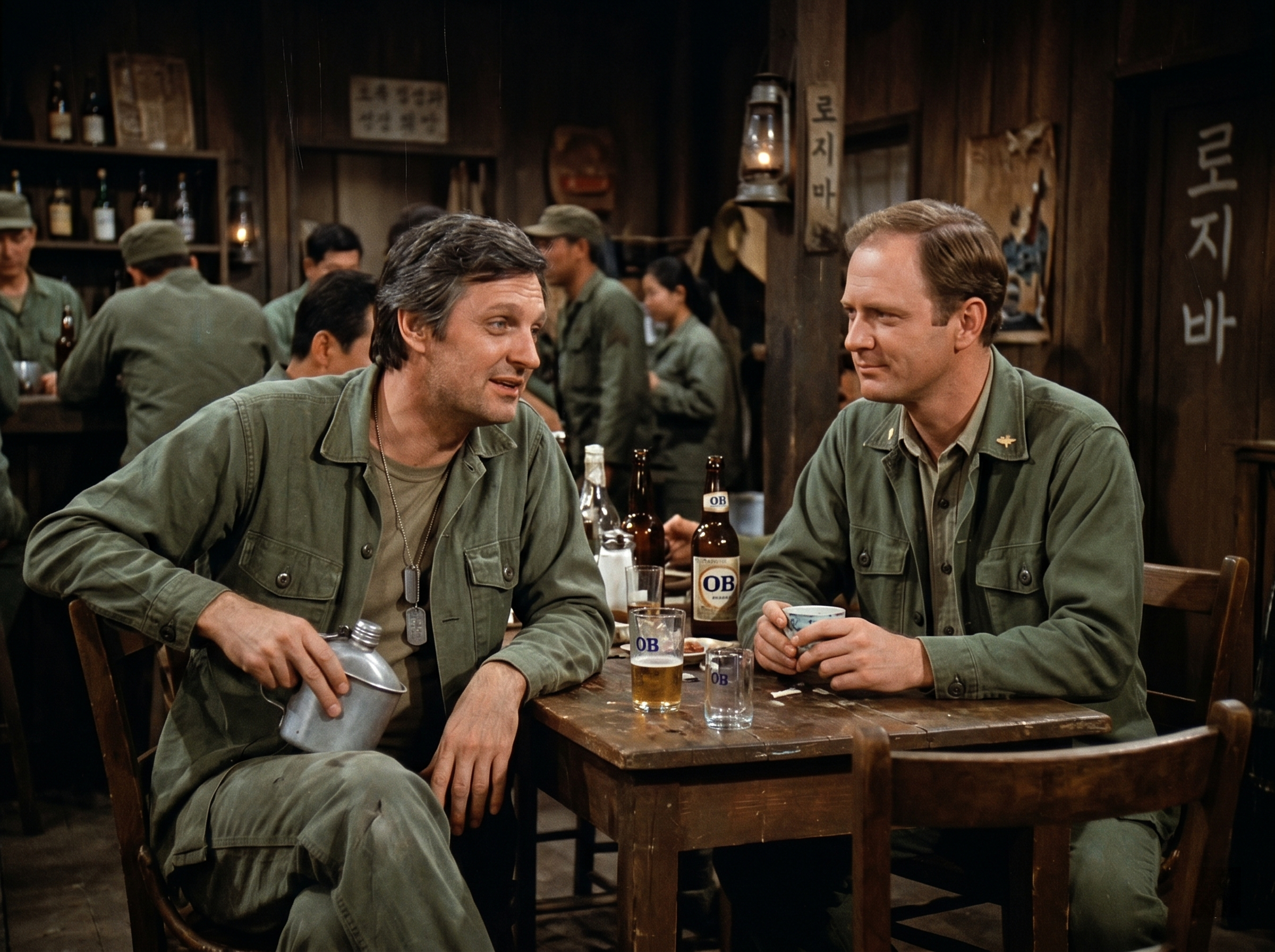
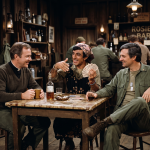
The smell of stale OB beer, sizzling garlic, and damp wool was hardly the perfume of the gods. Yet, at three in the morning, after a grueling thirty-six straight hours standing over the operating tables, Rosie’s Bar felt like the finest establishment on earth. It was a small, rustic sanctuary, a local social room held together by splintered wood, worn wall textures, and the desperate need of the 4077th to briefly forget where they were.
Hawkeye Pierce sat hunched over a scarred wooden table, his long frame folded into an expressive, carelessly confident slouch. His green fatigues were deeply wrinkled, smelling faintly of ether and iodine, and his metal dog tags clinked softly against his chest as he shifted his weight. In his right hand, he loosely gripped a dented aluminum canteen, undoubtedly filled with whatever volatile, paint-stripping mixture his tent’s still had produced that morning.
Directly across from him sat Major Charles Emerson Winchester III. Even in the dim, soft amber light of the smoky bar, Charles managed to look as though he were awaiting a private table at the Algonquin. His back was rigidly straight against the simple wooden chair, his collar neat despite the exhaustion, and his large hands delicately cradled a small, white ceramic cup. He looked distinctly out of place among the rough-hewn timbers and weary soldiers, yet entirely immovable.
The bar was packed with other exhausted members of the camp, their voices a low, humming blur in the background. But at this small corner table, an unusual, quiet intimacy had settled between the two surgeons. A loose, weary conversation had caught them mid-scene, fueled by fatigue and bad alcohol.
Hawkeye took a slow swig from his canteen. He wiped his mouth with the back of his hand, his eyes fixed on Charles with a thoughtful, teasing expression.
“Tell me something, Charles,” Hawkeye rasped, his voice rough. “How do you do it? How do you sit there looking like you’re waiting for the valet to bring around your carriage, when we both know you’ve been elbow-deep in the exact same mud and blood as the rest of us?”
Charles offered a dry, superior smile. “It is a simple matter of breeding, Pierce. One does not allow one’s tragic environment to dictate one’s posture.”
Hawkeye chuckled, but the sound lacked its usual sharp bite. The joke fell flat, evaporating into the heavy air. Slowly, the teasing light in Hawkeye’s eyes began to fade.
The casual slouch remained, but the mask slipped. The quiet, raw wounds beneath the joke suddenly breached the surface. Hawkeye stared blindly down at the half-empty bottles of OB beer and the small, empty glasses scattered across the wooden table. The memory of the last patient—a boy who couldn’t have been older than nineteen, pale and broken—flashed violently behind his eyes.
His knuckles whitened around the metal canteen. The silence between them grew incredibly heavy, thick with the unspoken horrors they had just walked away from. Hawkeye looked back up at Charles, his eyes suddenly glistening, his breathing shallow. The weight of the endless war was pressing down on his shoulders, threatening to finally crush him right there in the dim, warm light of Rosie’s Bar.
Charles saw the subtle shift instantly. The haughty amusement completely vanished from the Major’s face, replaced immediately by a look of reluctant, quiet compassion. He recognized that hollow stare on Pierce’s face all too well. It was the look of a man staring over the edge of a very steep, very dark cliff.
For a long, stretched moment, the only sounds were the low, murmuring chatter of the nurses at the bar and the distant, lonely howl of the Korean wind rattling the thin wooden walls. Charles did not look away. He did not offer a pitying sigh, nor did he make a joke to deflect the sudden, crushing gravity of the moment.
Instead, Charles slowly lowered his small white cup to the table. He reached across the worn wood, his movements deliberate and calm, and gently moved a stray glass an inch to the left, buying them both a necessary fraction of a second to breathe.
“He had a strong pulse when the chopper lifted him to Seoul, Benjamin,” Charles said. His voice was incredibly quiet. The rare use of Hawkeye’s given name acted as a subtle grounding wire, a lifeline thrown directly into the center of a storm.
Hawkeye blinked rapidly, the paralyzing spell breaking just a little. He leaned heavier onto his elbow, resting his chin in his hand. “Barely, Charles. Barely. And for what? So they can patch him up at General, pin a medal on his chest, and send him right back into this meat grinder?”
“We are not the architects of this madness, Pierce,” Charles replied gently. His voice maintained its refined, aristocratic clip, but it was profoundly softened by their shared, bone-deep exhaustion. “We are merely the repairmen. We stem the tide. And today, despite the sheer, unimaginable volume of the sea, your repairs held.”
Hawkeye stared down at the aluminum canteen in his hand, tracing the dented metal with his thumb. The tight, painful knot in his chest, the one that made it hard to draw a full breath, loosened just a fraction. He let out a long, ragged exhale that ruffled his messy hair.
“You know, Winchester,” Hawkeye said, his voice finally finding a faint trace of its usual cynical rhythm, “for a pompous, overstuffed blueblood from Boston, you occasionally possess a bedside manner that isn’t entirely repulsive.”
Charles picked up his cup again, flawlessly restoring his perfect, upright posture. “I shall take that as the absolute highest compliment your delightfully limited vocabulary can manage.”
Hawkeye smiled. It was a real smile this time. Small, weary, and cracked around the edges, but undeniably genuine. He lifted his heavy canteen, gesturing vaguely toward the major across the table.
“What exactly are you drinking out of that tiny thimble, anyway?” Hawkeye asked, nodding at Charles’s cup. “Don’t tell me you brought your own imported Darjeeling to Rosie’s.”
Charles raised a single, expressive eyebrow, his lips twitching into a wry, knowing smile. “It is a remarkably poor excuse for sake, served in a questionable vessel, at entirely the wrong temperature. However, under the current, tragic circumstances, it provides a certain… medicinal warmth.”
“Medicinal,” Hawkeye echoed softly. He reached across the table and clinked his heavy, battered metal canteen gently against Charles’s delicate ceramic cup. “To medicine. And to surviving another shift in the world’s most depressing tailor shop.”
“Hear, hear,” Charles murmured respectfully.
They drank in silence. Around them, the rustic bar continued its gentle hum of off-duty life. Someone dropped a coin into the jukebox in the corner, and a soft, scratchy 1940s jazz tune drifted through the amber shadows, wrapping around the room like a warm blanket.
Hawkeye slouched a little lower in his chair, the last of the frantic operating room tension finally draining out of his shoulders. He felt the sharp ache in his lower back, the burning fatigue in his eyes, but the overwhelming darkness had been successfully pushed back.
He looked across the table. Charles was staring straight ahead, dignified and poised. He looked entirely ridiculous in this rustic dive bar, yet he perfectly anchored the space they shared. They were worlds apart in every conceivable way—in class, in temperament, in geography—thrown together solely by a horrific accident of war.
But in the quiet, shadowed corners of Rosie’s, surrounded by the smell of cheap beer and the shared ghosts hovering just out of sight, they understood each other perfectly. They weren’t best friends, but they were brothers in this very specific, terrible fraternity.
Hawkeye took another sip of his homemade gin, closing his eyes as the horrible liquid burned its way down his throat. It tasted aggressively of lighter fluid, pine needles, and despair.
It was, without a doubt, the best thing he had ever tasted.
He opened his eyes, resting his chin in his hand once more, and quietly watched the room. The war was patiently waiting for them just outside the wooden doors. Tomorrow, the choppers would inevitably come again. But right now, in this soft, amber light, they were simply two tired men who had found a brief, vital moment of peace.
Even in a place built on broken pieces, they somehow always found a way to stitch each other back together.