The Day the Army Certified Toledo’s Finest
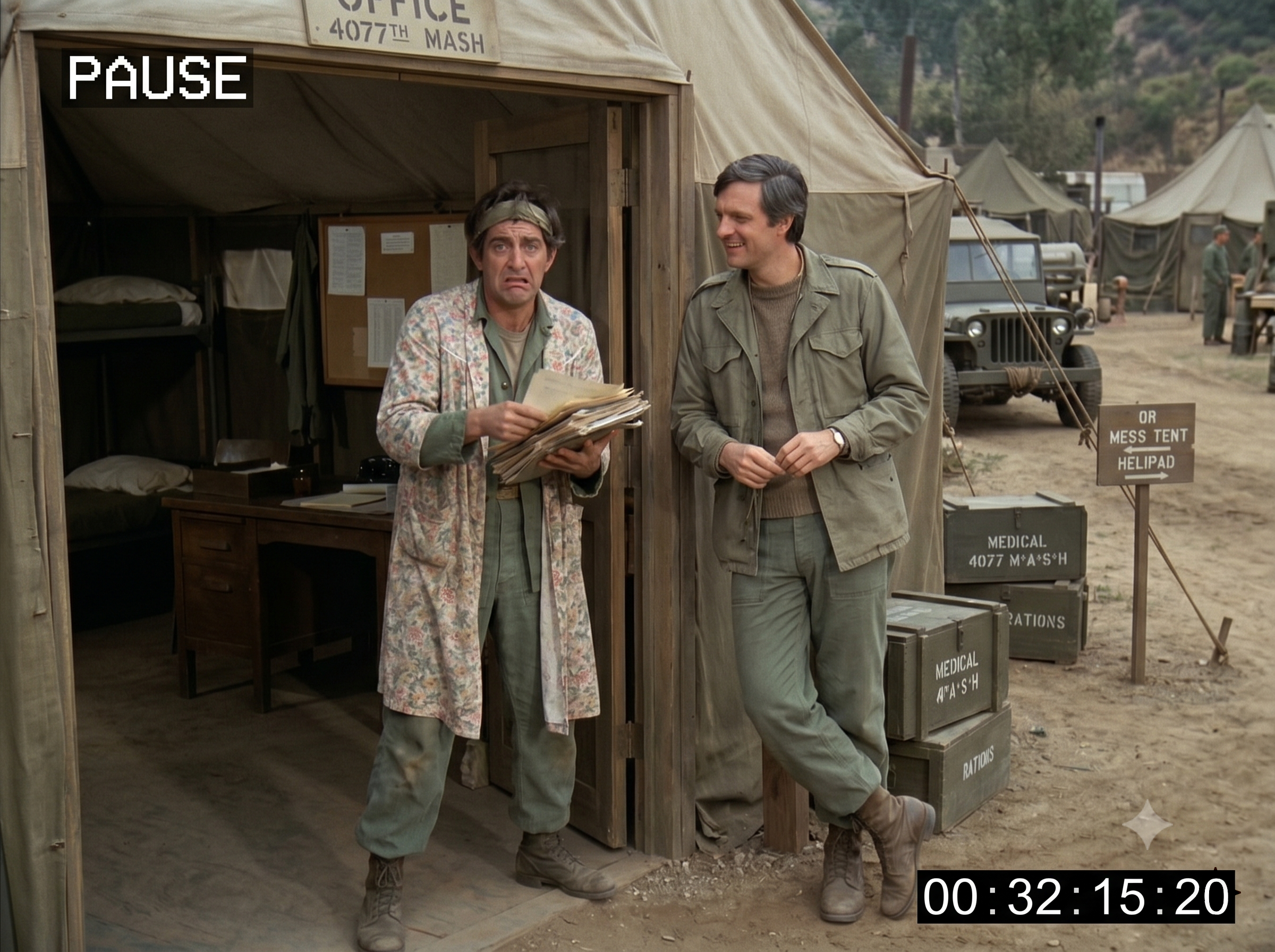
It was a quiet Tuesday afternoon at the 4077th, the kind of rare, dusty stillness that usually meant the universe was just stopping to reload.
The choppers had been silent since dawn, leaving the camp bathed in the heavy, baking heat of the Korean sun.
Outside the clerk’s tent, the air smelled faintly of canvas, motor oil, and the questionable mystery meat simmering in the mess tent down the hill.
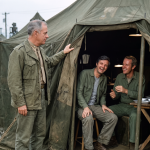
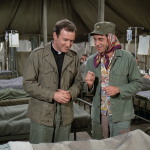
Captain B.J. Hunnicutt strolled down the dirt path, hands resting comfortably in the pockets of his green field jacket.
He wore his heavy olive-drab sweater underneath, braving the afternoon warmth just to feel a little bit of familiar comfort against the biting wind that would inevitably roll down the mountains by nightfall.
He was just passing a stack of wooden crates stenciled with “MEDICAL 4077 MAS*H” and “RATIONS” when the screen door of the office swung open.
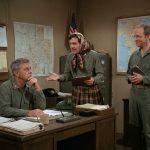
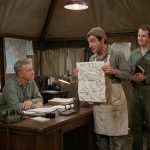
Corporal Maxwell Q. Klinger stood frozen in the doorway.
He was a vision of absolute, magnificent tragedy.
Klinger was dressed in his signature blend of military issue and thrift-store chic: a delicate, floral-patterned spring housecoat worn boldly over his standard green fatigues.
A green bandana held back his hair, and his dusty combat boots were planted firmly on the wooden floorboards of the clerk’s office.
But it wasn’t the outfit that caught B.J.’s attention. It was Klinger’s face.
The corporal’s eyes were wide with a mixture of theatrical panic and deeply wounded dignity.
His mouth was twisted into a grimace of pure, unadulterated betrayal.
In his hands, Klinger clutched a thick stack of official Army paperwork, holding it out as if the pages were actively on fire.
B.J. stopped in his tracks.
He didn’t rush forward. He didn’t ask if anyone was hurt.
Instead, a slow, knowing smile spread across his face. He leaned his shoulder casually against the wooden frame of the tent, his arms relaxed, waiting for the performance to begin.
He knew Klinger well enough to recognize the difference between an actual emergency and a bureaucratic catastrophe.
“Afternoon, Max,” B.J. said mildly, his voice steady and warm. “You look like a man who just found out the Mud Hens are moving to Cleveland.”
Klinger didn’t blink. He just stared at the papers in his hands, his breath hitching dramatically.
“Worse, Captain,” Klinger gasped, his voice trembling with the weight of a thousand shattered dreams. “So much worse.”
He shuffled the heavy stack of manila folders, pulling a single, crisp white sheet from the center.
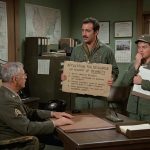
“The mail just came in from I-Corps,” Klinger explained, his tone hushed with reverence and horror. “Official correspondence. General Headquarters. Department of Psychiatric Evaluation.”
B.J.’s smile widened just a fraction. “Ah. The brass finally processed your latest appeal. Let me guess. They didn’t buy the story about your imaginary twin sister joining the convent?”
“I wish it were that simple,” Klinger wailed, stepping halfway out of the doorway, his floral housecoat catching a slight breeze.
He pointed a shaking finger at the official letterhead.
“Captain, I have spent two years cultivating a reputation as a dangerous, unpredictable lunatic. I have worn chiffon in a blizzard. I have eaten a jeep. I have thrown myself at the mercy of the United States Army’s medical establishment.”
He thrust the paper toward B.J., his face scrunching up in genuine, agonizing disbelief.
“And do you know what this says? Do you know what Major Sidney Freedman’s superiors have officially stamped on my permanent record?”
B.J. raised an eyebrow, thoroughly enjoying the quiet shade of the tent and the absolute absurdity of the moment. “Enlighten me, Max.”
Klinger took a deep, shuddering breath, his eyes scanning the typewritten words as if they were a death sentence.
“They denied my Section 8, Captain. But they didn’t just deny it. They ruined me. They officially declared me to be of ‘exceptionally robust mental fortitude.'”
B.J. bit his lower lip, fighting a losing battle against a genuine laugh.
He kept his posture entirely relaxed, letting the warm silence of the camp settle around Klinger’s devastating announcement.
“Robust mental fortitude,” B.J. repeated softly, letting the words roll around in the dusty air. “Congratulations, Max. You’re officially the sanest man in Korea.”
“It’s a disaster!” Klinger groaned, letting his arms drop to his sides, the paperwork rustling against his floral housecoat.
He looked down at his outfit, gesturing frantically at the delicate pink and yellow blossoms printed on the fabric.
“Look at me, Captain! I am standing in a combat zone wearing a spring garden party ensemble. I am accessorized with a bandana and dog tags. Does this scream ‘robust’ to you? It screams ‘send this boy back to Toledo before he tries to water himself!'”
B.J. shifted his weight, his smile softening into something more empathetic, though the humor never quite left his eyes.
He looked past Klinger, out toward the dusty motor pool where a lonely jeep sat parked beneath the shade of a scrubby pine tree.
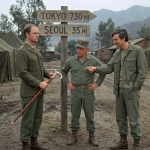
He looked at the little wooden sign pointing the way to the OR, the Mess Tent, and the Helipad.
It was a bleak, dusty, miserable place, held together entirely by surgical tape and sheer, stubborn willpower.
“Max,” B.J. said gently, “you’re missing the profound beauty of military bureaucracy. To the Army, a man trying to get out of a war by wearing a dress makes perfect, logical sense. It’s the guys who want to stay here that they should be worried about.”
Klinger sighed, a long, deflating sound that seemed to pull the theatrical energy right out of him.
He leaned back against the doorframe, his shoulders slumping beneath the flowery fabric.
For a brief second, the comedy faded, and B.J. could see the real, deep exhaustion underneath.
It was the same fatigue that lived in Hawkeye’s jokes, in Colonel Potter’s paintings, and in B.J.’s own letters home to Peggy.
It was the bone-deep weariness of a man who just wanted to sleep in his own bed, walk down his own street, and eat a hot dog that hadn’t been shipped across an ocean in a tin can.
“I just don’t get it, Captain,” Klinger murmured, his voice losing its dramatic flair, settling into a quiet, honest sadness. “I try so hard. I put my heart and soul into being crazy. And they just brush it off like it’s nothing.”
B.J. uncrossed his arms and took a half-step closer to the doorway.
He looked at the young corporal from Toledo, seeing past the ridiculous outfits and the endless schemes.
He saw the guy who stayed up all night typing reports so Radar could sleep. He saw the guy who scrounged fresh eggs for the wounded. He saw the guy who, despite his desperate desire to leave, never actually abandoned his post when the choppers came in.
“You want to know a secret, Max?” B.J. asked, his tone dropping to a quiet, conversational murmur.
Klinger looked up, his dark eyes tired but attentive. “What’s that, Captain?”
“You’re terrible at being crazy,” B.J. said warmly.
Klinger looked deeply offended, his dignity flaring back to life. “I beg your pardon! My Uncle Abdul was institutionalized for thinking he was a toaster, and I inherited his exact flair for the absurd!”
“No, you didn’t,” B.J. countered, smiling gently. “Because your heart isn’t in the crazy, Max. Your heart is right here. With us.”
B.J. gestured loosely toward the camp, toward the hospital tents and the stacks of medical supplies.
“You think you wear these outfits to get out of the Army. But the truth is, you wear them to keep the rest of us from losing our minds.”
Klinger blinked, the official Army paperwork lowering slightly in his hands.
“When the OR gets too heavy,” B.J. continued, “when the cold gets too bitter, or when Hawk and I start staring at the canvas ceiling for too long… you walk by in a Carmen Miranda fruit hat. Or a velvet evening gown. Or a floral housecoat.”
B.J. reached out and lightly tapped the crisp white paper in Klinger’s hand.
“The Army brass in Seoul might be idiots,” B.J. said, “but they accidentally got this one right. You are robust, Max. You’re the most resilient guy I know. You keep the color in this drab, olive-drab world.”
Klinger stood quietly in the doorway, digesting the words.
The wind picked up slightly, rustling the fabric of his housecoat and kicking up a small swirl of dust across the path.
He looked down at the paper that had broken his heart just minutes before. The word ‘sane’ stared back at him, an official condemnation of his greatest efforts.
Slowly, the theatrical spark returned to his eyes. The wounded pride shifted, transforming into a new, dangerous kind of determination.
“So,” Klinger said slowly, his voice finding its familiar, rhythmic cadence. “You’re telling me that the Army thinks I’m wearing this because I’m strong enough to handle the war.”
“That’s exactly what I’m telling you,” B.J. agreed, a wide grin breaking across his face.
“Which means,” Klinger reasoned, “that a simple floral housecoat is no longer sufficient to demonstrate my profound psychological collapse.”
“I’d say you need to up your game, Corporal.”
Klinger nodded solemnly, carefully tapping the stack of papers against the wooden doorframe to straighten them.
“Captain, I appreciate your counsel,” Klinger said, his chin lifting with renewed, magnificent dignity. “If they want robust, I’ll give them robust. I’m going to need to cable my mother in Toledo immediately. There’s a 1920s flapper dress with sequined fringe in the attic. If I pair it with a welding mask and a live chicken, not even General MacArthur could call me sane.”
B.J. laughed, a warm, genuine sound that echoed briefly against the canvas tents.
“I look forward to the fashion show, Max.”
“Oh, it won’t be a show, Captain,” Klinger said, adjusting his green bandana and stepping back into the dim interior of the clerk’s office. “It’s going to be a masterpiece.”
The screen door banged shut, leaving B.J. alone on the dusty path.
He stood there for a moment longer, looking at the stacks of rations and the quiet, waiting camp.
He slid his hands back into the pockets of his field jacket, feeling a little lighter, a little warmer, and deeply grateful for the perfectly sane insanity of Corporal Klinger.
B.J. turned and continued his walk down the dirt path, ready to face whatever the rest of the day had in store.
In a place where everything was broken, sometimes the only way to hold the pieces together was with a gentle smile and a floral housecoat.