The Symphony of Scarcity
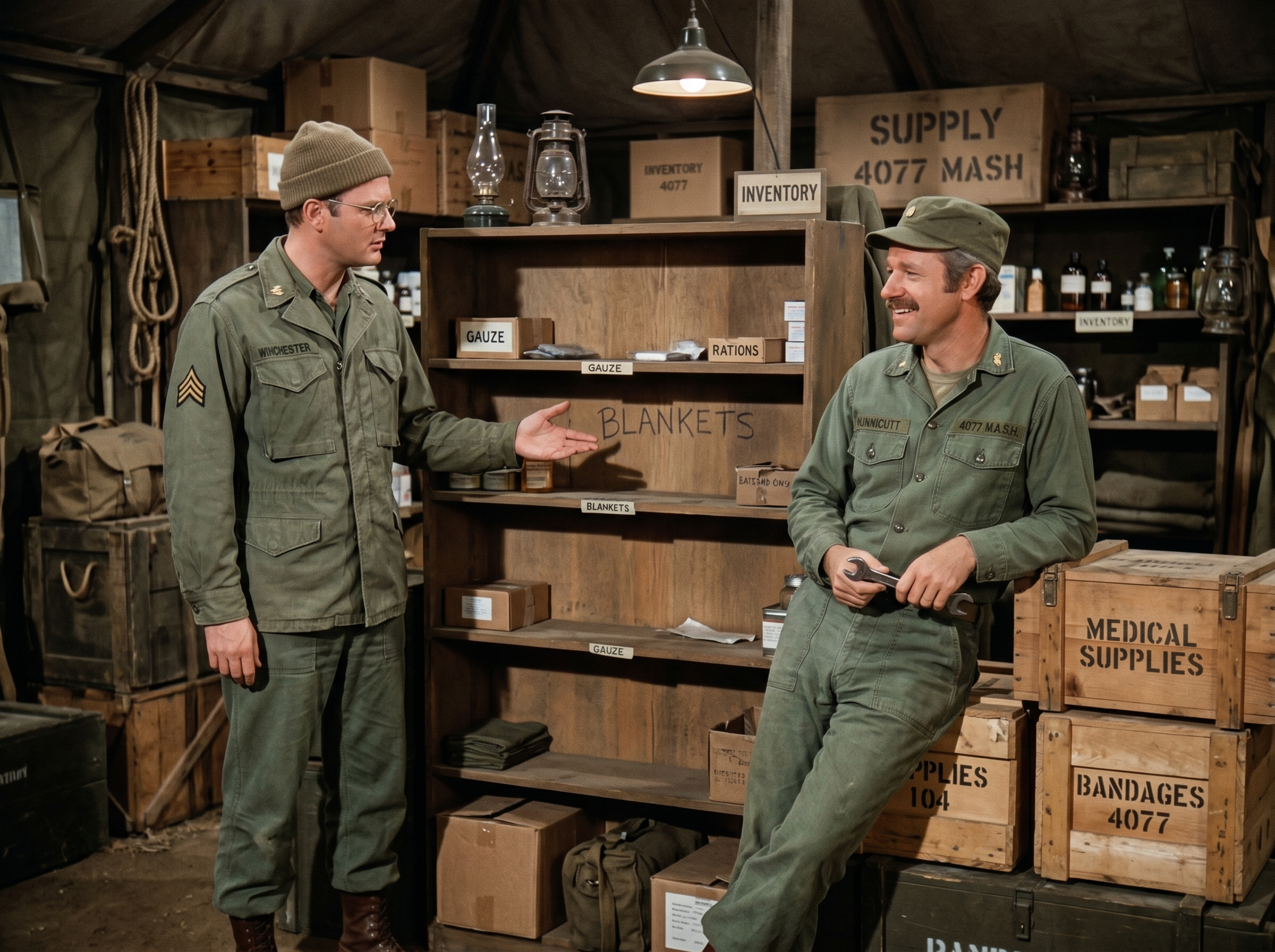
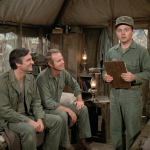
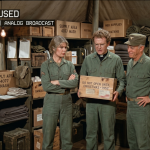
The supply tent of the 4077th was less a warehouse and more a canvas monument to misplaced hope.
It smelled of damp canvas, old pine, and the unmistakable dusty scent of military bureaucracy. Wooden crates were stacked haphazardly against cardboard boxes, forming a maze of faded paper labels that promised penicillin but usually delivered foot powder.
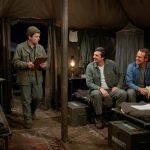
The lighting in the tent was a soft, practical warm glow, dimmer than the harsh glare of the mess tent, casting long shadows across the canvas walls. It was a resourceful, cluttered, and entirely improvised space.
In the center of this chaotic stockpile stood Major Charles Emerson Winchester III.
He was standing rigidly upright, his posture a defiant protest against his surroundings. His hands were planted firmly on his hips, his uniform pressed as neatly as the Korean mud would allow.
Charles was staring down a dusty wooden shelf with a look of wounded pride and restrained, aristocratic irritation.
“I am simply asking for a rational explanation,” Charles announced to the empty canvas ceiling, his voice dripping with dry sarcasm. “I realize that asking the United States Army for rationality is akin to asking a pig to perform a waltz, but surely even this parade of incompetence has a limit.”
A few feet away, Captain B.J. Hunnicutt leaned comfortably against a battered crate marked ‘Bandages, Triangular.’
B.J. looked entirely at home in the clutter. His shoulders were relaxed, his boots crossed at the ankles. In his hands, he held a simple pair of pliers and a small, unidentifiable piece of metal.
He wasn’t looking at Charles. He was focused on the tool in his hand, a quiet, gentle smile playing at the corners of his mouth.
“You’re assuming the Army knows you exist, Charles,” B.J. said smoothly, his tone laced with quiet irony. “That’s your first mistake.”
Charles slowly turned his head to glare at his tentmate. “Hunnicutt, a package from my sister Honoria arrived yesterday. A very specific, very fragile package containing a replacement stylus for my gramophone.”
He pointed an accusatory finger at the empty, dusty shelf. “I was informed it was placed exactly here. And yet, I am looking at a space currently occupied by nothing but lint and despair.”
B.J. didn’t look up from his work. He just kept making tiny, precise adjustments with the pliers. “Things move around, Charles. It’s a mobile hospital.”
“It is a stylus, Hunnicutt! A diamond-tipped instrument of cultural salvation!” Charles took a step closer, his voice rising in dramatic disbelief. “Without it, I am trapped in a musical wasteland, forced to listen to whatever hillbilly caterwauling Pierce decides to hum while he shaves!”
Charles squinted, finally noticing the concentrated way B.J. was working the metal in his hands. The gentle, knowing smile on B.J.’s face suddenly seemed highly suspicious to the Boston surgeon.
“What exactly are you doing with those pliers?” Charles asked, his eyes narrowing as a dreadful thought crossed his mind. “Hunnicutt, look at me. What are you doing?”
B.J. paused, blowing a speck of dust off the metal. He looked up, his smile completely serene.
“Well, Charles,” B.J. said calmly, “I didn’t steal your Beethoven. But I am performing a little bit of emergency surgery.”
Charles felt his stomach drop as he stared at the crude tool in B.J.’s hand. “Surgery? On my Mozart? Hunnicutt, if you have desecrated…”
“Relax, Charles,” B.J. said gently, finally lowering the pliers. The quiet irony left his voice, replaced by the steady, grounded tone of a man trying to soften a blow.
B.J. pushed himself off the crate and took a step forward. “Your package from Honoria did arrive. But it came in on the same truck as a hundred pounds of canned surplus peaches.”
Charles closed his eyes, his wounded pride immediately shifting into genuine, quiet dread. “Oh, dear God. Please tell me the symphony did not meet the peaches.”
“The truck hit a pothole near Ouijeongbu,” B.J. explained, his voice sympathetic. “The crate of peaches shifted. Your box was right underneath it.”
Charles opened his eyes. The sarcastic fight drained out of him, leaving behind only the profound, exhausted posture of a man who had lost his last tether to home.
He didn’t yell. He didn’t rant about the supply corps. He just stared at the dusty floor of the supply tent.
“Crushed,” Charles whispered, the weight of the war suddenly looking very heavy on his shoulders. “Three months of waiting. Three months of mud, blood, and liver, holding onto the thought of a flawless rendition of Bach’s Cello Suites. All of it… reduced to dust by a canned peach.”
B.J. watched his friend. He knew exactly what that music meant to Winchester. It wasn’t just a luxury; it was Charles’s armor. It was the only thing that reminded the Major he was still a human being and not just a meat-grinder mechanic.
“I went down to the loading dock when I heard,” B.J. said quietly. “I dug through the cardboard. The needle was shattered, Charles. There was nothing left to salvage.”
Charles gave a tight, dignified nod, refusing to show how much it hurt. “I see. Thank you, Hunnicutt. I suppose I shall simply have to order another and hope the war ends before it arrives.”
He turned to leave the tent, retreating back behind his walls of refinement.
“Hold on,” B.J. called out softly.
Charles paused, turning back with a look of tired confusion.
B.J. walked over, holding out his hand. Sitting in the center of his palm was the small piece of metal he had been working on with the pliers.
“I couldn’t save the diamond tip,” B.J. said, a warm, modest smile returning to his face. “But I found a heavy-duty surgical needle in a discarded suture kit. It’s high-grade steel. I used the pliers to bend it, filed down the tip to match the grooves of a record, and set it into a piece of cork from an old plasma bottle.”
Charles stared at the crude, improvised contraption in B.J.’s hand. It was the absolute antithesis of Boston refinement. It was rough, makeshift, and born entirely of scarcity.
“You… you made a phonograph needle out of a surgical suture?” Charles asked, his voice entirely stripped of its usual bravado.
“It won’t sound like Symphony Hall, Charles,” B.J. warned gently, offering the makeshift stylus. “It’s gonna be scratchy. It might even hiss a little. But it fits the arm of your player. I checked.”
Charles slowly reached out and took the small piece of cork and steel. He looked at it as if it were the Hope Diamond.
He looked up at B.J. He knew that Hunnicutt had just spent a grueling twelve-hour shift in the O.R. He knew B.J. was just as exhausted, just as homesick, and just as desperate for sleep as the rest of them.
And yet, instead of sleeping, B.J. had spent his only free hour sitting in a dim, dusty supply tent, filing down a piece of scrap metal so Charles wouldn’t have to go without his music.
The aristocratic defenses finally crumbled, revealing the secret, profound compassion Charles usually kept hidden.
“It is… the most appalling, crude, medically unsanitary piece of engineering I have ever seen,” Charles said softly, his voice thick with uncharacteristic emotion.
He closed his hand around the makeshift needle, holding it gently against his chest.
“Thank you, Beej,” Charles whispered.
B.J. gave a warm, quiet nod, slipping the pliers into his pocket. “You’re welcome, Charles. Now go put on some Bach. I think we could all use a little civilization around here.”
Charles stood a little taller, the wounded pride replaced by a quiet, resilient dignity. He turned and walked out of the dim supply tent, stepping back out into the reality of the 4077th, holding his small piece of salvaged humanity tightly in his hand.
B.J. leaned back against the wooden crates, alone in the warm, practical light of the canvas room, smiling gently into the quiet dust.
In a place where everything was broken, the greatest miracles were always the things they patched together for each other.