The Paper War of the 4077th
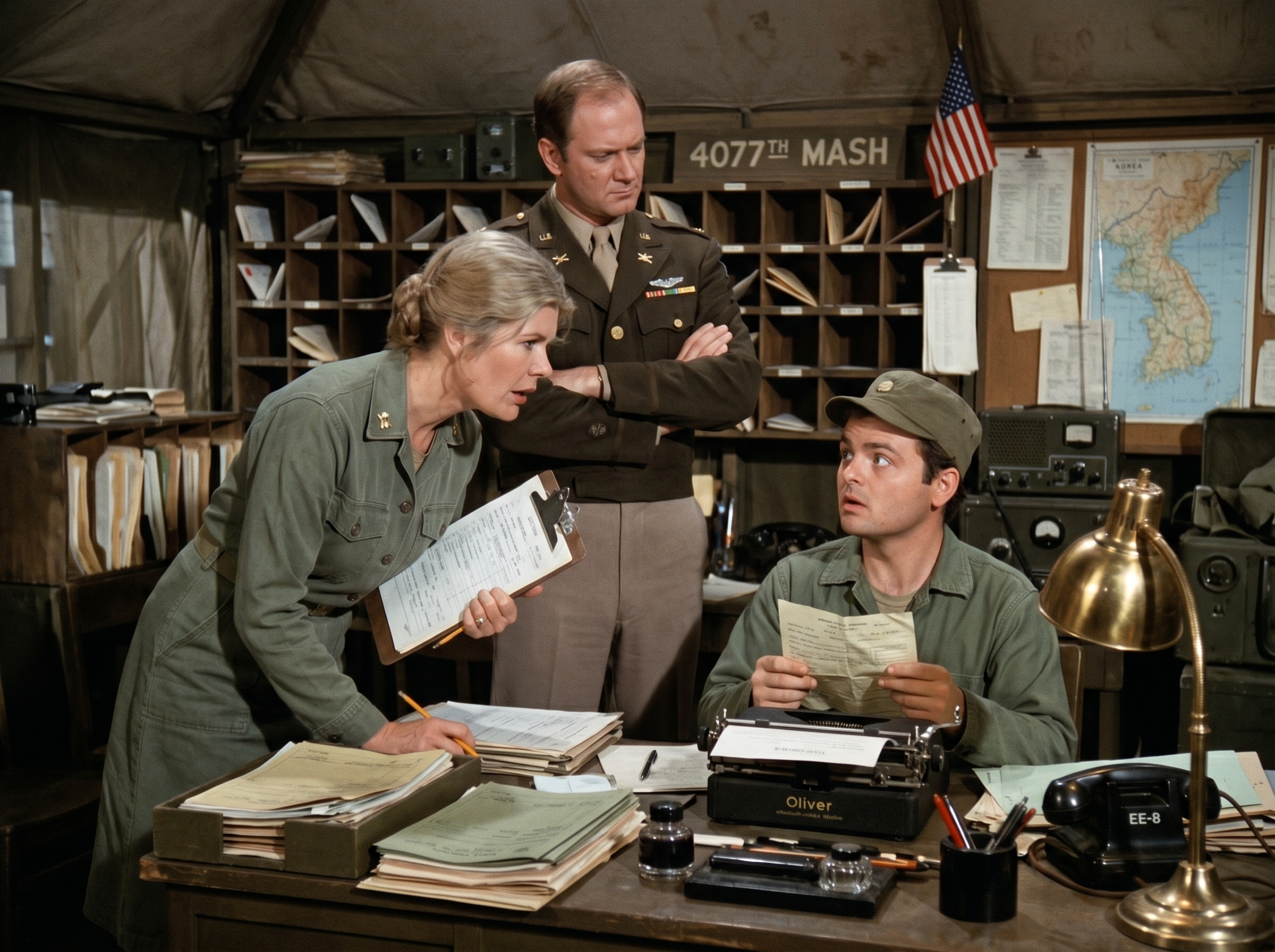
The paper war at the 4077th was almost as relentless as the real one raging just a few miles north.
It was a quiet Tuesday morning, the kind of quiet that always felt more like a threat than a promise. The camp was wrapped in a damp, lingering fog, and the only sound in the clerk’s office was the rhythmic, heavy clacking of a typewriter.
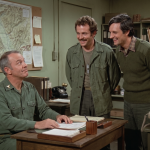
Corporal Walter “Radar” O’Reilly sat behind his desk, surrounded by the physical weight of the United States Army. Stacks of olive drab folders, beige requisition forms, and carbon copies threatened to swallow his small workstation whole. The soft, even glow of a practical desk lamp cast a warm, yellow light over the chaos, making the endless sea of paperwork look almost peaceful.
Almost.
The peace was instantly shattered by the sharp squeak of the screen door. Radar didn’t have to look up to know who it was. The rhythmic, determined march of combat boots meant only one thing.
Major Margaret Houlihan stood before his desk, looking as though she were ready to inspect the troops or court-martial a private. She held a wooden clipboard tightly in her hands, her expression sharp, composed, and intensely focused.
Behind her stood Major Charles Emerson Winchester III. He was standing perfectly upright, his arms folded across his chest with a look of dry superiority and refined irritation. Even in a muddy tent in the middle of Korea, Charles managed to look as though he were waiting in line at a bank where the teller had deeply offended him.
“Corporal,” Margaret began, her voice tight and clipped. “I am looking for a very simple explanation to a very complicated piece of incompetence.”
Radar swallowed hard, his fingers freezing over the typewriter keys. He slowly picked up a flimsy, yellowed piece of paper from the center of his desk. He looked up at her with innocent, wide-eyed concern, the nervous confusion evident in every line of his youthful face.
“I… I think I know what you’re gonna say, Major,” Radar stammered, holding the paper up as a weak shield. “But it wasn’t my fault. Honestly. It was I Corps. They transposed the routing numbers on the new supply manifest.”
Margaret leaned in closer, her elbows resting near the heavy black typewriter. Her eyes narrowed. “I Corps did not transpose a routing number, O’Reilly. I Corps deliberately ignored my urgent requisition for double-layered surgical gauze. And instead, they sent us… this.”
She slammed the clipboard down onto the desk, pointing a perfectly manicured, though understandably weary, finger at the top line.
Charles sighed heavily, an elegant puff of air that conveyed absolute disdain for the entire continent of Asia. “And let us not forget, Corporal, my personal request for a simple, civilized shipment of phonograph needles. A request that has been pending since the last monsoon.”
Radar looked at the paper in his hand, then at the clipboard, and then up at the two imposing majors towering over his desk. The warm light of the desk lamp seemed to highlight the deep exhaustion hidden just beneath their anger.
“Major Houlihan, Major Winchester, sir,” Radar started, his voice cracking slightly. “They didn’t ignore you. They just… well, they got the letters mixed up. The Army alphabet is very confusing when the teletype machine is low on ink.”
Margaret’s composed expression didn’t waver, but her grip on the clipboard tightened. “Spit it out, Radar. What did they send us instead of surgical gauze?”
Radar shrunk back slightly into his chair. He glanced nervously at the EE-8 field phone sitting uselessly beside him. He knew he was the bearer of bad news, and in the 4077th, the messenger rarely escaped without a few bruises.
“Well, ma’am,” Radar whispered, holding up the tiny beige form. “According to this waybill… instead of twenty crates of surgical gauze and three phonograph needles…”
He paused, terrified to finish the sentence. Margaret leaned in even further, her patience entirely evaporated, demanding an answer to the bureaucratic nightmare unfolding before them.
“We are currently the proud owners of two hundred pairs of bright yellow, rubberized wading boots,” Radar squeaked out, bracing for the explosion. “And… three crates of industrial-grade tuba polish.”
Silence fell over the small clerk’s station. It was a heavy, suffocating silence, broken only by the distant, mechanical hum of the camp’s main generator.
Charles slowly uncrossed his arms, his mouth opening slightly in genuine, aristocratic disbelief. “Tuba polish,” he repeated, the words tasting like ash in his mouth. “They sent us tuba polish in lieu of surgical supplies. In a mobile hospital. During a war.”
Margaret didn’t shout. That was the scariest part. Instead, she just stared at the paper in Radar’s hand, her sharp, focused expression slowly cracking under the sheer, absurd weight of military bureaucracy.
“Boots,” Margaret whispered, her voice losing its edge. “Two hundred pairs of bright yellow wading boots. What am I supposed to do with those, Corporal? Have the nurses wade through the blood in the OR like we’re fly-fishing in Montana?”
Radar could see it then. The anger was just a front. It was the armor they all wore.
Beneath Margaret’s crisp uniform and sharp tone, and beneath Charles’s refined arrogance, was bone-deep exhaustion. They had spent eighteen hours in surgery the day before. They were running on instant coffee, sheer willpower, and the desperate hope that the supplies they needed would actually arrive.
The comic tension in the room suddenly gave way to a profound, quiet sadness. It was the ridiculousness of their situation, trapped in a war where life and death were decided by typos on a teletype machine.
“I’m sorry, Major,” Radar said softly, dropping his hands to the desk. The nervous confusion faded, replaced by the quiet, capable empathy that made him the true heart of the camp. “I really am.”
Charles pinched the bridge of his nose, his eyes closed tightly. “It is not your fault, Max… Corporal,” Charles murmured, catching himself. “It is the fault of an institution that prizes triplicate forms over human life. We are governed by imbeciles.”
Margaret sighed, the sound long and shaky. She leaned back, standing up straight beside Charles. The fight had completely drained out of her. She looked down at Radar, her eyes softening.
“I know it’s not your fault, Radar,” Margaret said, her voice gentle now, the professional mask slipping entirely. “It’s just… we’re down to our last five rolls of gauze. If we get a push today…”
She didn’t have to finish the sentence. They all knew what it meant.
Radar sat up a little straighter. The innocent kid from Ottumwa vanished, replaced by the master sergeant of supply, the wizard of the 4077th. He reached out and placed his hand firmly on the heavy receiver of the field phone.
“You don’t have to worry about the gauze, Major,” Radar said, his voice surprisingly steady. “Or your phonograph needles, Major Winchester.”
Charles opened his eyes, looking down at the corporal with a mixture of doubt and desperate hope. “And how, pray tell, do you intend to conjure these items from the ether, Corporal?”
“I don’t need ether, sir,” Radar said, a small, knowing smile tugging at the corner of his mouth. “I have Sparky at I Corps. And Sparky happens to owe me a massive favor.”
Margaret raised an eyebrow. “What kind of favor?”
“Well,” Radar said, pulling the phone toward him and beginning to crank the handle. “It turns out the 8063rd has a general visiting next week. A general who happens to be an avid fisherman. And their brass band is looking terribly scuffed up.”
Charles let out a sudden, involuntary bark of laughter. It was a short, sharp sound, immediately muffled by a cough as he tried to regain his composure.
Margaret just shook her head, a genuine, tired smile finally breaking across her face. She reached out and gently tapped her fingernail against Radar’s desk.
“You trade those boots, Radar,” Margaret said softly. “You get us that gauze. And I’ll pretend I didn’t see you forging Colonel Potter’s signature on that transfer form.”
“What signature, ma’am?” Radar asked, his eyes wide and innocent once again.
Charles re-crossed his arms, but this time, the posture wasn’t defensive. It was comfortable. “Corporal O’Reilly,” Charles said, his tone dry but laced with unmistakable affection. “You are an enigma wrapped in an olive-drab sweater. Please, proceed.”
As Radar began speaking into the phone, bartering with the smooth confidence of a seasoned trader, Margaret and Charles stood quietly by the desk for just a moment longer. They didn’t rush off. They just stood in the warm, yellow light of the practical desk lamp, listening to the kid from Iowa fix the unfixable.
Outside, the faint, rhythmic chopping of helicopter blades began to echo over the distant hills. The war was coming back. The brief moment of peace was ending.
But inside the clerk’s office, surrounded by the beige forms and the smell of stale ink, there was a quiet, profound sense of safety. They were a strange, mismatched family, stitched together by exhaustion and held tight by mutual reliance.
Margaret gave Radar’s shoulder a quick, barely-there squeeze before turning toward the door. Charles gave a polite, respectful nod, following her out into the muddy compound to face whatever the choppers were bringing in.
Radar watched them go, the field phone pressed to his ear. He looked down at the paper in his hand, the silly little typo that had caused so much trouble. He crumpled it up and tossed it into the wastebasket. There was work to do, and he was right where he was supposed to be.
In a place where everything was broken, the truest comfort was knowing who would stand by your desk to help you fix it.