The Quiet Watch
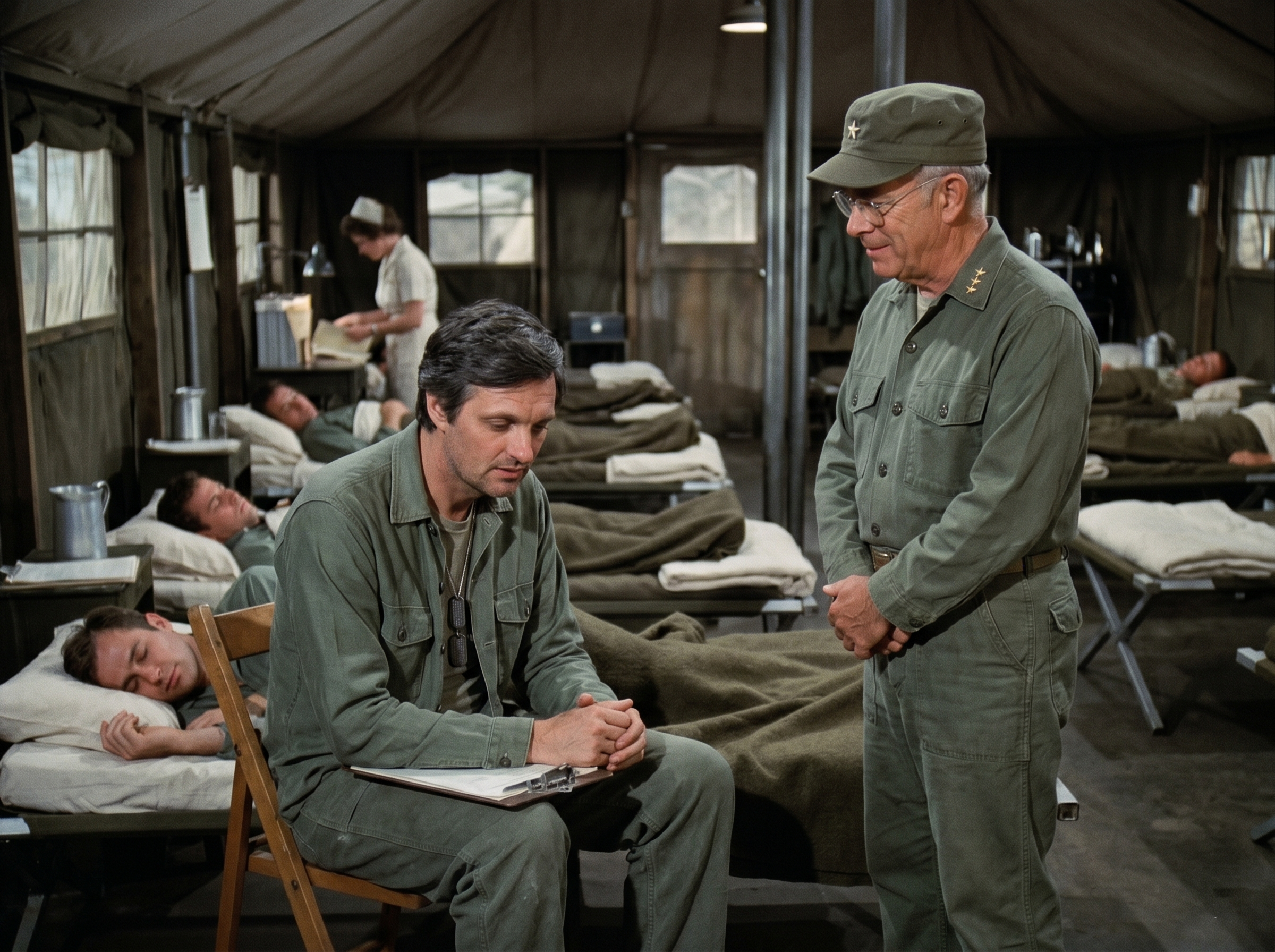
The heaviest sound at the 4077th wasn’t the deafening roar of incoming Choppers or the sharp, frantic barking of orders in the OR.
It was the thick, echoing silence of the Post-Op ward at three in the morning.
The surgical marathon had finally ended, leaving behind a profound stillness broken only by the hum of the camp generator and the shallow breathing of sleeping soldiers.
The pale green canvas walls seemed to exhale, settling into the damp Korean night.
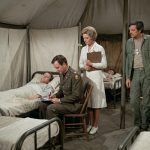
Rows of simple cots lined the room, tucked beneath crisp, white blankets that smelled faintly of pine soap and harsh antiseptic.
In the dim, even glow of the bedside lamps, the world of the war felt entirely suspended.
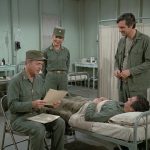
Captain Benjamin Franklin “Hawkeye” Pierce sat casually on a worn wooden stool beside one of the cots.
His posture was slumped, his shoulders carrying a weight that had nothing to do with physical gravity.
Usually, Hawkeye was a whirlwind of frantic motion and razor-sharp wisecracks, using his wit as an invisible shield against the horrors of the meat grinder.
But tonight, that playful surface was entirely stripped away.
His face, cast in soft grays and muted shadows, looked quietly wounded.
He stared out at the floorboards, his eyes distant and thoughtful, trapped somewhere between a memory of the surgery and the painful reality of the boy sleeping in the bed beside him.
The patient was just a kid from Iowa, barely old enough to shave, whose chest Hawkeye had spent the last four agonizing hours desperately trying to piece back together.
The kid was stable now. The vitals on the clipboard were steady.
But Hawkeye simply couldn’t bring himself to leave the room.
A quiet set of footsteps broke the silence, the soft scuff of worn, sensible leather boots against the plywood floor.
Colonel Sherman T. Potter walked down the center aisle, moving with the calm, practiced control of a man who had walked through the aftermath of three different wars.
He stopped beside Hawkeye, his hands resting easily at his sides, observing the room with a weary, fatherly wisdom.
Potter’s uniform was practical and lived-in, the olive drab fabric softened by countless wash cycles and long, sleepless nights.
There was no gloss, no vanity, just the modest, natural dignity of a commander who cared more about his people than his brass.
Potter didn’t speak immediately. He just stood there, lending his steady presence to the quiet recovery space.
“You’re going to burn a hole right through the floorboards, Pierce,” Potter finally said, his voice a low, gravelly whisper that barely disturbed the air.
Hawkeye blinked, pulling himself back to the present. He didn’t look up, just offered a weak, tired half-smile.
“Just trying to figure out the architectural integrity of this plywood, Colonel. I think the termites are holding hands to keep it together.”
It was a classic Hawkeye line, but the delivery was hollow. The usual spark was missing, drowned out by a deep, bone-aching fatigue.
Potter looked down at his chief surgeon. He knew the signs of a doctor flying too close to the edge of his own empathy.
“The boy is breathing on his own, Hawk,” Potter said gently. “His pressure is up. You did good. You did the impossible.”
Hawkeye finally looked up, his eyes meeting Potter’s. The vulnerability in the younger doctor’s face was startling.
“That’s the problem, Sherman,” Hawkeye whispered, his voice catching in the quiet room. “I did the impossible today. So they can patch him up, hand him a rifle, and ask him to do the impossible tomorrow.”
Hawkeye leaned forward, resting his elbows on his knees, his hands trembling ever so slightly as he stared at his own palms.
“I can’t leave this chair, Colonel. Because if I walk out that door, I have to admit that we’re just a rest stop on a highway to nowhere. And right now… I just don’t think I can swallow that.”
Colonel Potter stood perfectly still for a long moment, letting Hawkeye’s heavy words hang in the subdued light of the ward.
He didn’t offer a quick reprimand. He didn’t bark a military order about morale or duty.
Potter had seen too much death, and patched too many broken souls, to pretend that a pep talk could bandage a bruised heart.
Instead, the older man slowly reached out and placed a firm, grounding hand on Hawkeye’s shoulder.
The grip was solid, warm, and distinctly fatherly, an unspoken anchor in a world that constantly threatened to spin out of control.
“You’re right,” Potter said quietly.
Hawkeye looked up, slightly surprised. He had expected a lecture, or perhaps a gentle scolding. He hadn’t expected complete, unvarnished agreement.
“You are absolutely right, Pierce,” Potter continued, his voice steady and low. “It’s a rest stop. It’s a leaky lifeboat in the middle of a typhoon.”
Potter moved a step closer, looking down at the sleeping boy from Iowa, his own eyes reflecting a lifetime of weary sorrow.
“In the First World War, I used to think if I just worked fast enough, I could outrun the bullets. In the Second, I thought if I just got angry enough, I could scare the Grim Reaper away.”
Potter offered a small, bittersweet smile, shaking his head slowly.
“It took me a long time, and a lot of sleepless nights in rooms exactly like this one, to realize that we don’t control the war, Hawkeye. We don’t get to write the ending.”
Hawkeye let out a long, shaky breath, the tension in his shoulders beginning to loosen just a fraction.
“Then what are we doing here, Colonel? Why do we keep washing our hands?”
“Because we control the lifeboat,” Potter said simply, his grip tightening slightly on Hawkeye’s shoulder.
“The world outside this tent is pure madness. It’s loud, and it’s cruel, and it doesn’t make a lick of sense. But inside this room?”
Potter gestured to the rows of cots, to the soft white blankets and the quiet, steady breathing of the wounded men.
“Inside this room, we push the madness back. We give them a clean bed. We give them a moment of peace. We give them a chance.”
Hawkeye looked around the dimly lit post-op ward. The pale greens and soft grays suddenly felt less like a prison and more like a sanctuary.
The quiet wasn’t empty anymore; it was a hard-fought victory.
“We give them back their humanity, Hawk,” Potter said, his voice brimming with a quiet, fierce pride. “And we hold onto our own while we do it.”
The heavy, crushing weight that had been sitting on Hawkeye’s chest didn’t entirely vanish—it never did in the 4077th—but it shifted.
It became something he could carry again, especially knowing he wasn’t carrying it alone.
Hawkeye let out a soft chuckle, rubbing his tired eyes with the heels of his hands.
“You know, Colonel, for a regular army man, you can be remarkably poetic when you want to be.”
Potter smiled, the corners of his eyes crinkling with dry, affectionate humor.
“Don’t let it get around, Pierce. It’ll ruin my reputation as a hard-nosed, saddle-sore cavalry officer.”
“Your secret is safe with me,” Hawkeye said, his usual rhythm slowly returning to his voice. “Mostly because I’m too tired to blackmail you properly.”
“Glad to hear it,” Potter replied smoothly. “Because if you don’t get your exhausted carcass out of that chair and back to the Swamp for some shut-eye, I’m going to have Klinger write you up for loitering.”
Hawkeye groaned theatrically, finally pushing himself up from the wooden stool. His joints popped, protesting the long hours of standing over an operating table.
“Alright, alright. I’m going. But if you let Igor serve powdered eggs again tomorrow, I’m filing a grievance with the Geneva Convention.”
“Go to sleep, Hawkeye,” Potter said warmly. “I’ll take the watch.”
Hawkeye paused at the end of the aisle. He looked back at the sleeping boy, then at the older man standing watch beside him.
Potter was already checking the clipboard, his presence an immovable wall of care between the wounded and the war outside.
In that quiet, dimly lit space, Hawkeye felt a profound sense of family. They were a strange, mismatched collection of drafted doctors and tired nurses, but they had each other.
“Goodnight, Sherman,” Hawkeye said softly.
“Goodnight, son,” Potter replied without looking up, his voice a comforting rumble in the dark.
Hawkeye pushed through the canvas flaps and stepped out into the cool Korean night, leaving the quiet sanctuary in the best possible hands.
In a world torn apart by madness, the greatest medicine they had was simply each other.