The Direction of Home
The mud in Korea has a way of working itself into everything—your boots, your socks, and eventually, the very gears of your mind. After a thirty-six-hour session in the operating tent, the world narrows down to a steady, ringing silence that no amount of sleep can quite wash away.
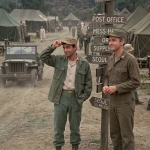
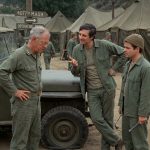
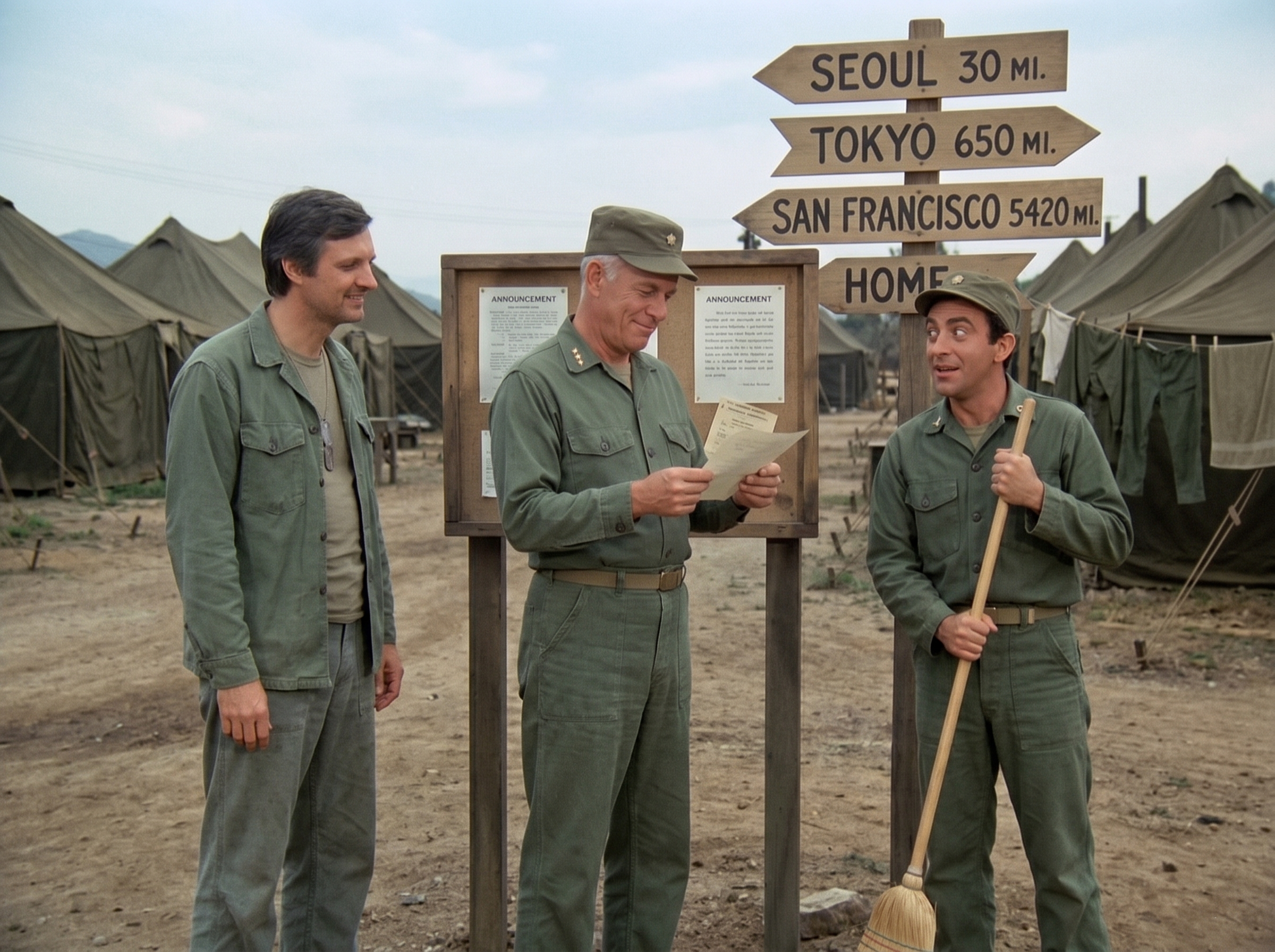
Hawkeye Pierce stood by the compound’s central signpost, his hands hanging loosely at his sides, his eyes fixed on the wooden slat pointing toward San Francisco. Five thousand, four hundred, and twenty miles. It might as well have been on the dark side of the moon.
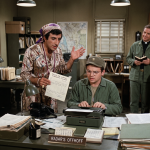
Colonel Potter emerged from his office, a rare, unhurried slowness in his stride. In his hands, he held a crisp sheet of paper, freshly delivered by the morning courier jeep.
Klinger, who had been lazily pushing a broom through the dust near the announcement board, stopped his sweeping immediately. He leaned heavily on the broom handle, his eyes locked onto the document like a hawk tracking a field mouse.
“What have you got there, Colonel?” Hawkeye asked, his voice laced with the dry, gravelly fatigue that defined every morning after a heavy intake. “A formal apology from the Pentagon, or did the Sears Roebuck catalog finally find us?”
Potter didn’t answer right away. He adjusted his cap, his grandfatherly face settling into a soft, unmistakable smile as his eyes scanned the typed lines.
“It’s an official directive, Pierce,” Potter said softly, the corners of his mouth twitching upward. “Direct from Tokyo. And for once, it wasn’t written by a bureaucrat with an ulcer.”
Klinger edged closer, his head tilting back as he tried to read the words upside down. “Is it a hardship discharge, sir? Tell me it’s a dress-code exemption for Toledo natives. My feet are crying out for a nice pair of open-toed pumps.”
“Quiet, Klinger,” Potter chuckled, though there was no real bite to his command. He held the paper out slightly, allowing the two men to share in whatever news had managed to pierce through the heavy gray cloud of the camp’s exhaustion.
Hawkeye looked down at the page, the cynical quip dying on his lips as his eyes caught the heading. The atmosphere between the three men shifted instantly, the background noise of the camp fading away as the true weight of the letter began to sink in.
The paper wasn’t an order for more supplies, nor was it a reprimand from some distant general. It was a special authorization form, stamped with a quiet validation that none of them had anticipated receiving during their time in this godforsaken valley.
“It’s from the Red Cross liaison in Tokyo,” Colonel Potter explained, his voice dropping into that steady, paternal tone that always made the 4077th feel a little less like an army unit and more like a home. “They’ve officially processed the emergency family leave requests we submitted three months ago.”
Hawkeye stared at the signature at the bottom. He felt a sudden, sharp ache in his chest—not of sorrow, but of a profound, overwhelming relief. For months, he had watched the toll the war was taking on the men around him, especially the younger kids who hadn’t seen their families in years.
“So, who gets to go, Colonel?” Klinger asked, his theatrical bravado completely vanishing. The broom stayed planted firmly on the ground, but his face was now filled with a genuine, childlike vulnerability. “Is it… is it really happening?”
Potter looked up from the paper, his gaze resting first on Klinger, then on Hawkeye. “It’s for Radar’s family. His mother’s farm got hit by a severe storm back in Iowa, and she’s been struggling to keep up with the harvest alone. This paper grants him three weeks of immediate, fully-paid compassionate leave to go home and set things right.”
A profound silence settled over the small group by the signpost. In a place where good news was as rare as a decent steak, the realization that one of their own was actually going to step foot on American soil felt almost miraculous.
“Three weeks,” Hawkeye murmured, a genuine, unburdened smile finally breaking across his face. “The kid is actually going to smell real grass instead of canvas and antiseptic. He might even forget what a helicopter sounds like.”
“He’s earned it twice over,” Potter said, folding the paper with meticulous care, as if handling a fragile piece of history. “But it means we’re going to be short-handed in the clerk’s office, and God help us, we’ll have to figure out how to predict the arrival of the choppers without his ears.”
Klinger looked down at his broom, a soft, wistful expression crossing his features. For all his scheming to get out of the army, there wasn’t a single trace of jealousy in his eyes. “I can cover his shifts, Colonel. I mean, I won’t look as good in khaki as he does, but I’ll make sure the forms get filed. He needs to see his mom.”
Hawkeye reached out, clapping a hand onto Klinger’s shoulder. “Look at you, Klinger. A saint in olive drab. If we aren’t careful, the chaplain’s going to put you in a stained-glass window.”
“Don’t push your luck, Pierce,” Klinger shot back, though his voice was thick with emotion. “I still want my discharge. But Radar… Radar belongs on that farm.”
Potter looked at the two younger men, his heart swelling with a quiet pride. This was the true spirit of the 4077th—an unbroken chain of regular people who, when stripped of everything else, still looked out for one another with fierce, unwavering loyalty.
“Come on,” Potter said, gesturing toward the office tent. “Let’s go break the news to the son of Iowa. I want to see the look on his face when he realizes he’s heading east instead of north.”
As they turned to walk away, Hawkeye cast one last glance back at the wooden signpost. The distance to San Francisco hadn’t changed, but looking at the paper in the Colonel’s hand, home suddenly didn’t feel quite so far away anymore.
In the heart of the 4077th, the longest road home was always walked together.