A Touch of Shade in a Nameless Valley
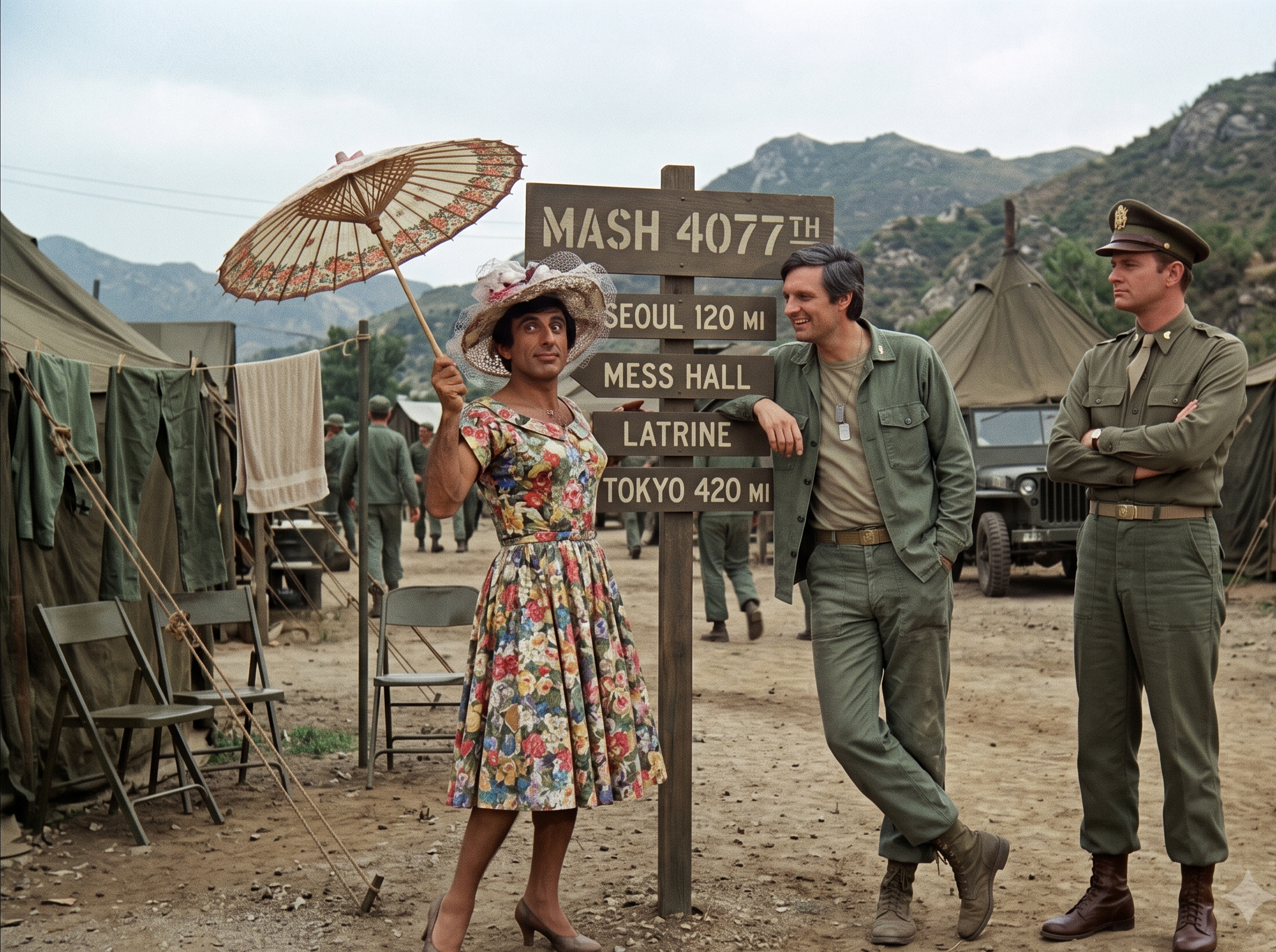
The heat in South Korea didn’t just make you sweat; it moved in and took away your will to complain.
It was mid-afternoon at the 4077th, and the air was completely entirely still.
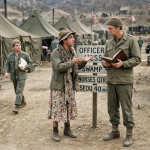
Dust settled over the canvas tents, over the wooden signpost pointing to places thousands of miles away, and over the sagging laundry line where olive drab t-shirts baked in the relentless sun.
It had been thirty-six hours since the last choppers had departed, leaving behind a camp composed entirely of walking ghosts.
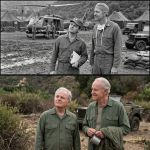
Hawkeye Pierce stood leaning against the guidepost, practically holding it up with his own exhaustion.
He wore his fatigue shirt unbuttoned over a faded t-shirt, his shoulders slumped in a deeply relaxed, bone-tired slouch.
He was trying his hardest to think about absolute nothingness, staring blankly at the dirt compound and hoping a cold martini would magically materialize in his hand.
Then, the screen door of the clerk’s tent banged open with the force of a theatrical debut.
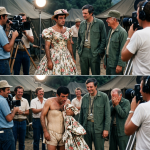
Out stepped Corporal Maxwell Q. Klinger, and suddenly, the bleak and dusty compound was a stage.
Klinger made a grand, sweeping entrance, one hand placed dramatically on his hip, the other holding onto his newest and most prized possession.
It was an eccentric, extravagantly ruffled parasol.
The fabric was a faded, ridiculous shade of lavender, trimmed with drooping lace that looked like it had survived a saloon brawl in the 1890s.
Klinger paraded toward the signpost, his combat boots kicking up little clouds of dust beneath a remarkably modest, worn-in floral skirt that had definitely seen better days.
He struck a pose next to the sign pointing to Toledo, lifting his chin with a sly, hopeful expression that dared anyone to challenge his absolute elegance.
Hawkeye blinked, and the profound weariness in his face slowly fractured into an affectionately teasing, spontaneous smile.
Only in this purgatory of canvas and mud could a man find salvation in a fuzzy pink and purple sunshade.
Standing a few feet away, Major Charles Emerson Winchester III had been attempting to enjoy a moment of solitary, upright dignity.
Charles was impeccably buttoned up, refusing to let the Korean heat defeat his Bostonian posture.
As Klinger twirled the ridiculous parasol, Winchester turned his head, his posture stiffening even further.
One thick eyebrow crawled slowly up his forehead.
A look of restrained irritation, mixed with profound aesthetic offense, settled over the Major’s features.
“Corporal,” Winchester drawled, his voice cutting through the heavy, humid air like a dull butter knife.
“May I inquire as to why you are parading about the compound looking like a heavily armed Victorian lampshade?”
Klinger gasped, clutching the handle of the parasol to his chest as if Charles had just insulted his own mother.
“A lampshade, Major?” Klinger said, his voice dripping with wounded theatrical charm.
“This happens to be an authentic, imported parasol of the highest continental pedigree.”
Winchester let out a sharp, aristocratic scoff that seemed to echo off the mountains.
“Continental?” Charles sneered. “The only continent that monstrosity has ever seen is the clearance bin at a Toledo five-and-dime. Put it away before you induce a collective migraine.”
Klinger stood his ground, planting his boots firmly in the dirt.
He turned his eyes to Hawkeye, waiting for the chief surgeon to either burst his bubble or join the performance.
The air in the compound seemed to pause, waiting to see which way the wind would blow.
Hawkeye pushed himself gently off the wooden signpost, folding his arms across his chest.
He looked at Charles, then at Klinger, his smile growing wider and warmer.
“Now hold on a minute, Charles,” Hawkeye said, his voice smooth and laced with quiet amusement.
“You’re looking at this all wrong. You lack vision.”
Winchester closed his eyes for a brief, pained second. “Pierce, please. Do not encourage this madness. I have only just recovered my equilibrium from the breakfast powdered eggs.”
“I’m not encouraging madness, Major,” Hawkeye countered, taking a slow step toward Klinger.
“I am defending an oasis. Look at this man. Look at the lace. Look at the sheer, unadulterated dedication to keeping his nose from peeling.”
Klinger beamed, twirling the parasol so the fringe danced in a sudden, tiny breeze.
“Thank you, Captain,” Klinger said, lifting his chin even higher. “It’s a known medical fact that my delicate complexion cannot withstand the harsh ultraviolet rays of an unprovoked war.”
“It is a known medical fact,” Winchester retorted, his voice rising just a fraction, “that you are a lunatic, Corporal.”
“Only on paper, Major,” Hawkeye said softly.
Hawkeye reached out and gently fingered the frayed lace hanging from the edge of the parasol.
As he stood closer to Klinger, Hawkeye noticed something beneath the comedy.
He saw the dark, bruised bags under Klinger’s eyes.
He remembered that Klinger had been in the plasma ward all night, holding the hands of scared kids, cracking terrible jokes until his voice went hoarse.
This whole grand entrance, the parasol, the theatrical pose—it wasn’t about bucking for a Section 8 today.
It was a performance for an audience of two.
Klinger had seen how deeply the camp was hurting, how broken Hawkeye had looked leaning against that post, and he had dug to the bottom of his footlocker to find a reason for them to smile.
Hawkeye felt a sudden, heavy warmth in his chest.
It was that familiar, bittersweet ache that came from loving the people you were trapped in hell with.
“You know, Charles,” Hawkeye said, his voice dropping its teasing edge and settling into something deeply sincere.
“I think it’s the most beautiful thing I’ve seen all week. It’s got flair. It’s got style. It’s got a distinct lack of olive drab.”
Charles looked at Hawkeye, catching the subtle shift in the surgeon’s tone.
The Major was pompous, but he was never entirely blind.
Winchester looked back at Klinger, who was still holding his ridiculous pose but watching them both with a quiet, cautious hope.
For a fleeting second, the irritation melted out of Charles’s eyes, replaced by a weary, unspoken understanding.
Charles cleared his throat, adjusting the collar of his shirt with a gloved hand.
“Well,” Winchester muttered, refusing to look either of them directly in the eye.
“I suppose… in a landscape entirely devoid of civilization, even a poorly constructed Toledo sunshade provides a modicum of visual variety.”
Charles turned on his heel. “Just keep the fringe out of my airspace, Corporal,” he added, before marching off toward the Swamp with his dignity intact.
Hawkeye watched him go, a soft chuckle escaping his lips.
He turned back to Klinger, who was lowering the parasol just a fraction, the grand theatricality melting into a tired, genuine smile.
“You really think it’s beautiful, Captain?” Klinger asked softly.
Hawkeye reached out and gave Klinger’s shoulder a gentle, tired squeeze.
“I think it’s a masterpiece, Klinger,” Hawkeye said quietly. “Best medicine I’ve had all day.”
Klinger smiled, shifting his grip on the handle.
He stepped a little closer to Hawkeye, tilting the parasol so that its faded lavender shadow fell over both of them, blocking out the harsh Korean sun.
They stood there together by the signpost in comfortable silence, two men finding a small, ridiculous patch of grace in the middle of a war.
For a few minutes, under the fringe of a cheap lace umbrella, they were safe.
Sometimes the greatest act of bravery in a war zone is simply daring to make your friends smile.