A Vintage of Survival in the Amber Light
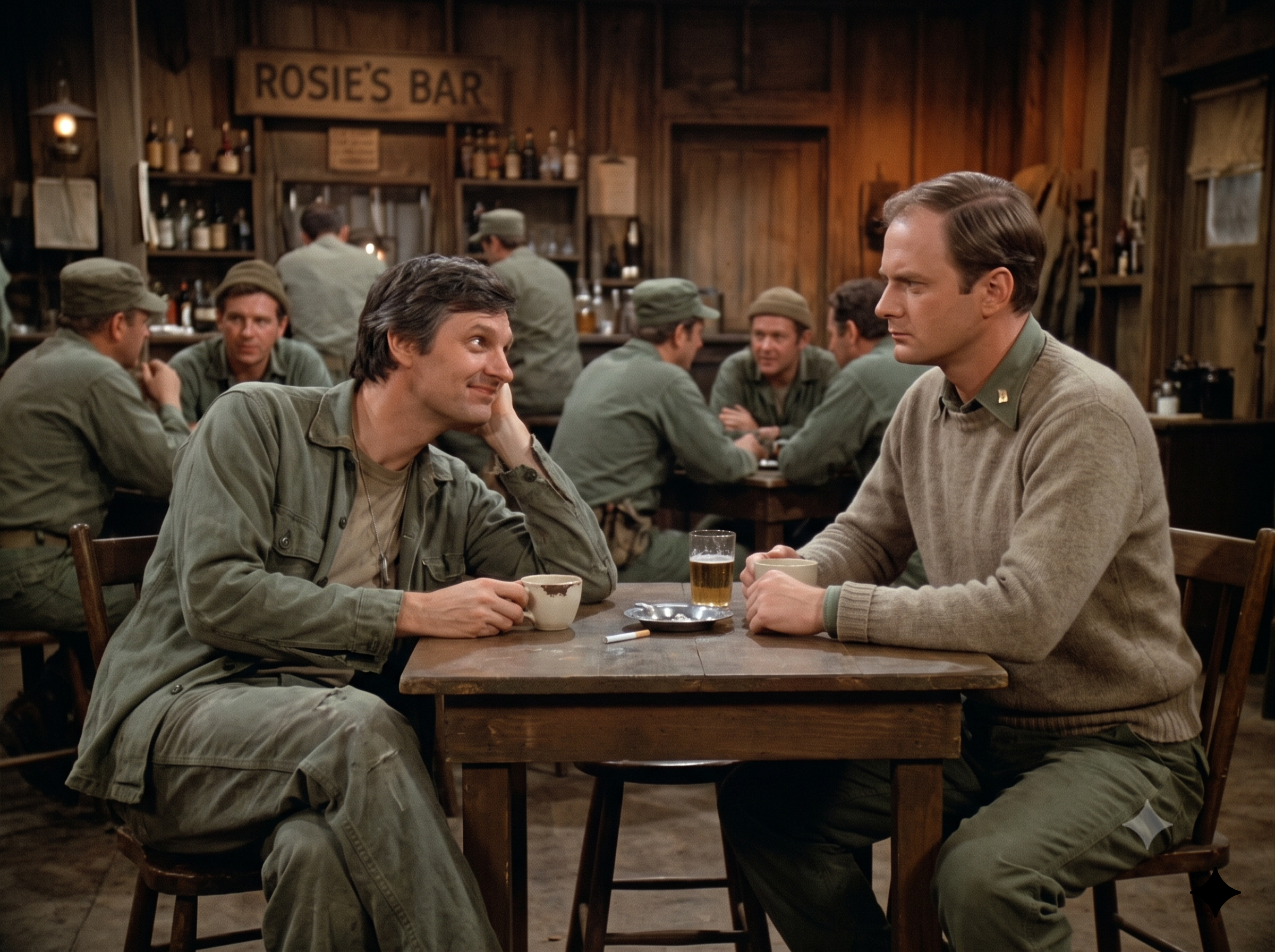
The war was always waiting right outside the door, but inside Rosie’s Bar, time had a quiet habit of slowing down.
It wasn’t much of a sanctuary. The room smelled permanently of stale beer, damp wool, and the kind of cheap cigar smoke that clung to your uniform for days.
The walls were worn, the wooden tables were scarred with the initials of men who had long since shipped out, and the ambient light was nothing more than a dim, warm amber glow.
But for the surgeons of the 4077th, that muddy amber light was a temporary shield against the olive drab reality of the Korean War.
They had just walked out of the O.R. after a grueling twenty-hour shift. The camp was finally quiet, the helicopters had stopped churning the sky, and the adrenaline that kept them standing had abruptly evaporated.
Hawkeye Pierce and Charles Emerson Winchester III had migrated to a corner table in Rosie’s out of pure, unspoken necessity.
Hawkeye sat with a deeply relaxed slouch, his elbows resting heavily on the sticky wooden table.
He looked entirely at home in the dingy surroundings, wearing a tired but clever, playful smile that never quite reached his exhausted eyes.
Across from him, Charles sat rigidly upright.
Even in the middle of a war zone, Charles maintained the posture of a man waiting for the valet to bring his car around at the Somerset Club.
His expression was one of absolute, reluctant participation. He looked at the rustic local social room with a mixture of dry superiority and profound personal offense.
Between his pristine fingers, Charles held a simple, thick, chipped ceramic cup.
He stared down at the dark, questionable liquid inside it as if he were inspecting a slide under a microscope in a pathology lab.
“Pierce,” Charles said, his resonant voice slicing through the low murmur of the bar. “I have consumed many questionable substances since arriving in this purgatory. But this… this particular concoction defies all laws of chemistry.”
Hawkeye leaned in a little closer, his grin widening with amusement.
“Come on, Charles. Rosie said it’s a special reserve. It’s got body. It’s got character. It’s probably got a little bit of the jeep’s radiator fluid, but that just adds to the finish.”
Charles did not smile. He lifted the cup an inch off the table, holding it out as if presenting evidence to a jury.
“This vessel,” Charles enunciated clearly, “appears to have been molded from the mud outside our tent, baked in the sun, and handed directly to me. It is heavy, it is unrefined, and the liquid within it smells remarkably like floor wax.”
“Drink up, Major,” Hawkeye countered smoothly. “It’ll put hair on your chest. Or take it off. It’s a gamble, really. That’s the fun of Rosie’s.”
Charles slowly lowered the cup. The theatrical annoyance on his face began to slip, just slightly.
The long hours over the operating table were catching up to him. The physical toll of repairing broken boys was a weight that even the best Boston tailoring couldn’t hide.
His rigid shoulders dropped a fraction of an inch. He looked around the dim, worn room, and the dry superiority in his eyes faded into something that looked dangerously like despair.
“There is no glass,” Charles said, his voice suddenly very quiet.
Hawkeye’s playful smile faltered. “What?”
“Glass, Pierce,” Charles repeated, staring into the ceramic cup. “Crystal. The delicate clinking of a proper tumbler against a mahogany bar. The way the light catches the amber of a twenty-year-old scotch.”
He traced a finger along the chipped rim of the thick clay mug.
“I realized today, standing over that table… I have forgotten what it feels like to hold something fragile. Something beautiful.”
The warm, ambient noise of the bar seemed to fade away.
Charles looked up, meeting Hawkeye’s gaze, the mask of the pompous aristocrat peeling back to reveal a deeply exhausted, frightened man.
“Tell me, Pierce,” Charles asked softly, the tension thick in the space between them. “If a man forgets the feeling of civilization… does he ever truly get it back?”
Hawkeye didn’t answer right away.
He sat up slightly, the relaxed slouch disappearing as he recognized the genuine crack in his tentmate’s armor.
He knew exactly what Charles was feeling. It was the same hollow, sinking dread that hit Hawkeye whenever he tried to remember the smell of the ocean breeze back in Maine, only to find the memory blocked by the scent of iodine and blood.
They were all losing pieces of themselves in this place. The only difference was how they chose to hide it.
“I don’t know, Charles,” Hawkeye finally said, his tone stripped of all sarcasm. His voice was gentle, grounded in the shared reality of their fatigue.
“I really don’t know,” Hawkeye continued. “I think… I think you just have to hold onto the memory of the glass. You hold onto it so tight that your hands cramp up.”
Charles looked down at his hands. Surgeon’s hands. Capable of delicate miracles, currently wrapped around the ugliest piece of pottery in the Eastern Hemisphere.
“It is difficult,” Charles murmured, almost to himself. “The memories… they grow faint. The noise of this place drowns them out. The helicopters. The sirens. The constant, unrelenting vulgarity of it all.”
Hawkeye gave a small, quiet nod. He leaned his forearms on the table, closing the distance between them.
“That’s why we’re here, Charles. In this luxurious, five-star establishment.” Hawkeye gestured to the worn walls of Rosie’s.
“We come here,” Hawkeye said, “and we drink terrible liquor out of ugly cups, because for ten minutes, we aren’t listening for the choppers. We aren’t doctors. We’re just two guys complaining about the service.”
Charles took a deep breath. He held it for a moment, letting the warm, slightly smoky air of the bar fill his lungs.
Slowly, almost imperceptibly, the rigid posture returned. The spine straightened. The chin lifted.
Charles Emerson Winchester III was putting the armor back on. And Hawkeye, watching him, felt a profound wave of relief.
“Pierce,” Charles said, his voice regaining its familiar, resonant superiority. “While your homespun, rustic philosophy is touching in its simplicity, it entirely misses the point.”
Hawkeye’s playful, clever smile slowly crept back onto his face. “Does it now?”
“Indeed,” Charles replied smoothly. He adjusted his collar, brushing an invisible speck of dust from his olive drab uniform.
“I do not simply ‘hold onto’ the memory of civilization,” Charles declared. “I am civilization. The refinement of Boston does not simply vanish because I am forced to reside in a canvas hovel. It is ingrained in my very marrow.”
He picked up the thick ceramic cup once again, holding it with an exaggerated elegance that completely mocked the cheapness of the object.
“And furthermore,” Charles added, his eyes glinting with a familiar, sarcastic spark in the dim light. “If I am to lose my sanity in this godforsaken country, I refuse to do it while drinking something that tastes like a heavily varnished shoe.”
Hawkeye let out a soft, genuine laugh. The tension broke, dissolving into the warm amber glow of the room.
“Fair enough, Charles. Fair enough.” Hawkeye lifted his own battered tin cup. “To civilization, then. Wherever it went.”
Charles looked at Hawkeye’s tin cup, then down at his own ceramic nightmare.
A tiny, reluctant smirk pulled at the corner of Charles’s mouth. It was the closest he would ever come to admitting that he was exactly where he needed to be, with exactly the company he needed to keep.
“To civilization,” Charles echoed dryly. “May it survive our current custodianship.”
They clinked their cups together. The sound was dull—a quiet thud of tin against thick ceramic—a far cry from the delicate ring of crystal.
But in that moment, sitting in the worn, wooden heart of Rosie’s Bar, it was the best sound in the world.
Charles brought the cup to his lips and took a sip of the terrible liquid. He winced, his face briefly contorting in aristocratic agony.
Hawkeye leaned back into his comfortable slouch, his clever smile brighter now, resting his chin in his hand as he watched his friend suffer through the rotgut.
The war was still waiting outside. The helicopters would eventually return. The olive drab reality would be there in the morning.
But for tonight, in the muddy amber light, they had found a temporary escape, anchored by terrible drinks and the quiet, stubborn bond of brothers in arms.
They were miles from home, deep in the mud of a war they didn’t want, but in the amber light of Rosie’s, they were never truly alone.