The Miracle of the Golden Brown
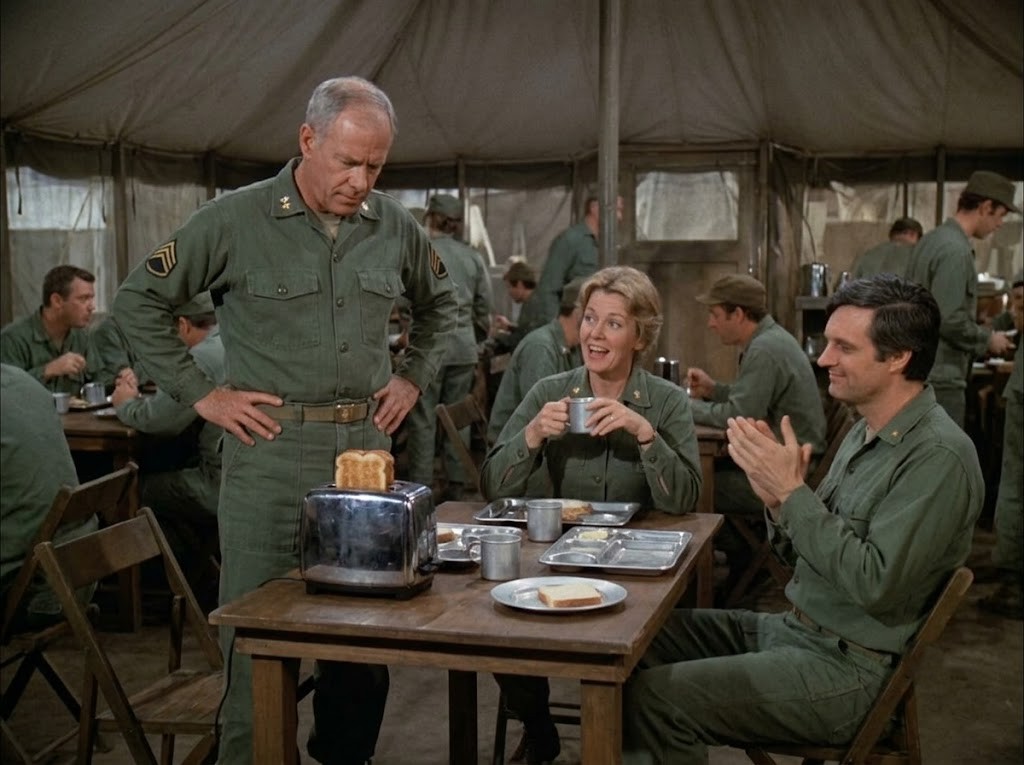
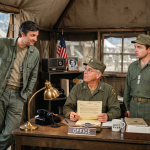
The mess tent was, as usual, a cathedral of clattering metal trays and the low, monotonous drone of tired men trying to forget the day’s work.
It was mid-morning, or perhaps it was midnight—in Korea, time was just a suggestion that the war frequently ignored.
At a small, scarred wooden table, B.J. Hunnicutt sat nursing a cup of lukewarm coffee, his eyes tracking a peculiar sight.
Across from him, Margaret Houlihan was laughing, a rare, genuine sound that cut through the gloom of the tent like a beacon.
Between them, sitting on the table like a holy relic, was a chrome toaster.
It was an impossible machine, a piece of domestic luxury that had no business existing within fifty miles of the front lines.
Colonel Potter stood over it, his hands on his hips, wearing the focused, furrowed expression he usually reserved for reviewing casualty reports or inspecting the surgical scrub area.
He was watching the two slices of bread he had inserted with the intensity of a man monitoring a high-stakes poker hand.
“I’m telling you, Margaret,” B.J. said, clapping his hands together with theatrical anticipation, “if this comes out golden brown, it’s a sign. The war ends by Tuesday.”
Margaret took a sip from her mug, her eyes twinkling with a mix of amusement and genuine hope.
“If it comes out charred, Colonel, I’m putting you on report for wasting rations,” she teased, though her smile softened the sting.
The room seemed to hold its breath.
The toaster groaned, a metallic, mechanical protest that sounded louder than any mortar blast.
Suddenly, with a sharp *clack*, the springs released.
The toast popped up, but it didn’t just brown—it smoked, a thin, gray wisp curling toward the tent’s canvas ceiling.
Colonel Potter didn’t reach for the toast.
Instead, he went perfectly still, his jaw tightening as he stared at the blackened, smoldering edges of the bread.
“Well,” B.J. said, breaking the silence with a soft, dry chuckle. “I suppose that means the war is lasting through the weekend.”
Colonel Potter let out a long, weary sigh, the kind that seemed to carry the weight of every casualty he’d signed off on that week.
He leaned down, carefully plucking the smoking toast with his thumb and forefinger, blowing on it like he was trying to cool a feverish child.
“It’s not the toast, Hunnicutt,” the Colonel muttered, his voice dropping to a gravelly, private register. “It’s the principle of the thing.”
Margaret reached out, her hand hovering near the toaster for a moment before she pulled it back, her professional mask slipping just enough to reveal the exhaustion underneath.
“The principle that we’re still here, sir?” she asked, her voice quiet.
“The principle that we’re still trying to have breakfast,” Potter replied, finally glancing up.
He looked at the two of them—B.J., who still tried to find a joke in the wreckage, and Margaret, who still tried to find order in the chaos.
He placed the slightly burnt toast on a nearby tray, not as food, but as if it were a fragile artifact.
B.J. leaned forward, his humor shifting into a quiet, steady kindness.
“You know, sir,” B.J. said, “my father always said that if the toast burns, it means the stove is working too hard to make things perfect. I’d say this camp has been working pretty hard.”
A faint, self-deprecating smile touched the Colonel’s lips.
He looked around the mess tent, at the other faces obscured by shadows and steam, all of them just trying to make it to the next cycle.
He realized then that the toast didn’t matter, and the war didn’t care about their breakfast, but the fact that they were sitting there, sharing a space and a failed effort, was the only thing that kept the gears turning.
Margaret picked up a knife and began scraping the burnt edges off the bread, her movements rhythmic and calm.
“There,” she said, sliding a slice toward the Colonel. “It’s not toast, but it’s edible. And it’s better than the dehydrated eggs.”
Potter took the piece of bread, looked at it, and took a bite.
It was dry, slightly bitter, and tasted of nothing in particular, but for a brief moment in the middle of a war, it felt like a meal shared at a kitchen table back home.
The tension in his shoulders eased, just a fraction.
He sat down across from them, the chrome toaster sitting between them like a silent, loyal friend.
They sat for a few minutes in a comfortable, tired silence, watching the steam rise from their coffee, connected by nothing more than a burnt piece of bread and the unspoken knowledge that they were the only ones who truly understood the cost of a long day.
Outside, the distant rumble of the front line continued, but inside the tent, the air felt a little warmer, a little more human.
Sometimes, it’s not the miracle you get, but the friends you share the failure with.