The Direction of Healing
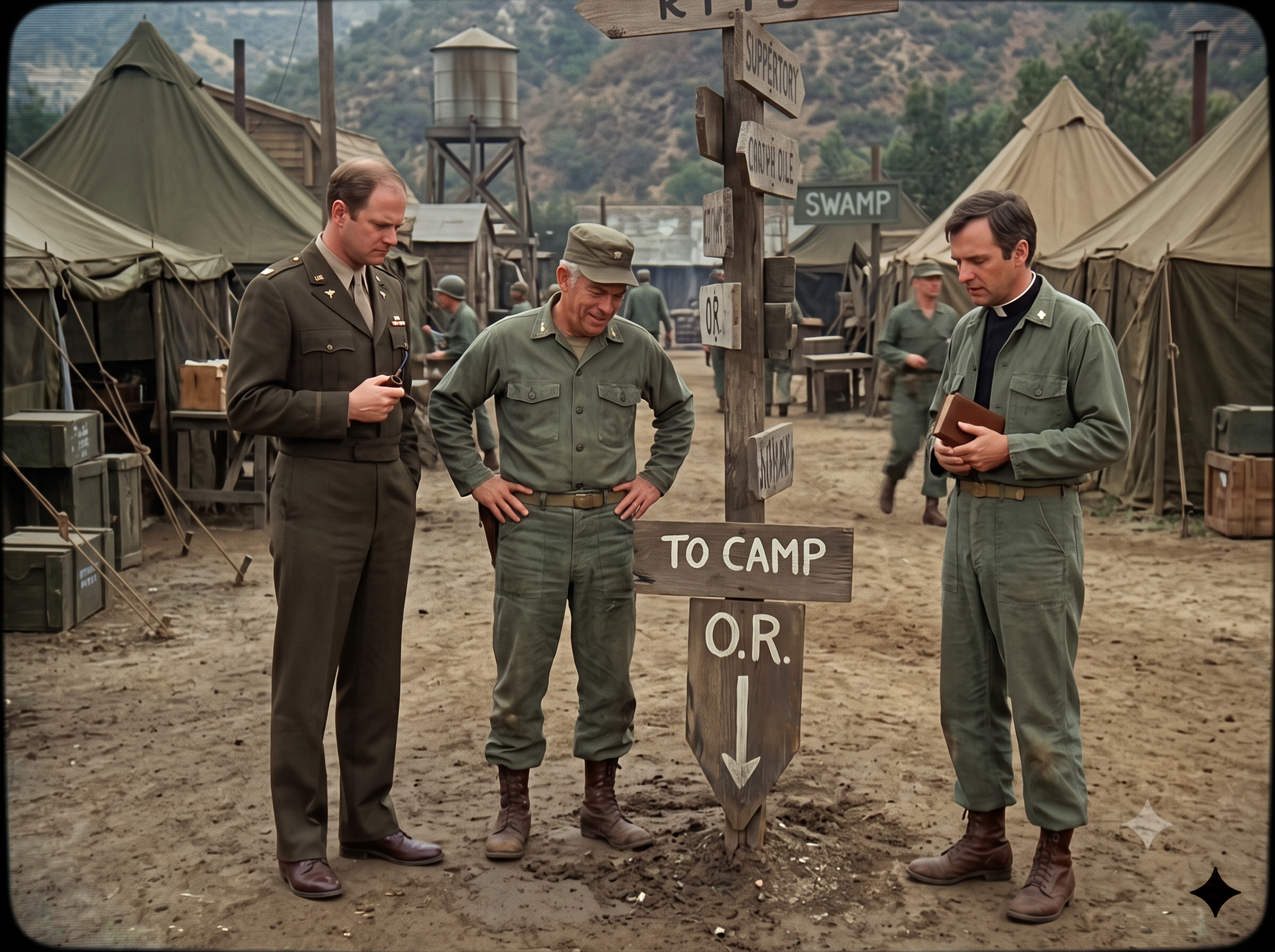
The afternoon sun hung low over the 4077th, casting long, muted shadows across a compound that looked exactly how its inhabitants felt: completely washed out. The canvas tents were bleached a pale, dusty tan by the relentless Korean summer, and the air was thick with the scent of motor oil, canvas, and lingering exhaustion. It was the kind of quiet that only falls over a mobile army surgical hospital after a brutal, unending rush of casualties. The generators had finally stopped their frantic humming. The choppers were miles away.
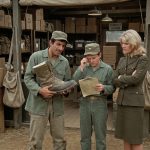
Colonel Sherman T. Potter stood in the center of the compound, his boots planted firmly in the familiar dirt. His hands rested heavily on his hips, a posture that usually signaled authority, but today just seemed to be the only thing keeping his spine upright. He stared at the wooden camp signpost with a look of profound, seasoned weariness.
To his left stood Major Charles Emerson Winchester III. The Bostonian surgeon was a portrait of restrained irritation. His green fatigues were rumpled, a grave insult to his usual fastidious nature. He held an unlit pipe in his right hand, his knuckles white with tension. Charles looked at the signpost with the dry superiority of a man who believed the entire war was a personal affront to his sensibilities.
On Potter’s right, Father John Mulcahy observed the scene. The gentle priest clutched a small, worn breviary in both hands. His face, usually a beacon of calm assurance, was twisted into a mask of mild, endearing confusion.
They had just walked out of a thirty-six-hour marathon in the Operating Room. Their bones ached, their eyes burned, and their souls felt frayed at the edges.
They were heading for their respective cots, desperate for the sweet oblivion of sleep, when they were stopped in their tracks by a new addition to the camp’s famous directional signpost.
Nailed haphazardly beneath the arrows pointing to Toledo, Boston, and Death Valley was a piece of scrap wood.
The words “TO CAMP O.R.” were painted on it in uneven, rushed white letters.
That wasn’t the problem. The problem was the large, unmistakable arrow painted beneath the letters.
It was pointing straight down. Directly into the dusty beige earth of the compound.
“Well,” Colonel Potter muttered, his voice a gravelly rumble that seemed to vibrate in the quiet air. “I will be the first to admit that we’ve had a remarkably rough couple of days. But I didn’t think the front line had literally moved beneath our boots while we were scrubbing up.”
Charles let out a long, aristocratic sigh. It was a sound that conveyed volumes of disdain, though today it lacked its usual sharp bite. He was simply too tired to muster full venom.
“It is, without a doubt, the most accurate piece of directional literature in this entire godforsaken peninsula,” Charles murmured, staring down at the dust. “A direct and literal descent. I have always maintained that the O.R. was merely the anteroom to the underworld, Colonel. It appears the enlisted men have finally provided the appropriate signage.”
Father Mulcahy tilted his head, his eyes tracing the downward trajectory of the painted arrow. He looked genuinely perplexed, trying to find a rational explanation for the visual joke.
“I imagine it’s just a loose nail,” the priest offered, ever the voice of hopeful reason. “The wind, perhaps, caught the wood overnight and spun it downward? Gravity can be quite persistent, you know.”
“Padre,” Potter sighed, rubbing his tired eyes. “There hasn’t been a breeze in this camp since Tuesday. Somebody pointed this thing down to the ground on purpose. The question is why.”
Charles adjusted his grip on his pipe. His eyes narrowed as he stared at the dry, trampled earth where the arrow was pointing. The dry humor faded from his face, replaced by something much heavier.
A sudden, unsettling thought seemed to strike the Major. It stripped away his usual mask of pompous superiority, leaving behind a painfully observant doctor.
He stepped closer to the signpost, his gaze fixed not on the wood, but on the stained, dark patch of dirt directly beneath it.
“Good Lord,” Charles whispered, the color draining slightly from his face. “Do you realize what they’ve actually pointed to?”
The silence that followed stretched between the three men, heavy and thick as the summer humidity. It was a sudden, profound quiet that made the distant rumble of a jeep sound like it was on another planet.
Colonel Potter lowered his gaze to follow Winchester’s stare.
The earth directly beneath the signpost was uneven and packed hard. But in this specific spot, the dirt was a slightly darker, richer shade of brown than the rest of the compound.
It was the triage overflow spot.
When the choppers came in too fast, and the jeeps piled up at the gate, the litters had to go somewhere. This patch of ground was where the wounded boys were often set down in the chaotic rush, waiting their turn for a table.
It was where the lifeblood of a generation seeped into the foreign dust before the surgeons could even get their gloves on.
“The blood,” Potter said quietly. The realization hit the old cavalryman with the weight of a physical blow, his shoulders slumping just a fraction of an inch.
Father Mulcahy gripped his small book a little tighter against his chest. His gentle face softened, his mild confusion melting into a profound, sudden sorrow.
“Oh, my,” the priest whispered, his voice trembling slightly. “The poor boys. They wait right here. I’ve knelt in this very spot so many times to pray with them.”
Charles didn’t move. For once, the theatrical Bostonian veneer was entirely gone. He wasn’t a Winchester of Beacon Hill in this moment; he was just a bone-tired doctor who had spent the last two days trying to stitch shattered lives back together.
“We stand under those hot lights in the O.R. and we fight for them,” Charles said. His voice was unusually soft, devoid of any sarcasm. “We think that tent is the center of the universe. But this… this patch of dirt is where the war actually happens, isn’t it? Right here at our feet.”
Potter nodded slowly, his jaw tight. He had seen more war than any man had a right to, across decades and continents. But the sight of that crude wooden arrow pointing to the stained earth still managed to break his heart just a little bit more.
“Somebody must have realized it,” Potter mused, his eyes scanning the quiet, sun-baked compound. “Maybe Pierce, in one of his darker moods. Or Hunnicutt. Or maybe just some exhausted corpsman who couldn’t find a hammer and just let the sign fall where it truly belonged.”
“It is a monument,” Charles stated firmly, his eyes never leaving the ground. “A crude, wooden, entirely depressing monument. But a monument nonetheless.”
Mulcahy stepped forward, standing shoulder-to-shoulder with the two officers. He looked down at the dirt, then up at the faded canvas tents of the hospital that surrounded them.
“It reminds us that the healing doesn’t just happen on the surgical tables, Major,” Mulcahy said gently, offering a small sliver of grace to the heavy moment. “It happens wherever they land. It happens when we hold their hands out here in the cold or the heat. The O.R. isn’t just a room. For these boys, it’s the whole camp.”
Charles slowly turned his head to look at the priest. A rare, unguarded flicker of genuine respect passed between them.
“For once, Father,” Charles replied, his tone quiet and sincere, “I find myself entirely unable to argue with your theology.”
Potter finally let his hands drop from his hips. The familiar, deep ache in his lower back reminded him of his age, of the miles he had traveled, and of the lumpy canvas cots waiting for them in their tents.
“Should I have someone fix it, Colonel?” Mulcahy asked softly, motioning to the sign. “Find a hammer and turn it back toward the surgical tent?”
Potter looked at the arrow, then at the stained dirt, and finally at the two men standing beside him in the muted daylight.
They were an incredibly unlikely trio. An old, seasoned horse soldier, a blue-blooded, refined snob, and a gentle, earnest priest. They had nothing in common before this war.
But in that shared moment, bathed in the dusty light of another survived afternoon, they were exactly the same. They were just three tired men, bonded by fatigue and humanity, trying to hold back the dark.
“No, Padre,” Potter said softly, reaching up to adjust the brim of his cap. “Leave it be.”
“Leave it?” Charles asked, raising an eyebrow, though he didn’t sound opposed to the idea in the slightest.
“It’s doing exactly what a signpost is supposed to do,” Potter said, offering a small, incredibly sad, yet warm smile. “It’s telling the truth about where we are.”
The Colonel reached out and gave the wooden post one last, affectionate pat, treating it with the gentleness of a man calming a weary horse that had carried him a very long way.
“Come on, gentlemen,” Potter said, turning his body toward the direction of the Swamp and his own tent. “Let’s go get some sleep. The war will still be here when we wake up.”
Charles took a deep breath of the dusty, dry air, finally placing the stem of his unlit pipe between his teeth. He seemed to pull his invisible armor back on, just a little bit, to face the walk across the compound.
“Lead the way, Colonel,” Charles murmured, falling into step beside him. “I find I am suddenly quite eager for a brief, unconscious departure from our current reality.”
Father Mulcahy did not immediately follow them. He lingered by the post for just a moment longer.
He looked down at the painted white arrow pointing to the dirt. He bowed his head, closing his eyes, and made a quick, quiet sign of the cross over that empty, sacred patch of earth.
Then, clutching his breviary tightly to his chest, the priest turned and hurried to catch up with the others, his boots kicking up small clouds of dust as they walked away.
Behind them, the sign remained exactly as it was, silently pointing the way.
Sometimes the truest directions we receive aren’t pointing to where we need to go, but reminding us of exactly where we stand.